Candy Cap Mushrooms
Candy caps are small, orange-brown mushrooms in the milk cap genus Lactarius that smell of maple syrup when dried. Several similar-looking species exist, and only some have that scent.
Lactarius rubidus is the name usually used for the local candy cap. Mushrooms of Cascadia (Siegel & Schwarz) reports it from western Cascadia, most common toward the southwest with tanoak but also in lower-elevation Douglas-fir valleys. Danny Miller treats it as the common local candy cap, described from Oregon, and notes that some nearly identical species lack the maple scent when dried (D. Miller, Danny’s DNA Discoveries). He also says the European names L. fragilis and L. camphoratus, long applied to it, do not occur here (D. Miller). Those are one expert’s calls, and the local candy cap taxonomy is not settled.
New Lesson: Candy Caps
Free
Key Characteristics:
Milky Latex Juice – the milk is watery white, like skim milk, rather than thick and opaque (D. Miller). It is often scant or absent (Arora).
Color – Orange to orange-brown cap; the stem is similar in colour
Shape – The cap surface is dry to moist, wrinkled or slightly roughened, like an orange peel, and never viscid (slimy) when wet. The margin is often wavy or ruffled.
Stem – The stem is slender and brittle. Lactarius is closely related to Russula, and both have brittle flesh. The stem is hollow, at least in older mushrooms (Arora), which can be hard to notice without cutting it open.
Scent
Fresh: a distinctive scent that is different from the dried one and hard to describe. Siegel & Schwarz compare it to fresh fenugreek.
Dried: a sweet maple syrup or brown sugar scent, much stronger than when fresh.
Habitat – The photos below were found in an urban park consisting of most of the common trees in the Puget Sound area. These were under Douglas fir, big leaf maple, and brambles. More generally, candy caps are reported on soil and on rotting stumps or logs, fruiting from late fall into winter (Siegel & Schwarz).
Similar – There are many orange milk caps in the Pacific Northwest, and no single feature separates candy caps from them. Look for the whole set: a dry, wrinkled cap, watery milk, a hollow stem and a mild taste. Look-alikes differ in one or more of these. Some have a slimy or viscid cap when wet (for example L. luculentus and L. subviscidus), some have opaque white milk, and some are intensely acrid or bitter. Several dry-capped look-alikes lack the maple scent when dried (D. Miller). Milk that turns yellow, as in the poisonous L. xanthogalactus, rules out a candy cap. L. rufus, also poisonous, has a dull reddish-brown cap and a very acrid taste.
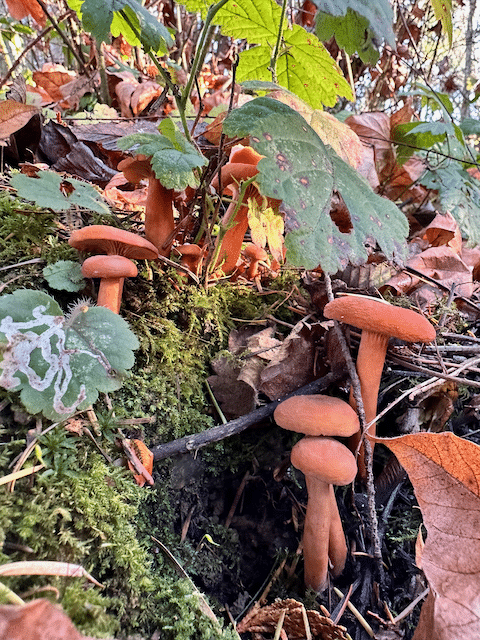
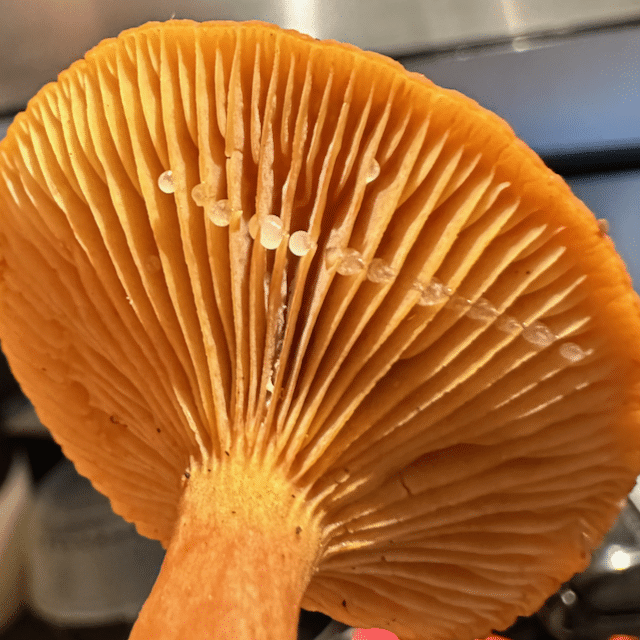
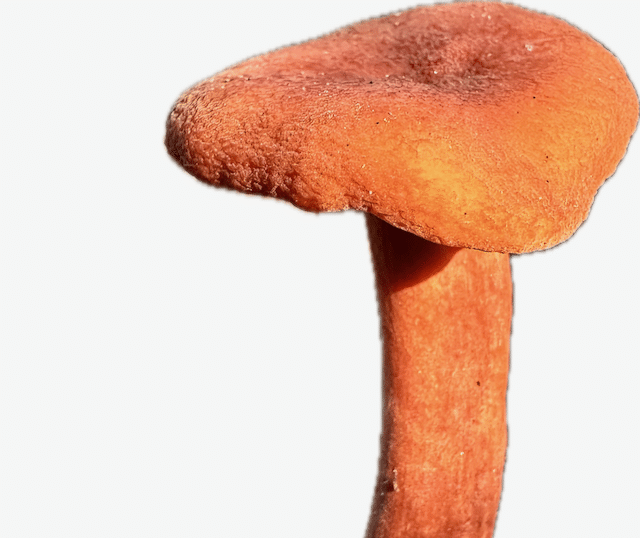
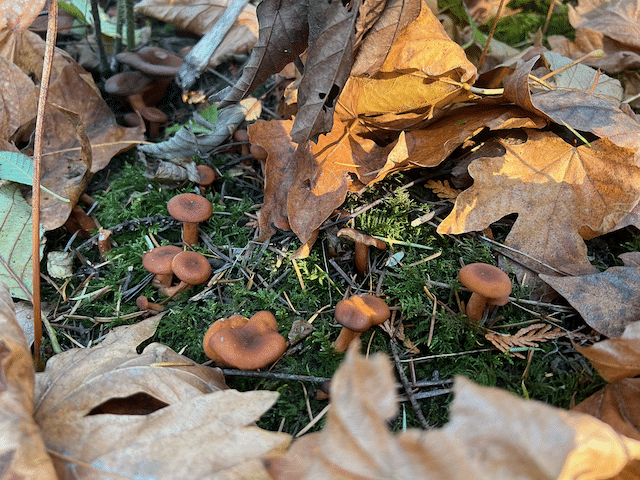
If you are confident that the mushroom is a lactarius but unsure if it is a candy cap, try the nibble and spit test to check that it tastes mild, not strongly bitter or peppery. Chew a small piece briefly at the front of the mouth, then spit it out.
more on the Nibble and Spit test
Using Candy Caps
Dried candy caps are used mainly to flavour desserts such as ice cream, cookies and syrups (Siegel & Schwarz). The aroma is strong, so a little goes a long way.
Note: Be confident of the identity of a mushroom before eating it. Even classically edible mushrooms can cause negative reactions for some, and a few people are allergic to candy caps (Arora). Avoid eating Lactarius mushrooms that have a strong bitter or spicy taste.
More on Milk Caps
Sources: Mushrooms of Cascadia (Siegel & Schwarz, 2024); MycoMatch (© Ian Gibson), a compilation of published descriptions through which most other field-guide authors named here are quoted; Danny Miller’s Danny’s DNA Discoveries.
Get the data serious foragers use to find more mushrooms
Free members get soil conditions, the past week of rain, snow, smoke and historical burns. Pro unlocks the layers that help you narrow down exactly where to look.
- Newest burn years, managed burns & burn severity
- Tree species maps (22 species) & timber harvests
- Town and mountain pass fruiting calendars with current conditions
- Offline map downloads in the iOS & Android apps
- 14- and 30-day rainfall windows
- Soil temperature & moisture at full zoom