
Caloboletus The bitter boletes — large, king-bolete-shaped mushrooms that stain blue and taste unmistakably bitter
Caloboletus is a small genus of large, stocky boletes that grow under conifers (and, for one PNW species, oaks) through the summer and fall. At a glance they can be mistaken for a king bolete (Boletus edulis), but every Caloboletus stains blue where it’s cut or bruised and tastes bitter — sometimes mildly, sometimes intensely — which a true porcini never does.
Once grouped with Boletus, these bitter, blue-staining species now sit in their own segregate genus, split off along with several other former Boletus lineages such as Rubroboletus, Butyriboletus and Xerocomellus (D. Miller, Danny’s DNA Discoveries). Chewing a small piece and spitting it out is a common way to check for the bitterness, but as noted below, it isn’t equally reliable across every species in the genus.
Scout Summer and Fall Conditions on Forayz
Check rainfall, soil moisture and soil temperature to see where conditions are wet enough for mushrooms near you, free with a Forayz account.
Identification
Large, bitter, and quick to turn blue
Every Pacific Northwest Caloboletus is a big, firm-fleshed bolete with yellow pores that stain blue readily, a cap that dries dull and often cracks with age, and a bitter taste. None is reticulate (netted) and reddish over the whole stem the way the true European C. calopus is said to be — see the note below.
The four species confirmed in Oregon and Washington are separated mainly by stem surface and color, cap color, and habitat:
| Feature | C. conifericola | C. frustosus | C. rubripes | C. marshii |
|---|---|---|---|---|
| Cap | Dark olive-gray to grayish or dark brown, cracking with age (MycoMatch) | Dark olivaceous gray, fading paler with age, becoming areolate-cracked (Siegel & Schwarz) | Buff to olive-buff, browning with age, suede-textured; sterile cap margin turns rosy pink in age (Siegel & Schwarz) | Whitish to grayish white, aging buff or tan (Frank) |
| Stem | Yellow, no red, finely reticulate on the upper part (MycoMatch) | Yellow, reticulate at least at the apex, sometimes a dingy red base in age (Siegel & Schwarz) | Not reticulate; pinkish-red color starts at the base when the mushroom is young and spreads upward with age (Siegel & Schwarz) | Yellow, bulbous, not reticulate, no red (Frank) |
| Taste | Bitter (Bessette) | Extremely bitter (Siegel & Schwarz) | Slightly bitter or sour (Siegel & Schwarz) | Bitter, sometimes only latently so (Frank) |
| Habitat | Conifers (MycoMatch) | Conifers, especially true firs and hemlock (Siegel & Schwarz) | Conifers, especially fir and hemlock (Siegel & Schwarz) | Oaks — Quercus garryana in the Northwest (Frank) |
Species in the Pacific Northwest
Caloboletus conifericola — Dark Bitter Bolete
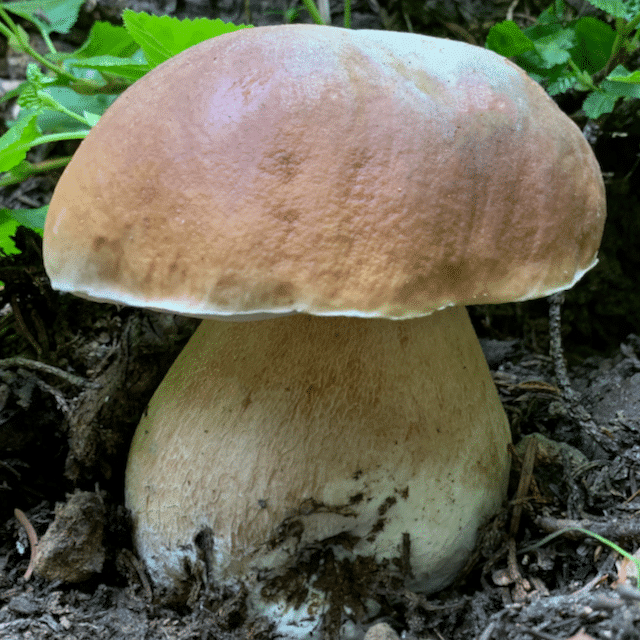
Pictured above. The palest-yellow, non-reddening stem and dark olive-gray to blackish-brown cap separate it from the other bitter boletes; the stem shows fine reticulation on its upper part but, unlike C. rubripes, never develops red color (Bessette). Found from British Columbia through Washington and Oregon, with reports from Idaho and rare far-northern California records (MycoMatch).
Caloboletus frustosus
A large bolete, 7–25 (rarely 30) cm across, with a dark olivaceous-gray cap that fades to grayish or dingy brown with age and cracks into a dry, patchy surface; the stem carries fine reticulation at least near the top, and the taste is extremely bitter (Siegel & Schwarz). It grows on the ground in mossy conifer duff, favoring true fir and hemlock stands, and Mushrooms of Cascadia describes it as a widespread species that turns up regularly through the warmer months (Siegel & Schwarz).
Caloboletus rubripes — Western Bitter Bolete
Its suede-textured, buff-to-olive-buff cap darkens with age, and a narrow band of sterile tissue at the cap margin turns rosy pink as it matures. The smooth (non-reticulate) stem starts yellow on top with a pink-to-red blush low down, and that red color climbs the stem as the mushroom ages until old specimens are dark red nearly throughout (Siegel & Schwarz). It is only slightly bitter or sour — noticeably milder than C. frustosus — so a quick taste test does not always catch it.
Caloboletus marshii
An uncommon, mostly Californian species that reaches Oregon and Washington in low numbers, always with oaks — in the Northwest, Quercus garryana (Frank). Its pale, whitish-to-buff cap and bulbous, non-reticulate, non-reddening stem set it apart from the three conifer-associated species above. Butyriboletus persolidus, an oak associate with a mild taste and a reticulate stem, is the main look-alike where their ranges overlap (Arora).
Taxonomy Notes
“Caloboletus calopus” is a European name, not a confirmed Pacific Northwest species. The true C. calopus has a stem that is reticulated (netted) over its top and carmine-red lower down. MycoMatch (Gibson) cautions that the Pacific Northwest status of mushrooms passing under that name is unclear, and some collections labeled C. calopus here may actually be C. rubripes. Danny Miller’s DNA Discoveries (D. Miller) goes further: PNW collections that look like the European species (red on the stem, reticulate on top) keep coming back, on sequencing, as the non-reticulate C. rubripes, and no genuinely reticulate-stemmed PNW collection has yet been confirmed. Treat a Northwest “C. calopus” sighting as C. rubripes until that changes.
C. frustosus and C. conifericola may turn out to be the same species. The two are still described separately by current sources, distinguished mainly by C. frustosus’s more conspicuously cracked, paler-with-age cap and pink-to-reddish stem tones versus C. conifericola’s consistently non-red stem (Trudell). But preliminary phylogenetic work cited in Mushrooms of Cascadia raised the possibility that they are one species (Siegel & Schwarz), and D. Miller reports that ITS DNA from Washington and British Columbia material matches California specimens identified as C. frustosus — if the two are synonymized, the older name C. frustosus would take precedence.
Habitat & Season
All four Northwest species are ground-dwellers, fruiting singly, scattered or in small groups in moss or duff with their host trees — conifers for three of the four, oaks for C. marshii. Across the genus, iNaturalist observations from Oregon and Washington run from April through November, mostly from August to October:
Based on 1,476 iNaturalist observations of the genus Caloboletus from Oregon and Washington
Caloboletus rubripes is primarily a fall species here, with occasional appearances at higher elevations in spring (Siegel & Schwarz) — the genus-wide chart above reflects that pattern rather than any one species on its own.
Edibility
Not eaten — bitter and not recommended
No Caloboletus in the Pacific Northwest is a target species. C. conifericola is listed inedible because of its bitterness (Bessette); C. marshii the same (Arora). Mushrooms of Cascadia calls C. frustosus’s edibility unknown given its extreme bitterness, and gives C. rubripes the same unknown, not-recommended rating — noting that even though it is only mildly bitter itself, other Caloboletus have been linked to reports of mild stomach upset (Siegel & Schwarz).
A small taste-and-spit test — chew a tiny raw piece briefly, then spit it out before swallowing — is a common way foragers check for bitter boletes in the field. It works well for the intensely bitter C. frustosus, but C. rubripes is only slightly bitter or sour, so the test won’t always catch it; don’t rely on taste alone if the stem, cap and habitat otherwise point to this genus.
Try the Bolete Finder
Identify Pacific Northwest boletes with our step-by-step guide. Answer questions about cap color, pore characteristics, and staining reactions to narrow down your find.
Sources: Mushrooms of Cascadia (Siegel & Schwarz, 2024); MycoMatch (© Ian Gibson), a compilation of published descriptions through which most other field-guide authors named here are quoted; Danny’s DNA Discoveries and the PNW Pictorial Key (© Danny Miller); iNaturalist observations.