
Chanterelle Mushrooms A Pacific Northwest guide to finding, identifying, and cooking chanterelles
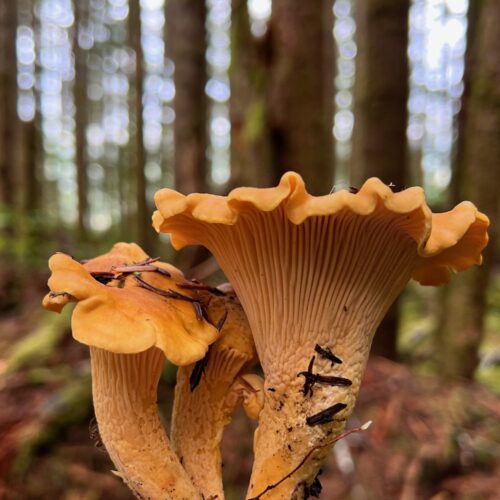
Chanterelles are among the most widely picked wild mushrooms in the Pacific Northwest. They fruit in conifer forests of Washington, Oregon and British Columbia from late summer into early winter, mostly in fall. Many foragers start with them: they are relatively easy to identify, often abundant in the right habitat, and excellent to eat.
The PNW has several chanterelle species. Cantharellus cibarius is a European name; what older field guides called C. cibarius here is mostly C. formosus, the Pacific golden chanterelle, along with C. roseocanus and C. cascadensis. Each has its own habitat, which is why knowing the species helps you find them.
Track Chanterelle Conditions on Forayz
Check rainfall, soil moisture, and soil temperature layers to time your chanterelle hunts. Free with a Forayz account.
Train Your Chanterelle Eye
ForayzU is a free iOS app for learning Pacific Northwest mushroom ID — swipeable photo flashcards with spaced repetition that build the pattern recognition you need to separate true chanterelles from jack-o’-lanterns and false chanterelles. Morel and bolete decks now, more coming.
Identification Basics
All chanterelles share a few key features that set them apart from true gilled mushrooms:
- False gills: The underside usually has blunt, rounded ridges that fork, are linked by cross veins, and run down the stem, unlike the thin, sharp-edged gills of an Agaricus or Amanita. This is the key feature, but it varies: some chanterelles, including young golden chanterelles, have thinner, more gill-like ridges with few cross veins. When the ridges aren’t clear-cut, check the other features as well, especially the solid, stringy white flesh.
- Solid flesh: Cut a Cantharellus in half and the flesh is solid, white and stringy. The yellowfoot (Craterellus) is the exception: its stem is hollow.
- Aroma: Often described as fruity or apricot-like, and sometimes as similar to raw pumpkin. Those comparisons may be partly suggested by the mushroom’s orange color. The scent can also be faint or absent, and the yellowfoot has little odor, so don’t rely on it.
- Growth pattern: Chanterelles fruit from soil, moss and needle duff, singly, scattered, in arcs or in small clumps. They are mycorrhizal, connected to living tree roots. They do not grow in overlapping clusters out of stumps or logs.
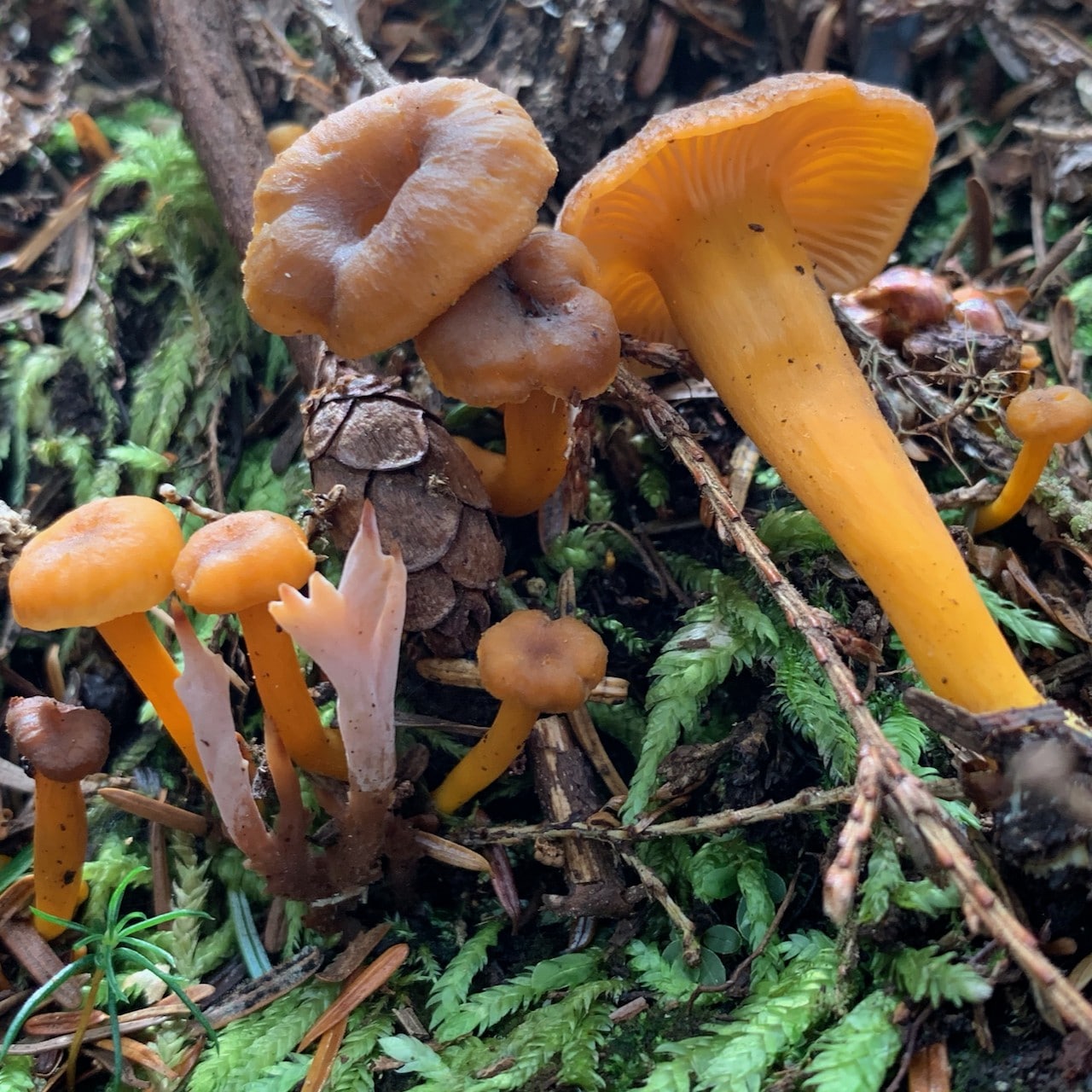
- Color: Ranges from bright golden-yellow (C. formosus) to pale white (C. subalbidus) to brown-capped with yellow stems (Craterellus tubaeformis).
False gills vs. true gills
True gills are thin, blade-like plates with sharp edges. False gills are blunt-edged, forked ridges with cross veins that run down the stem and look carved from the same flesh as the cap. Check this on every chanterelle: it is what separates them from the jack-o’-lantern and the false chanterelle.
PNW Chanterelle Species
Five of the Pacific Northwest’s chanterelles are shown here. The Pacific golden is by far the most common.
Where to Find Chanterelles
Chanterelles are mycorrhizal — they form symbiotic partnerships with living tree roots. In the PNW, that means conifers. You will not find them in open grass or away from trees. Golden, white and rainbow chanterelles grow from the ground; the yellowfoot also fruits around stumps and on well-rotted wood. Here’s what to look for:
- Douglas-fir and western hemlock: The main hosts of C. formosus. It prefers younger to middle-aged forest and is often abundant in lower-elevation plantation stands.
- Mature Douglas-fir: The white chanterelle favors older Douglas-fir stands, especially east of the Cascade crest.
- Sitka spruce: Coastal spruce forest is where the rainbow chanterelle grows (it is not found in pure Douglas-fir or hemlock) and is prime yellowfoot habitat.
- Moss and needle beds: Chanterelles fruit in both moss and bare needle duff. Moss often goes with productive habitat, but its absence does not rule an area out.
- West of the crest: The golden chanterelle is much more common on the west side of the Cascades, from sea level on the coast up into the foothills.
- Slope and drainage: Well-drained slopes and benches are better than flat, waterlogged areas. Chanterelles don’t like standing water.
Rain and a long season
Chanterelles often appear a couple of weeks after fall rain returns following the summer drought. They are slow growers: individual mushrooms keep growing for weeks, and new ones keep coming, so they stay abundant from the return of rain until freezing weather sets in, which happens first in the mountains. Late in the season they turn waterlogged, or soft from freeze-thaw cycles. Coastal forests, especially on the Olympic Peninsula, can start fruiting in summer, and inland sites come on later. Use Forayz precipitation layers to track where rain has fallen in the past 14 days.
Chanterelle Season Timing
Season timing varies by elevation, latitude, and how early the fall rains arrive. Here’s a general calendar for western Washington and Oregon:
| Window | Where to Look | What to Expect |
|---|---|---|
| Late Aug–Sep | Olympic Peninsula and coastal forests | Early golden chanterelles, some starting in summer. Rainbow chanterelles under coastal spruce. White chanterelles begin. |
| October | Cascade foothills, Coast Range, Olympic Peninsula | Peak season begins. Golden chanterelles abundant in second-growth Doug fir stands. |
| November | Low to mid elevations throughout western WA/OR | Peak harvest of golden and white chanterelles. Yellowfoot building. |
| December | Low elevations, coastal forests | Golden chanterelles winding down on the coast. Yellowfoot at or near peak. |
Find Chanterelle Habitat with Environmental Data
Soil moisture, precipitation, ecoregions, and public land boundaries — all the layers you need to scout chanterelle habitat. Pro members get burn maps and offline downloads.
Lookalikes & Safety
Chanterelles have fewer dangerous lookalikes than most popular edible mushrooms, but there are three to know. For a broader overview of toxic mushrooms in the Pacific Northwest, see our dedicated page.
- Western jack-o’-lantern (Omphalotus olivascens): Orange to olive-orange, in overlapping clusters on stumps and dead roots, usually of oak or other hardwoods, rarely conifers. Mostly a California species; rare in the PNW. Has true gills, thin and blade-like, though sometimes forked. Causes severe vomiting and diarrhea. (O. olearius is the European species.)
- False chanterelle (Hygrophoropsis aurantiaca group): Orange, with crowded, thin true gills that fork repeatedly. Thin, soft flesh rather than thick and stringy. Grows on rotting wood, coarse humus and wood chips. Best avoided: it has caused mild reactions in some people. At least five species are involved in the Pacific states, most undescribed.
- Scaly chanterelle (Turbinellus floccosus): Tall and vase-shaped, with a red to orange shaggy-scaly cap and a hollow center. Not a true chanterelle. Causes gastrointestinal upset in some people, with onset that can be delayed 8–14 hours (Ammirati). The scaly cap usually gives it away, though scales can wear off on old specimens; check the deep vase shape and pale ridged underside too.
The practical rule: If it has thin, blade-like gills, or grows in overlapping clusters out of a stump or log, it is not a chanterelle. Real chanterelles have blunt, forked ridges, grow from the ground near living trees, and have solid, stringy white flesh (hollow-stemmed in the yellowfoot).
Is This a Chanterelle?
Real photos of Pacific Northwest chanterelles mixed with false chanterelles, jack-o’-lanterns and other look-alikes. Each answer explains what to look for. No account needed, and you can stop at any point to see your score.
Cooking Chanterelles
Chanterelles are a choice edible with a firm texture and, in young specimens especially, a fruity flavor. A few practical notes:
- Dry sauté: Start chanterelles in a dry pan over medium-high heat. Let them release their moisture and cook it off before adding butter. This concentrates flavor and prevents a soggy result.
- Simple preparations: Butter, shallots, salt, and a splash of white wine. Chanterelles have a delicate flavor that heavy sauces will bury. Serve on toast, with pasta, or alongside eggs.
- Don’t wash — brush: Clean chanterelles with a soft brush or damp cloth. They absorb water like sponges. If they’re very dirty, a quick rinse and thorough pat-dry is fine.
- Preservation: Dry sauté and freeze in portions for year-round use. Dehydrating works but changes the texture significantly.
- Always cook: Raw chanterelles can cause stomach upset. A small number of individual allergic-type reactions have been reported to the North American Mycological Association, so eat a modest portion the first time.
Ecology & Conservation
Chanterelles are integral to the health of PNW conifer forests. Their mycorrhizal networks help trees access water and nutrients, and in return receive sugars from photosynthesis. A few things worth understanding:
- Picking doesn’t harm the mycelium. You’re picking the fruiting body; the organism lives underground. The Oregon Cantharellus Study Project, run by Oregon Mycological Society volunteers on plots near Mount Hood since 1986, found in 13 years of data no evidence that plucking chanterelles reduced later fruiting (Pilz and others 2003). Heavy trampling of study plots in Switzerland did depress fruiting, though it recovered once the trampling stopped.
- Second-growth forests are key. The golden chanterelle prefers younger to middle-aged forest and is often abundant in plantation stands. The white chanterelle leans toward mature Douglas-fir.
- Cut vs. pull: In the same Oregon study, plots where chanterelles were cut showed a slight drop in chanterelle numbers and weight from 1999 on, compared with plots where they were plucked and with unpicked control plots. Plucked plots showed no decline.
Commercial harvest
The PNW chanterelle harvest is a significant commercial industry. Rules for personal picking vary by national forest and ranger district; many require a free personal-use permit, so check with the district before you go. Commercial harvest requires a paid permit.
Tips for New Chanterelle Foragers
- Start coastal. Coastal forests fruit earliest and for the longest season, from summer on the Olympic Peninsula into early winter.
- Read the forest. Moss under conifers is a good sign, but golden chanterelles also fruit on bare needle beds, so don’t skip a stand just because the floor is duff.
- Look for “chanterelle habitat,” not individual mushrooms. Scan for the right forest type first — younger Douglas-fir and hemlock west of the crest, or coastal spruce — then slow down and look at the ground.
- Check the ecoregion. Chanterelles are most reliable in the Western Cascades, Coast Range, and Puget Sound lowland ecoregions. Use Forayz ecoregion layers to identify these zones on a map.
- Take a class. A mushroom identification class or guided mushroom tour will compress months of trial and error into a single outing.
Get the data serious foragers use to find more mushrooms
Free members get soil conditions, the past week of rain, snow, smoke and historical burns. Pro unlocks the layers that help you narrow down exactly where to look.
- Newest burn years, managed burns & burn severity
- Tree species maps (22 species) & timber harvests
- Town and mountain pass fruiting calendars with current conditions
- Offline map downloads in the iOS & Android apps
- 14- and 30-day rainfall windows
- Soil temperature & moisture at full zoom
Learn More
Sources: Mushrooms of Cascadia (Siegel & Schwarz, 2024); MycoMatch (© Ian Gibson), a compilation of published descriptions through which most other field-guide authors named here are quoted.