
Yellowfoot Chanterelle Craterellus tubaeformis — The Winter Chanterelle
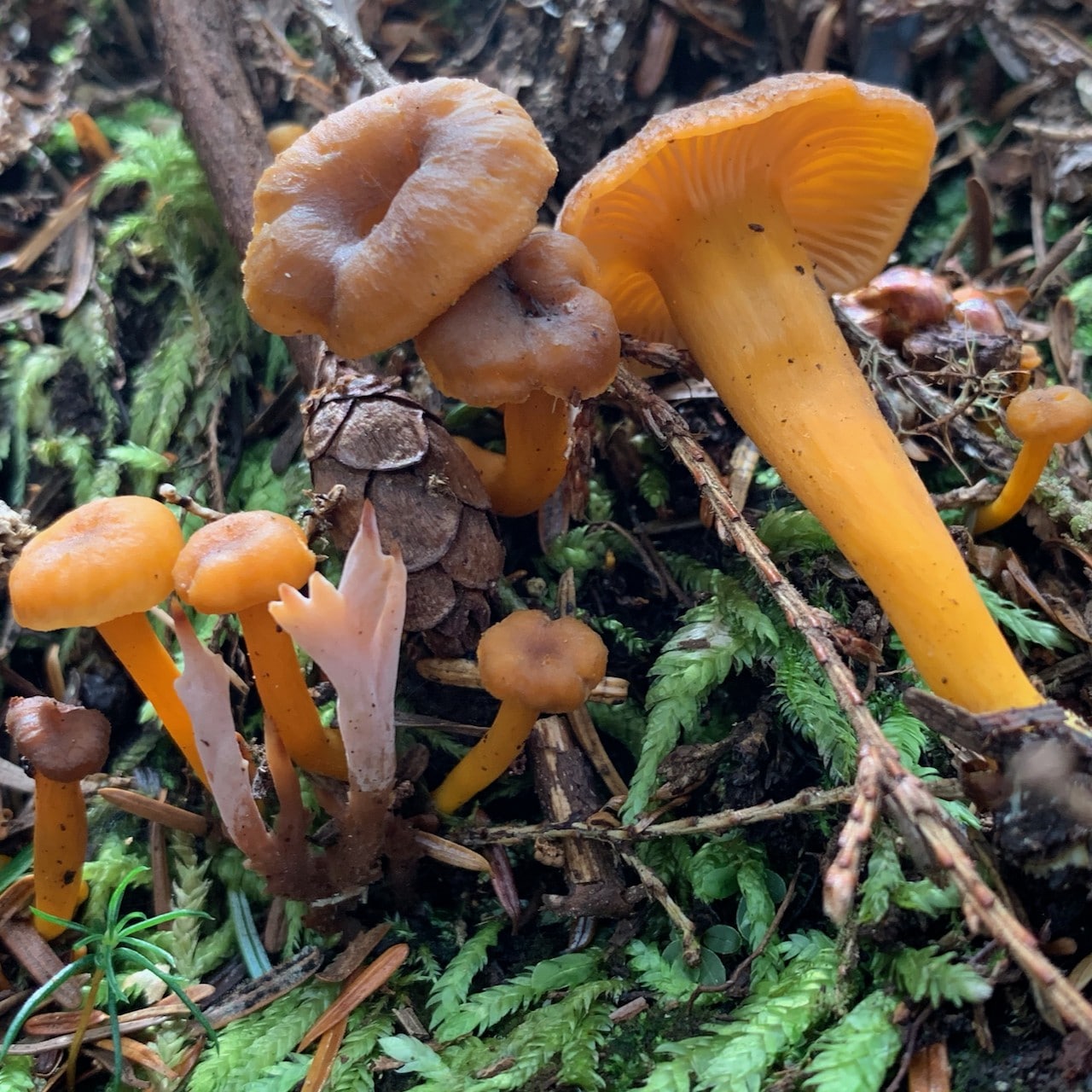
The yellowfoot is the late-season chanterelle of the Pacific Northwest. Its season runs from late summer into winter, with the most fruiting in late fall and early winter, after the Pacific golden chanterelles have mostly finished. It is smaller and thinner than the golden chanterelle but often abundant, growing in troops and arcs in moss and duff.
Formerly placed in Cantharellus, it is now in the genus Craterellus alongside the black trumpet. The name C. tubaeformis belongs to a European species not known from the Pacific Northwest; our yellowfoot is a distinct species. The name C. neotubaeformis has been proposed but not formally published, and more than one species may be involved. It is an underrated edible: easy to pick in quantity and very clean.
Time Late-Season Hunts with Soil Data
Track soil temperature and rainfall to know when yellowfoot conditions are right. Free with a Forayz account.
Identification
| Feature | Description |
|---|---|
| Cap | 2–6(8) cm across. Young caps are rounded with a dimple in the center; older ones open into a broad funnel. Brown to ocher-brown or yellowish-brown, paler orange to yellowish near the edge; one form is bright orange-yellow when young. Margin wavy and ruffled, often finely fringed. |
| False Gills | Subdecurrent to decurrent, shallow and blunt, forking with cross veins. Light pinkish to dingy orange-beige or whitish gray, usually contrasting strongly with the yellow stem. More vein-like than the ridges of golden chanterelles. |
| Stipe | 6–10(12) cm long, 0.5–1.5 cm thick. Tall, upright, often irregular and strongly grooved, and entirely hollow. Bright yellow-orange, sometimes duller beige-yellow, whitish at the very base — the defining field mark. |
| Flesh | Very thin and pliable in the cap. Stipe is cartilaginous and hollow throughout — snap one in half and you’ll see an empty tube. |
| Spore Deposit | Whitish |
| Odor | Indistinct |
The Quickest Field ID
The hollow, bright yellow-orange stem is the fastest way to recognize a yellowfoot. No other PNW chanterelle has a hollow stem of that color: golden chanterelles have solid, white flesh, and black trumpets are dark throughout. Snap the stem in half and look for an empty tube, then check the underside for blunt, forked ridges rather than true gills, since some small look-alikes also have yellow stems.
Season & Timing
Yellowfoot are the latest-fruiting chanterelle in the Pacific Northwest, continuing well past the golden chanterelle season.
Based on 1,581 research-grade iNaturalist observations from Oregon and Washington
Most observations are from October to January. Numbers taper through February and March, and a few are recorded in every month of the year.
| Window | Where to Look | What to Expect |
|---|---|---|
| Sep–Oct | Coastal spruce-hemlock forests, Olympic Peninsula | Early flushes in wet, mossy microsites. Often found alongside the last golden chanterelles. |
| November | Low to mid elevations throughout western WA/OR | Main season. Look for troops in moss and conifer needles near stumps and rotting wood. |
| December | Coastal and low-elevation forests | Still productive; one of the strongest months in observation records. |
| Jan–Feb | Mild coastal and low-elevation areas | January is still a strong month in observation records; February tapers off. |
Habitat & Where to Look
Yellowfoot chanterelles are ectomycorrhizal, forming partnerships with living conifer roots. They favor wet ground — often along streams, near springs, or in boggy spots under conifers (Smith; Castellano):
- Western hemlock: The main host. In northwestern Oregon, yellowfoot occurrence is highly correlated with western hemlock (Pilz). It also forms mycorrhizae with Douglas-fir.
- Sitka spruce: The other main host, in coastal spruce and hemlock forests.
- On or near well-rotted wood: Yellowfoot fruit in moss and duff around rotting stumps and downed logs, and directly on well-decayed wood (Pilz).
- Troops: Yellowfoot usually fruit in troops, arcs and small clumps, so when you find one, scan the area around it.
Follow the Moss and Stumps
Look for moss around old conifer stumps and woody debris in hemlock or spruce forest, especially on wet ground. If you’re finding golden chanterelles in a mixed Douglas-fir and hemlock stand, check the wetter, mossier patches. Yellowfoot are smaller and harder to spot than goldens, but they rarely grow alone.
Lookalikes
Yellowfoot have no dangerous look-alikes, but a few small yellow-orange mushrooms can resemble them. The closest is Chrysomphalina chrysophylla:
| Feature | Yellowfoot Chanterelle | Chrysomphalina chrysophylla |
|---|---|---|
| Cap | Brown to ocher-brown, funnel-shaped, 2–6 cm | Yellow-brown and scaly, with a depressed center |
| Underside | Blunt false gills (veins), forked with cross veins | True gills — thin, blade-like, yellow to golden |
| Stipe | Bright yellow-orange, hollow, strongly grooved | Yellow; thinner and less cartilaginous |
| Habitat | Moss and duff near stumps and wood, mycorrhizal with conifers | On rotting conifer logs and moss |
| Edibility | Edible, good | Unknown |
The key difference is the underside: yellowfoot have false gills (blunt, forked veins), while Chrysomphalina has true gills (thin blades). Where they grow is less reliable, since yellowfoot also fruit around stumps and on well-rotted wood. The hollow, cartilaginous stem of the yellowfoot is a second check.
- Xeromphalina: Tiny orange caps in large troops on rotting conifer logs and debris. They have true, decurrent gills and thin, solid, wiry stems that turn dark brown toward the base, often ending in a small tuft of ginger hairs.
- False chanterelle (Hygrophoropsis): Orange, with thin, crowded true gills that fork repeatedly, on rotting wood and wood chips. Covered on our chanterelles page.
For a broader overview of species to avoid, see our guide to poisonous mushrooms in the Pacific Northwest.
Cooking & Edibility
Yellowfoot are an underrated edible. They often come up in large numbers, pick easily, and need little cleaning. A few practical notes:
- Cleaning: A quick brush or rinse is usually all you need.
- Dry sauté: Start in a dry pan to cook off moisture, then add butter. Their thin flesh cooks quickly and shrinks considerably.
- Drying: Their thin flesh dries quickly. Small ones can be dried whole, and dried yellowfoot rehydrate well in soups and sauces.
- Soups and stews: Their thin texture suits broth-based dishes.
- Flavor: Mild, described as pleasant (Phillips) to not distinctive (Smith).
- Always cook: Like all chanterelles, yellowfoot should be cooked before eating. Raw consumption can cause stomach upset. Rare reactions have also been reported when yellowfoot were eaten with alcohol (Pilz).
The Drying Advantage
Their thin flesh makes yellowfoot easy to dehydrate, and a productive outing can yield more than you can eat fresh. Store dried yellowfoot in airtight jars away from light.
Find Coastal Conifer Forests on Forayz
Use ecoregion data to locate the Coast Range and Puget Lowland forests where yellowfoot thrive. Pro members get burn maps, timber harvest data, and offline downloads.
Sources: Mushrooms of Cascadia (Siegel & Schwarz, 2024); MycoMatch (© Ian Gibson), a compilation of published descriptions through which most other field-guide authors named here are quoted; iNaturalist observations.