
Polypore Mushrooms Bracket fungi, conks, and shelf mushrooms of the Pacific Northwest
Polypores produce spores inside tiny tubes that open as pores on the underside of the fruitbody — not gills, not ridges, but a surface of tiny holes. Most grow as brackets or shelves on wood, though a few are stemmed and grow on the ground. Many are tough, woody, or leathery and persist for months or years.
These are the recyclers and parasites of the forest. Some attack living trees (Phaeolus, Laetiporus). Others colonize dead wood and accelerate decomposition (Trametes, Fomitopsis). A few form perennial conks that grow for decades (Ganoderma, Fomes). The PNW’s old-growth forests support an exceptional diversity of polypores, including several species of conservation concern.
Explore Forest Types on Forayz
Polypores are tied to their host trees. Use forest type layers and public land overlays to locate old-growth conifer stands, hardwood corridors, and riparian zones where polypore diversity is highest. Pro members get full access to forest type data.
Notable PNW Species
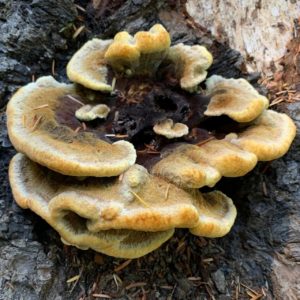
Chicken of the Woods — Laetiporus conifericola
Large, bright orange shelving brackets, often 15–60 cm across in overlapping rosettes. Pore surface is sulfur yellow. Grows on conifers — primarily Douglas-fir, hemlock, and true fir in Cascadia. Causes brown cubical rot. Edible and very good when young (soft and brightly colored). Older specimens become tough. Some people experience GI upset — try a small amount the first time. Fruits summer through fall.
Western Reishi — Ganoderma oregonense
Fan-shaped annual brackets, 10–60 cm across, with a shiny, lacquered reddish-brown upper surface when mature. Spore surface is white, staining brown when scratched. Grows on hemlock and other conifers. Not edible due to tough texture, but widely collected for medicinal tinctures and teas. Fruits late summer through fall, degrading by late winter.
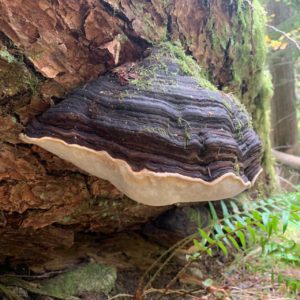
Artist’s Conk — Ganoderma applanatum
Perennial bracket, 6–30 cm across, woody and fan-shaped with concentric growth rings. Gray-brown upper surface, white pore surface that bruises dark brown instantly when scratched — used for etching artwork. Grows on hardwoods and conifers. Not edible. Sometimes collected for medicinal preparations. Fruitbodies can persist and grow for decades.
Red Belt Conk — Fomitopsis mounceae
One of the most common polypores in PNW conifer forests. Hoof to cushion-shaped perennial conk, 5–30 cm across. Surface develops a characteristic reddish band. Whitish to cream pore surface. Flesh smells faintly lemony. Found on both conifers and hardwoods but far more common on conifers. Causes brown cubical rot. Inedible.
Turkey Tail — Trametes versicolor
Thin, flexible, fan-shaped shelves in overlapping rows on dead hardwoods. Surface has striking concentric color zones — brown, tan, gray, blue, and cream. Pore surface white to cream with tiny, round pores. Very common throughout Cascadia. Inedible but widely used in medicinal teas and tinctures. Long studied for immune-boosting and anti-cancer properties.
Dyer’s Polypore — Phaeolus schweinitzii
Large, spongy, cushion-shaped when young, becoming flat and leathery. Orange-brown to dark brown, often with concentric zones. Grows at the base of conifers or from roots, indicating root rot. Used by dyers to produce gold, olive, and brown wool dyes. Not edible, possibly toxic.
Agarikon — Laricifomes officinalis
Elongated, columnar conk that can grow to 50 cm or more, hanging from old-growth conifers, especially larch and Douglas-fir. Chalky white to gray. Increasingly rare due to old-growth logging. Inedible but highly prized for purported medicinal properties — over-collection is a concern. Important for conservation.
Veiled Polypore — Cryptoporus volvatus
Small (2–5 cm), round polypore with a smooth, varnished surface and a unique membrane that covers the pore surface until maturity. Found on dead conifers, especially after fire. Bark beetles help disperse spores. Common in recently burned areas. Inedible.
Flett’s Albatrellus — Albatrellus avellaneus
Stemmed polypore growing on the ground, 5–15 cm across, with a hazel to grayish cap and white pore surface. Flesh turns golden when cooked. Found in old-growth conifer forests. Edible and good — firm, meaty texture with sweet flavor. One of the few choice edible polypores.
Western Conifer Polypore — Bondarzewia occidentalis
Large (up to 50 cm), fan-shaped or rosette clusters at the base of conifers, especially true fir. Cream to tan with concentric zones. Edible but tough and often bitter.
Orange Crust Polypore — Pycnoporellus fulgens
Bright orange, soft, shelf-like, 3–10 cm across. Grows on dead conifer wood, often on logs already hosting Fomitopsis. Distinctive color makes it easy to spot. Inedible.
Pores, Not Gills
Turn a polypore over. Instead of blade-like gills, you’ll see a surface covered in tiny holes — those are the pore openings. In some species (Ganoderma, Trametes) they’re barely visible without a lens. In others (Laetiporus) they’re clearly visible. This pore surface is the defining feature of the group.
Find Old-Growth Habitat for Rare Polypores
Agarikon and Bridgeoporus depend on old-growth forests. Use the public lands layer and forest type overlays on Forayz to find mature forest stands in national forests and wilderness areas. Pro features include past burn perimeters for finding fire-associated species like Cryptoporus.
Habitat & Season
Polypores are primarily wood decomposers. Most grow on dead or dying trees, logs, and stumps. Bracket-forming species (Trametes, Fomitopsis, Ganoderma) are found year-round as persistent fruitbodies, though they actively grow in fall and winter. Fleshy polypores like Laetiporus and Albatrellus are seasonal — primarily summer through fall. Old-growth conifers support the highest diversity, including rare species like Laricifomes officinalis and Bridgeoporus nobilissimus.