
Amanita Identification & safety in the Pacific Northwest

Amanita is one of the most important genera for any mushroom forager to learn. The group includes some of the most seriously poisonous mushrooms in the world alongside a handful of edible species. In the Pacific Northwest, Amanitas are common in conifer and mixed forests from late summer through fall.
These are large, robust mushrooms that can resemble edible species like matsutake, puffballs, and even field mushrooms at certain life stages. Knowing Amanita features — universal veil, partial veil, bulbous base — is essential before foraging any gilled mushroom.
This Genus Demands Respect
Amanita contains species responsible for the vast majority of fatal mushroom poisonings worldwide. A. phalloides (death cap) and A. ocreata (destroying angel) are present in parts of the Pacific Northwest and California. A. smithiana, a native PNW species, causes kidney failure.
It is safe to touch any mushroom — toxins must be ingested to cause harm. But never eat an Amanita unless you are absolutely certain of the species and its edibility.
How to Recognize an Amanita
Amanitas share a set of features that, taken together, make the genus recognizable in the field. Not every species shows every feature, but the pattern is consistent enough that experienced foragers learn to spot it quickly.
Universal Veil
Young Amanitas emerge from an egg-like structure called a universal veil — a layer of tissue that encloses the entire mushroom. As the mushroom expands, remnants of this veil remain on the cap and base. These can appear as removable warts, flat ironed-on patches, or a continuous skullcap of tissue on the cap surface. The shape and texture of these remnants vary by species and are important for identification.
Partial Veil & Ring
Many Amanitas have a skirt-like ring on the stem — the remnant of a partial veil that covered the gills before the cap expanded. This ring can be persistent and leathery or fragile and easily lost. Its presence (or absence) helps narrow down species.
Base & Volva
The base of an Amanita often retains universal veil tissue in the form of a sac-like volva, a bulbous swelling, or concentric rings of tissue. The shape of the base — whether it flares smoothly, has an abrupt shelf, or sits in a cup — is one of the most important identification features. Always dig up the entire base when examining an unknown Amanita.
Gills & Spore Print
Amanita gills are always light-colored — white to cream — and the spore print is white. The gills are typically free or narrowly attached to the stem.
The Egg Stage
Before the cap expands, young Amanitas can look like small white eggs or puffballs sitting on the ground. This is one of the most dangerous stages — deadly species like A. phalloides at this stage can be mistaken for edible puffballs. Always slice unknown puffball-like fungi in half: a developing mushroom silhouette inside means it’s an Amanita egg, not a puffball.
PNW Amanita Species
The Pacific Northwest has a lot of Amanita species, and genetic sequencing continues to clarify boundaries within the genus — some names below represent species complexes rather than single species. Seven of the most commonly encountered are shown here; the fly agaric (A. muscaria) and the death cap (A. phalloides) are covered in the sections below.
Amanita augusta
Amanita augusta
A large, handsome species with a brown to yellow-brown cap dotted with yellowish patches of universal veil, and a stem base that stains reddish. Common under conifers in Pacific Northwest forests. Edible but not recommended.
Late Summer & Fall Conifer Forest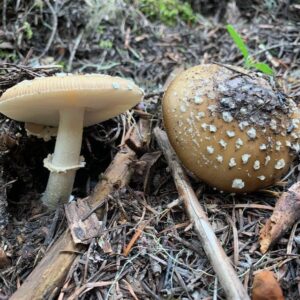
Panther Cap
Amanita pantherina grp
Brown cap with pure white, removable warts arranged in concentric rings. Contains ibotenic acid and muscimol. Causes serious poisoning — more potent than A. muscaria. Common under conifers; the group tends to fruit in spring but turns up at other times of year.
Spring & Fall Toxic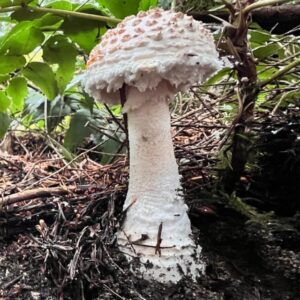
Smith’s Amanita
Amanita smithiana
A white to pale species with shaggy universal veil remnants. Causes kidney failure — sometimes confused with matsutake by inexperienced foragers. One of the most dangerous PNW species.
Fall NephrotoxicGemmed Amanita Group
Amanita gemmata group
Creamy to bright yellow cap with whitish warts that wash off easily in rain, a skirt-like ring, and a rimmed collar on a bulbous base. Spring and fall under conifers. This is a group of look-alikes that cannot be separated without DNA — A. pacificogemmata is the common one in Washington. True A. gemmata is a European name that does not apply here. All members contain ibotenic acid and muscimol.
Spring & Fall Toxic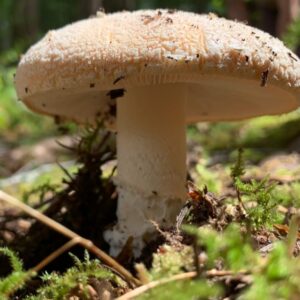
Sunshine Amanita
Amanita aprica
A stocky species with a bright orange-yellow cap under a frosty film of veil tissue. It is mycorrhizal with Douglas-fir and named for where it fruits — sunny breaks in the forest canopy such as road cuts, trail edges and campgrounds, rather than open meadows. Commonest on the east slope of the Cascades, coming up just after the morels. Poisoning resembles A. muscaria, though its toxins are not fully characterized.
Spring Toxic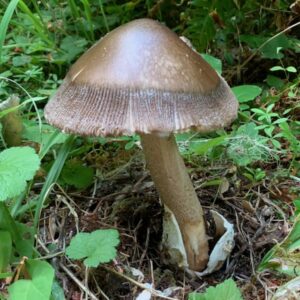
Western Grisette
Amanita pachycolea group
A large grisette with a dark brown to gray-brown cap, strongly grooved and often banded at the margin, and no ring on the stem. The best field mark is the thick, sheathing white volva that stains rusty orange. Edible and good when cooked, but this name covers more than one species, and confusion with toxic Amanitas is the real risk.
Fall Edible (cooked)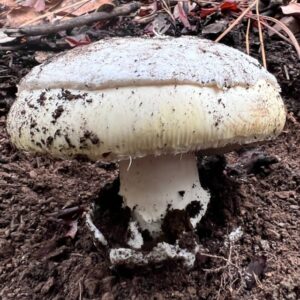
Spring Coccora
Amanita vernicoccora
A large pale yellow species with a thick sac-like volva and a fishy odor, fruiting in late winter and spring with oaks — Garry oak in Washington. The fall coccora is a different species, A. calyptroderma, with a warmer coppery to ochre cap. Both are edible and valued, but they look enough like A. phalloides and A. ocreata that beginners should stay away.
Spring Edible (expert only)Learn Mushroom ID on Your Phone
ForayzU has free flashcard decks for Pacific Northwest mushrooms — study species, key features, and look-alikes. No subscription required.
Dangerous Look-alikes & Confusion Species
Most Amanita poisonings happen when foragers mistake a toxic Amanita for something edible. Here’s where people get into trouble.
| Edible Species | Dangerous Amanita | How to Tell Apart |
|---|---|---|
| Matsutake (Tricholoma murrillianum) | A. smithiana | Matsutake has a firm, dense stem, attached gills, and no volva or bulb at the base. A. smithiana has shaggy, powdery veil remnants on cap and stem and a swollen, often rooting base. Do not decide on firmness — A. smithiana can be quite firm too — or on smell: it usually smells mild, bleach-like or unpleasant, but young ones are occasionally reported to smell spicy like matsutake, and matsutake’s smell rubs off on hands and other mushrooms in a basket. |
| Puffballs (Lycoperdon, Calvatia) | Amanita egg stage | Cut in half lengthwise. A true puffball is uniform white flesh throughout. An Amanita egg reveals a developing mushroom silhouette — cap, gills, and stem. |
| Meadow Mushroom (Agaricus campestris) | A. phalloides (death cap) | Meadow mushrooms have dark brown to black spore prints and pink-to-brown gills. A. phalloides has white gills, a white spore print, and a sac-like volva at the base. |
| Coccora (A. calyptroderma in fall, A. vernicoccora in spring) | A. phalloides, A. ocreata | All have a sac-like volva. The fall coccora has a coppery to ochre cap with a grooved margin and a thick white patch on top; the spring coccora is pale yellow. A. phalloides is olive-green to yellowish with a smooth, ungrooved margin. This is an expert-level distinction — beginners should avoid all of them. |
Toxicity Groups
Amanita toxins fall into several categories, each with a different mechanism and timeline.
- Amatoxins (A. phalloides, A. ocreata): First symptoms (vomiting, diarrhea) typically appear 6–24 hours after eating (NAMA); liver and kidney failure follow over the next days, often after a deceptive apparent recovery. Often fatal without aggressive medical treatment. These species are the most dangerous mushrooms in the world.
- Nephrotoxins (A. smithiana): Gastrointestinal symptoms appear 4–11 hours after ingestion, with kidney failure developing over the following days. Dialysis is often required. This is the primary Amanita poisoning concern in the PNW.
- Ibotenic acid & muscimol (A. muscaria, A. pantherina, A. gemmata group): Cause neurotoxic effects including confusion, agitation, and sometimes seizures. Rarely fatal, but A. pantherina poisonings can be severe. A. aprica produces the same syndrome, though its toxins have not been fully characterized.
A. smithiana & Matsutake Confusion
Amanita smithiana is responsible for most serious Amanita poisonings in the Pacific Northwest. It fruits in the same conifer forests, at the same time of year, and at a similar size as matsutake. Several poisoning cases in British Columbia and Washington have involved foragers who were specifically hunting matsutake. Before you eat matsutake, have every mushroom checked in hand by someone who can reliably tell matsutake from other Tricholoma and from Amanita. If there is any doubt, do not eat it.
Edibility of Amanita muscaria
Amanita muscaria — the iconic red-and-white fly agaric — can be rendered edible by boiling in a large volume of water to remove water-soluble toxins (ibotenic acid and muscimol). The standard method is to boil sliced mushrooms for 15–20 minutes, discard the water, and repeat. This works because the toxins are water-soluble.
Two articles frame the debate well:
- Rubel & Arora argued that A. muscaria has a long history of culinary use in multiple cultures and that our classification of it as “poisonous” reflects cultural bias more than actual risk when properly prepared.
- Debbie Viess responded that while detoxification does work, calling the mushroom “edible” may overstate its culinary value and understate the preparation required. She also noted that cultural use often involved small quantities with additional processing like pickling.
The bottom line: A. muscaria can be eaten safely after proper preparation, but it requires deliberate effort and knowledge that most casual foragers don’t have.
Genetic Sequencing Is Changing Amanita Taxonomy
Molecular work continues to reveal that many names applied to Pacific Northwest Amanitas were originally described from European or eastern North American collections. Our local species may turn out to be distinct. The names used on this page reflect current common usage, but expect revisions as more sequencing data is published.
Sources: Mushrooms of Cascadia (Siegel & Schwarz, 2024); MycoMatch (© Ian Gibson), a compilation of published descriptions through which most other field-guide authors named here are quoted.
Related Resources
More on PNW mushroom safety and foraging.
Poisonous Mushrooms of the PNW
Toxic species in Washington and Oregon, including Amanita, Galerina, and Cortinarius.
GuideMatsutake Identification
How to identify matsutake and tell them apart from Amanita smithiana.
GuideEdible Mushrooms Guide
Safe, beginner-friendly edible species found in Cascadia — no Amanita expertise required.
In-PersonMushroom Classes
Live workshops on Pacific Northwest mushroom identification. Amanita recognition is covered in depth.
CourseOnline Lessons
Online lessons on identification, ecology, and foraging — go at your own pace.
In-PersonGuided Mushroom Tours
Fall tours are prime season for encountering Amanitas in the field.
Further Reading
- Amanitaceae.org — Rod Tulloss’s comprehensive taxonomic resource for the genus
- MushroomExpert.com: Amanita — Michael Kuo’s identification keys and species profiles
- Danny Miller’s Amanitaceae Key — A PNW-focused pictorial key to the family