
Fairy Ring Mushroom Marasmius oreades — a common, edible lawn mushroom that grows alongside a genuinely dangerous look-alike

The fairy ring mushroom is a small, tough-stemmed mushroom that grows almost entirely in grass — lawns, parks, meadows, grassy roadsides — often forming the arcs or rings that give it its name. It fruits throughout much of the year, with the heaviest flushes in spring and again in fall (Siegel & Schwarz, Mushrooms of Cascadia). Mushrooms of Cascadia calls it edible and good.
It’s covered here mainly because of what else grows in the same lawns: Clitocybe rivulosa (also called Collybia rivulosa), a small whitish mushroom containing muscarine that is potentially deadly to small children or pets. The two can come up in the same patch of grass, sometimes the same ring, and no single feature reliably separates them at a glance — see “Similar Species” below before eating anything picked off a lawn.
Scout Fall Conditions on Forayz
Check rainfall and soil moisture on the map to see when lawns and meadows near you are turning favorable for fruiting, free with a Forayz account.
Identification
| Feature | Description |
|---|---|
| Cap | Up to about 6 cm across; starts rounded, opening to a broad convex or nearly flat shape, and usually keeps a small raised knob (umbo) in the middle even in age. The margin can be wavy or turned up. Texture is smooth and slightly greasy at first, then dry. Color starts as a warm reddish or orangish tan, deepest at the rim, then bleaches out as it dries — a strongly hygrophanous species that can fade close to white (Siegel & Schwarz). |
| Gills | Attached only narrowly to the stem or entirely free from it, spaced apart rather than crowded, and fairly wide. Color runs from creamy to a light buff, sometimes developing ocher blotches with age (Siegel & Schwarz). |
| Stem | 3–7 cm long, thin (0.3–0.5 cm), tough and pliable rather than brittle, cylindrical. Finely powdery near the top, finely velvety to matted-fuzzy over the lower half when young; ivory to tan. The base sits on an often inconspicuous corky mycelial mat (Siegel & Schwarz). |
| Flesh | Thin, somewhat tough, whitish to buff. Dried specimens can revive and look fresh again when wetted — a trait shared by many Marasmius species (MycoMatch). |
| Odor & Spore print | Odor reported inconsistently across sources — mild, almond-like, or chemical/cyanide-like — so it isn’t a reliable field mark. Spore print white (Siegel & Schwarz; MycoMatch). |
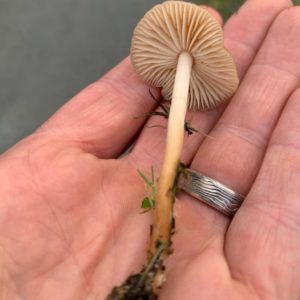

Tan cap, tough stem, growing in rings on grass
No one of these is unique on its own, but Cascadia notes the combination — warm buff-beige, often knobby caps; thin, tough, finely fuzzy-based stems; and the habit of forming rings or arcs in lawns — is distinctive for this species. Still confirm against the toxic look-alike below before eating anything from a lawn.
Similar Species — Including a Deadly One
Few mushrooms that regularly grow on lawns get confused with the fairy ring mushroom (Siegel & Schwarz), but one genuinely dangerous species shares its exact habitat, and its naming history is tangled enough that it’s worth reading carefully.
| Feature | Fairy Ring Mushroom (M. oreades) | Clitocybe rivulosa |
|---|---|---|
| Cap | Pinkish tan to ocher-beige, often with a low central knob (umbo) | Whitish to gray, with darker “water spots,” concentric rings and cracks; can flush pinkish brown |
| Gills | Narrowly attached or free, well-spaced, broad, creamy white | Broadly attached to decurrent (running down the stem), crowded, narrow, dingy gray |
| Stem | Thin, tough, base finely fuzzy, rooted in a corky mat | Often flattened, grooved or twisted; pale grayish, browning where handled |
| Odor / spore print | Inconsistently reported; white spores | Indistinct to mild; white spores — neither one distinguishes the two |
| Toxicity | Edible (Siegel & Schwarz) | Highly toxic: contains muscarine (sweating, salivation, stomach upset); potentially deadly to small children or pets if many are eaten (Siegel & Schwarz) |

This mushroom’s name has a tangled history. What’s long been called Clitocybe dealbata in North America is a misapplied European name — that fungus is a different, poorly understood species. Bigelow found our collections don’t match the European one and argued the correct name was Clitocybe sudorifica; more recent treatments instead use Clitocybe rivulosa (D. Miller, Danny’s DNA Discoveries; MycoMatch), which is the name Mushrooms of Cascadia (Siegel & Schwarz) and this page use. iNaturalist places the same fungus in a different genus, as Collybia rivulosa; the two names are synonyms (common name “Fool’s Funnel”). There’s also at least one separate, undescribed PNW grass-dwelling Clitocybe that resembles this group closely enough to have been mistaken for it by researchers working from photos (D. Miller, Danny’s DNA Discoveries) — a reminder that this is a small complex of similar white lawn mushrooms, not one clean-cut species.
Lawns and parks near planted trees can also host Inocybe species, most of which are suspected to contain muscarine and are responsible for many accidental poisonings of children and pets, simply because they’re common almost everywhere (D. Miller, Danny’s DNA Discoveries). One that’s been documented in Pacific Northwest urban lawns and landscaping is Inocybe curvipes, often published under the misapplied names I. radiata or I. variabillima (D. Miller). Inocybe caps are typically brown, dry and fibrous rather than smooth pinkish tan, but they’re one more reason not to identify a lawn mushroom on looks alone.
No shortcut test
Cap color, gill attachment and spacing, and stem toughness only work as a combination — not as any single “safe” test. Smell isn’t reliable (sources describe the fairy ring mushroom’s odor inconsistently), and spore print doesn’t help, since both this species and Clitocybe rivulosa are white-spored. If you can’t confidently confirm every feature in the identification table above, don’t eat what you picked from the lawn.
A couple of other mushrooms turn up in similar spots but aren’t easily mistaken for either of the above once you know to look: the oak-loving Gymnopus (Gymnopus dryophilus) is usually larger, with a fleshier cap and a cartilaginous rather than tough stem, and grows in forest duff and litter rather than open grass; “Luxury Caps” (Collybiopsis luxurians) has a reddish-brown cap, closer gills and conspicuous microscopic cystidia (Siegel & Schwarz; Arora).
Habitat & Season
The fairy ring mushroom grows in clumps, arcs and rings, almost always in grass. It shows up mainly in lower-elevation lawns, but it isn’t limited to them — look for it in mowed meadows further up in elevation too, and in dry, grassy rangeland on the east side of the Cascades (Siegel & Schwarz). It can fruit at almost any time of year, but activity isn’t steady: there’s a strong burst in spring that carries into early summer, a quieter stretch, and then another surge once fall rains arrive. iNaturalist records from Oregon and Washington track that pattern:
Based on 266 research-grade iNaturalist observations from Oregon and Washington
Edibility
Mushrooms of Cascadia rates the fairy ring mushroom edible and good, but adds a caution: it’s often not recommended because it commonly grows in lawns treated with herbicides or exposed to urban pollution. The same source and Phillips both note that a few people report adverse reactions after eating it, even when it’s correctly identified. If you do collect it, avoid lawns and roadsides that may have been treated or heavily trafficked, and confirm the identification against Clitocybe rivulosa above every time — the two can fruit in the same ring.
Sources: Mushrooms of Cascadia (Siegel & Schwarz, 2024); MycoMatch (© Ian Gibson), a compilation of published descriptions through which most other field-guide authors named here are quoted; Danny’s DNA Discoveries and the PNW Pictorial Key (© Danny Miller); iNaturalist observations.