
Mycena the bonnets — a large genus of small, easily overlooked species
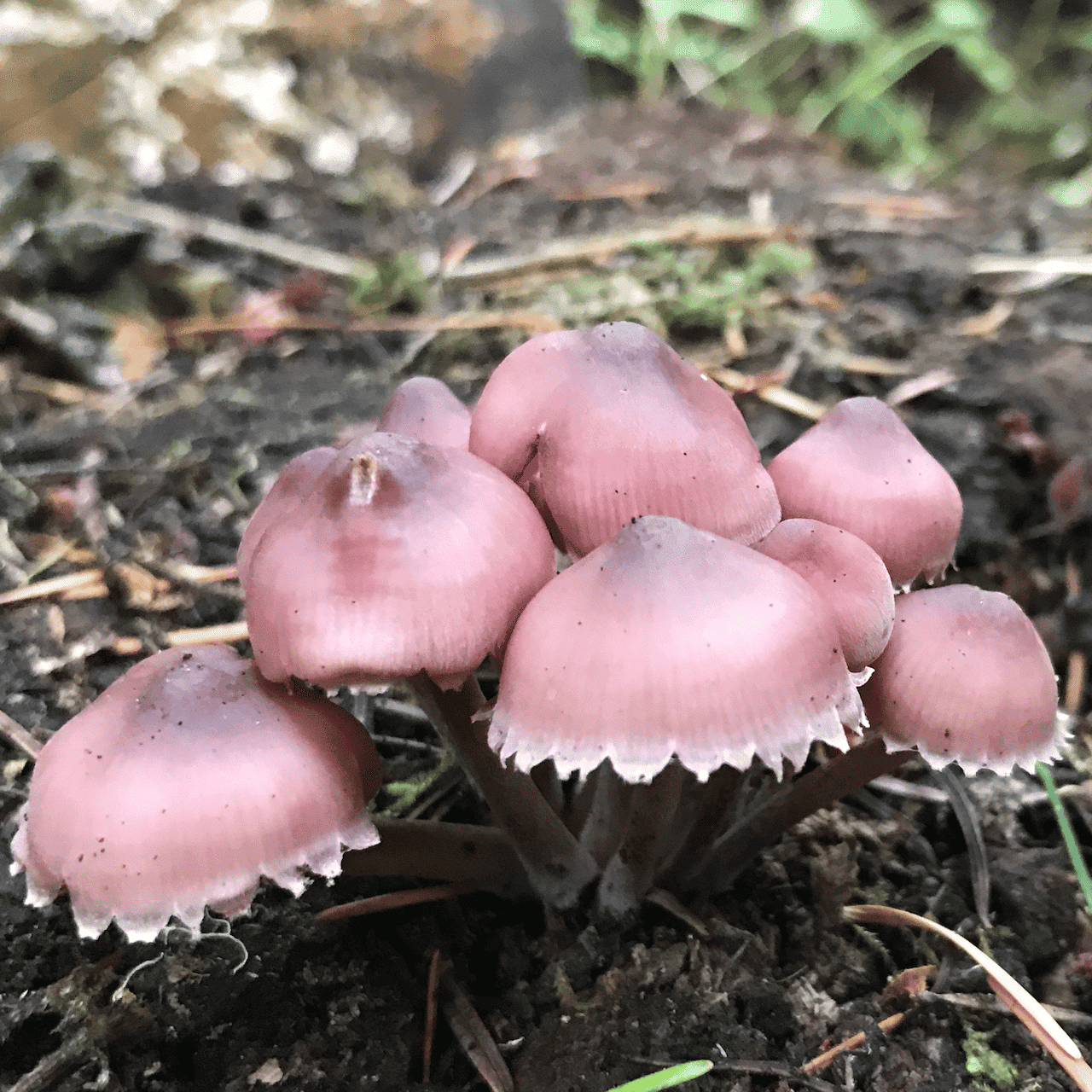
Mycena is a huge genus of small, thin-stemmed, pale-spored mushrooms — the “bonnets.” Dozens of species grow in Cascadia, and many more are recognized only by DNA, so identifying most finds to species takes a microscope (D. Miller, Danny’s DNA Discoveries). A handful, though, are distinctive enough in the field to learn by sight, and this page covers seven of the more common or recognizable ones.
Most Mycena are too small and thin-fleshed to be worth eating, and edibility is simply unknown for most species. A few, covered below, are better known — and not necessarily in a good way.
Scout Fall Conditions on Forayz
Use rainfall and soil moisture layers to see when the ground is wet enough for fall mushrooms near you, free with a Forayz account.
What Makes a Mycena
Mycena mushrooms share a small, thin-fleshed build: a bell-shaped to conical cap, often less than 2–3 cm across, on a slender, brittle, cartilaginous stem. Caps are frequently hygrophanous and translucent-striate — showing the gill outlines through the cap surface when wet — and the spore print is white (Siegel & Schwarz, Mushrooms of Cascadia). Most species grow saprobically, breaking down wood, needle litter, duff or moss rather than partnering with tree roots.
Because so many species look alike, Danny Miller’s Danny’s DNA Discoveries (D. Miller) sorts Cascadia’s Mycena into working field groups rather than relying on color alone: species that “bleed” colored latex when the stem is broken, species with a colored (“marginate”) line along the gill edge, species with a distinctly slimy (viscid) stem, and so on. The species below are picked from several of those groups.
“Bonnet” covers a lot of ground
Most Cascadia common names for Mycena end in “bonnet,” but that word alone doesn’t identify a species — cap color, gill-edge color, stem viscidity, substrate and whether the stem bleeds when broken all matter, and several look-alikes are told apart only under a microscope.
Distinctive Smells
A few Mycena are easiest to place by smell rather than looks. M. epipterygia (below) and M. cinerella both smell distinctly farinaceous (mealy, like fresh cut flour), M. capillaripes smells like chlorine or bean sprouts when crushed, M. tenax has a strong rancid-farinaceous or cucumber-like smell, and M. pura (below) smells of radish or cucumber (Siegel & Schwarz; Smith).
Edibility
Edibility is listed as unknown for most Mycena, including several of the species below — most are too small to be worth trying (Siegel & Schwarz). Mycena pura is the exception: it’s not recommended. See its entry below.
Species to Know
Bleeding Fairy Helmet — Mycena haematopus
Named for the dark red “blood” that oozes from the flesh or stem when broken, this is one of the easier Mycena to place in the field. The cap is pinkish brown to reddish or vinaceous brown, with a scalloped margin where flaps of sterile tissue overhang the gills, ragged with age. It grows clustered on rotting wood — especially bigleaf maple and alder, though also conifers — and is common at low-to-mid elevations, fruiting year-round but heaviest in fall and spring (Siegel & Schwarz).
Look-alikes include another bleeder, M. subsanguinolenta, which is smaller, grows on duff rather than wood, and has colored gill edges; and several non-bleeding species — M. bulliformis (similar but doesn’t bleed and lacks the overhanging cap tissue), M. maculata (gray, developing reddish stains with age) and M. purpureofusca (purplish cap and gill edges, no bleeding) (Siegel & Schwarz). Danny Miller’s genetic survey found that a bleeding Mycena collected on the ground rather than on wood usually turns out to be M. subsanguinolenta, not M. haematopus — so where it is growing is a useful clue (D. Miller, Danny’s DNA Discoveries).
Yellowleg Bonnet — Mycena epipterygia group
A small mushroom with a sticky, grayish-olive to grayish-yellow cap and a distinctly slimy, bright yellow-green stem that fades paler with age. Odor and taste are typically farinaceous. It grows on duff, moss or rotting conifer wood, mostly in fall (Siegel & Schwarz).
“M. epipterygia” is really a group of look-alikes rather than one settled species. Cascadia’s own description notes that DNA work has turned up several distinct species hiding under this name, without agreed-on field marks to separate them (Siegel & Schwarz). Older field guides also apply the name ‘griseoviridis’ to olive- or gray-capped, snowbank-associated members of the group, but Maas Geesteranus treated M. griseoviridis as a variety of M. epipterygia rather than its own species, and Danny Miller’s DNA survey hasn’t settled the question either — he still lists it as a name applied to more than one thing (D. Miller, Danny’s DNA Discoveries). Treat ‘griseoviridis’ as informal shorthand, not a confirmed species.
Mycena overholtsii — the snowbank bonnet
It has no widely used common name. It’s unusually large and sturdy for a Mycena — a 2–5 cm, dark gray to blackish cap fading pale with age, on a stem with a conspicuously fuzzy white hairy base — growing in dense clusters on large conifer logs and stumps right at the edge of melting snowbanks. It’s most often found in old-growth or legacy stumps at higher elevations, fruiting as soon as snowmelt exposes the wood, from spring into early summer (Siegel & Schwarz).
Named for American collectors (A.H. Smith & Solheim), not a misapplied European name — but Danny Miller’s DNA work suggests the true European look-alike, M. laevigata, is genetically distinguishable, while some Pacific Northwest collections labeled ‘laevigata’ actually match M. overholtsii’s DNA instead. What field guides call M. overholtsii here may cover more than one closely related species (D. Miller, Danny’s DNA Discoveries).
Flame Bonnet — Mycena strobilinoidea
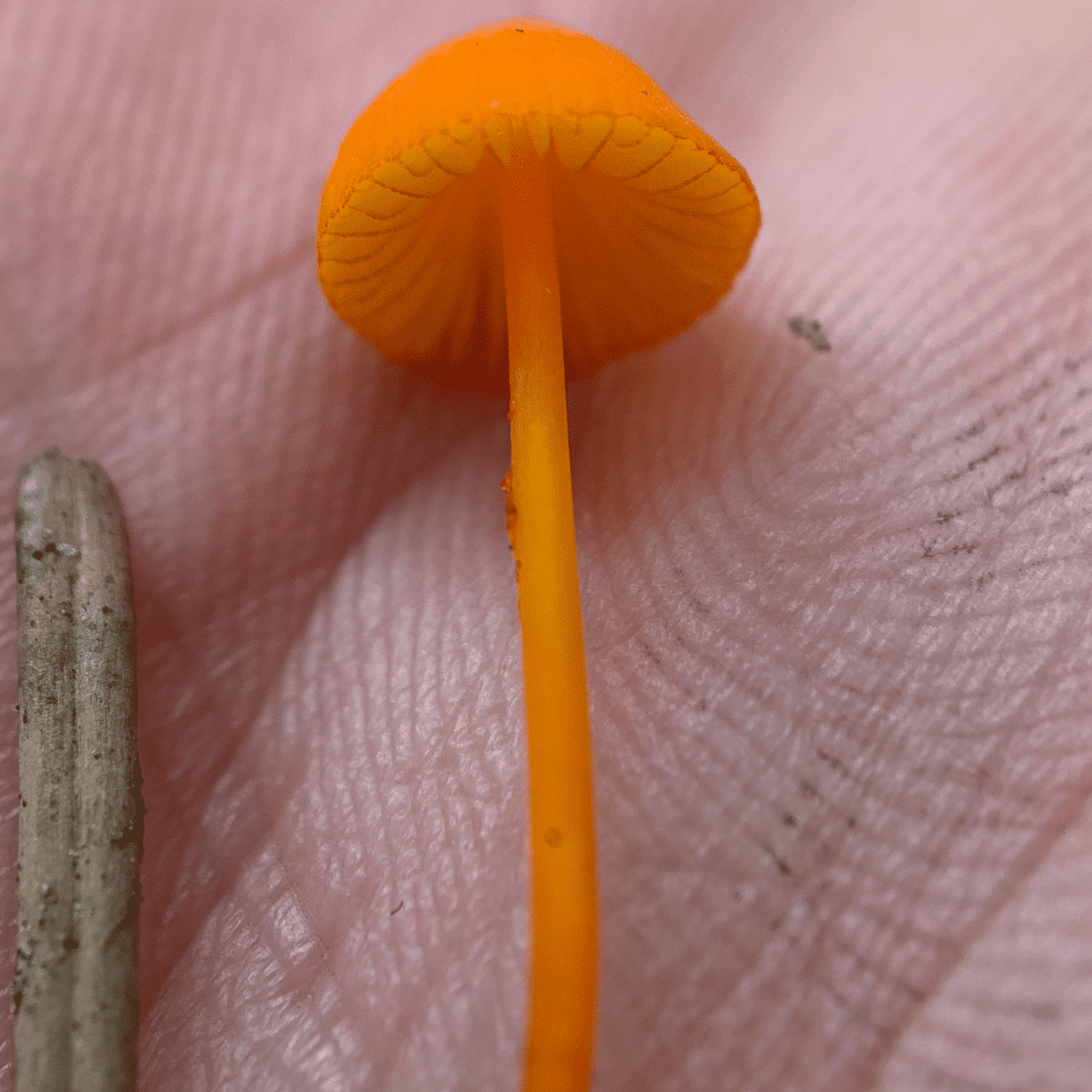
A small but vivid mushroom: a deep red-orange to bright orange, bell-shaped cap fading paler with age, over pale yellowish-orange gills edged in dark red-orange — a “marginate” gill edge, one of the field marks Danny Miller uses to sort the genus. It grows scattered in conifer duff and moss, mostly at higher elevations across the Cascades, fruiting in late summer and fall (Siegel & Schwarz).
Two look-alikes share the orange coloring: M. aurantiomarginata has similarly marginate gills, but its cap runs more olive-brown or yellowish-brown — muddier and less uniformly orange — and shows the gill pattern through the surface when wet; and Atheniella aurantiidisca (below) lacks the colored gill edge entirely (Siegel & Schwarz; D. Miller, Danny’s DNA Discoveries).
Tangerine Bonnet — Atheniella aurantiidisca (formerly a Mycena)
A genus-wide DNA study (Redhead et al., 2020) moved a number of former Mycena species — including this one — into new genera; Mushrooms of Cascadia (2024) already lists it as Atheniella aurantiidisca. It still looks and behaves like a small Mycena: a conical cap that’s often three-toned (dark orange at the center, yellow-orange in the middle, whitish at the rim), whitish to pale yellow-orange gills with plain (non-marginate) edges, and a thin, translucent yellow to whitish stem. It grows scattered to abundant in duff, especially in wetter parts of Cascadia, mostly in fall and early winter (Siegel & Schwarz).
A faded, washed-out specimen can be confused with A. flavoalba, which runs pale yellow to whitish rather than three-toned. Young caps of A. adonis start out pink rather than orange, only fading toward whitish later. M. strobilinoidea (above) stays a more uniform orange throughout and, unlike this species, has a colored gill edge (Siegel & Schwarz).
Gray, viscid-stemmed Mycenas — M. clavicularis & M. vulgaris
Several small gray Mycena with a slimy stem grow in Cascadia and are hard to separate without a microscope. Needle bonnet (M. clavicularis) has a dry-to-moist gray to gray-brown cap, white gills, a glutinous-to-viscid stem, and no strong odor; it’s locally common west of the Cascades, especially under Sitka spruce and Douglas-fir, fruiting soon after the first fall rains into late fall (Siegel & Schwarz). M. vulgaris (no established common name) is told apart by decurrent gills and a more mid-to-high-elevation, east-side distribution (Siegel & Schwarz).
The two names carry different confidence levels in Danny Miller’s DNA survey: he calls the Pacific Northwest application of M. clavicularis only tentative — the one sequenced Oregon collection is “close enough” to European reference sequences that he uses the name provisionally, without being sure it’s the same species. M. vulgaris, by contrast, is a solid match: local sequences line up closely with more than 100 compared European sequences (D. Miller, Danny’s DNA Discoveries).
Lilac Bonnet — Mycena pura group
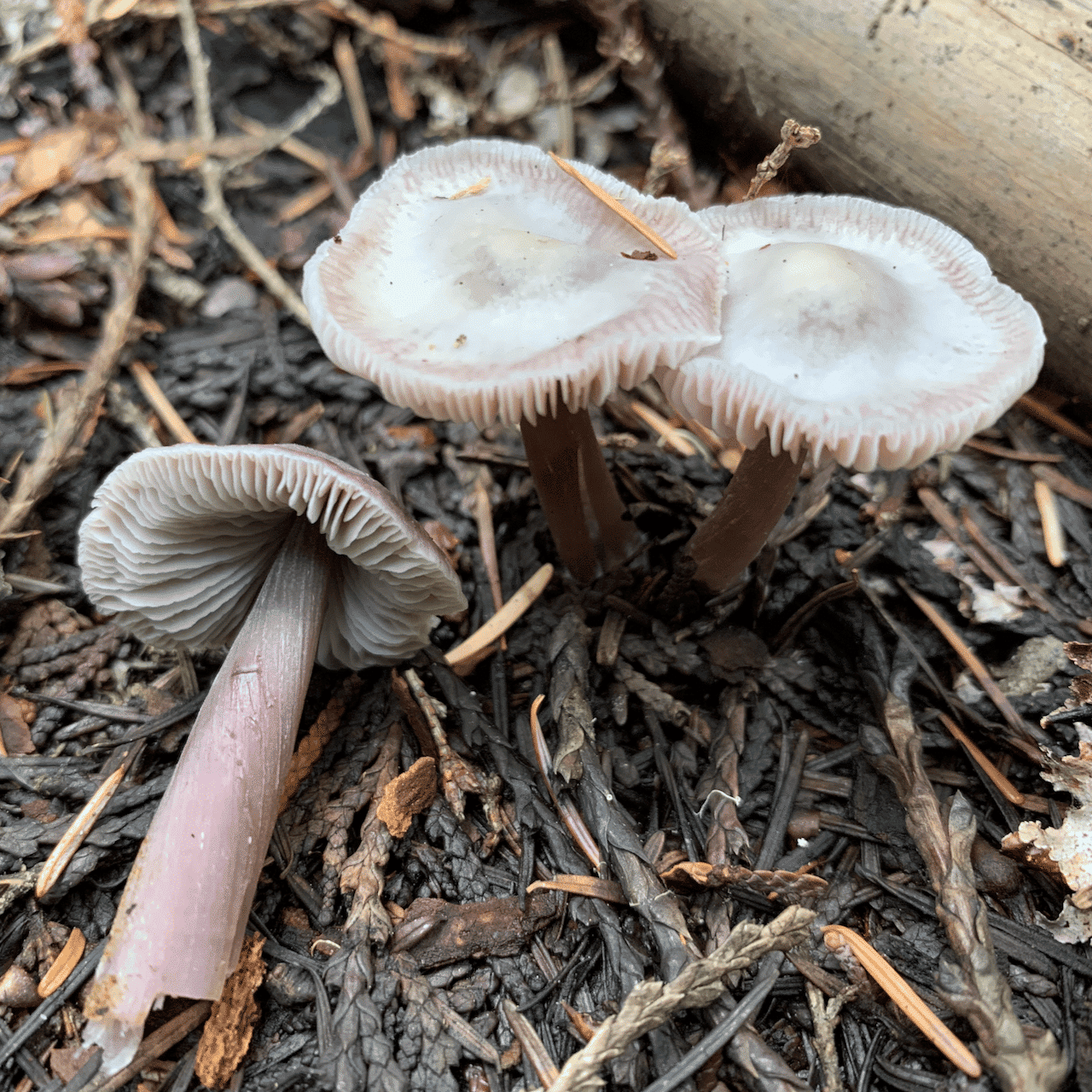
A relatively large, variably colored Mycena — lilac, purple, pink or gray when fresh, fading toward gray or whitish as it dries — with a hygrophanous, translucent-striate cap and a distinctive radish or cucumber smell. It grows solitary to scattered in duff, moss or well-decayed wood across nearly all forested habitats in Cascadia, fruiting year-round with the heaviest flush in fall (Siegel & Schwarz).
Genetic work has found at least eight distinct lineages hiding under the name “M. pura,” with no reliable way yet to separate most of them by looks; the true M. pura is probably just one of these (D. Miller, Danny’s DNA Discoveries). Mushrooms of Cascadia rates its edibility as possibly poisonous, and Arora notes that one study found it contains muscarine, even though some older sources call it edible (Siegel & Schwarz; Arora). Not recommended.
Sources: Mushrooms of Cascadia (Siegel & Schwarz, 2024); MycoMatch (© Ian Gibson), a compilation of published descriptions through which most other field-guide authors named here are quoted; Danny’s DNA Discoveries and the PNW Pictorial Key (© Danny Miller).