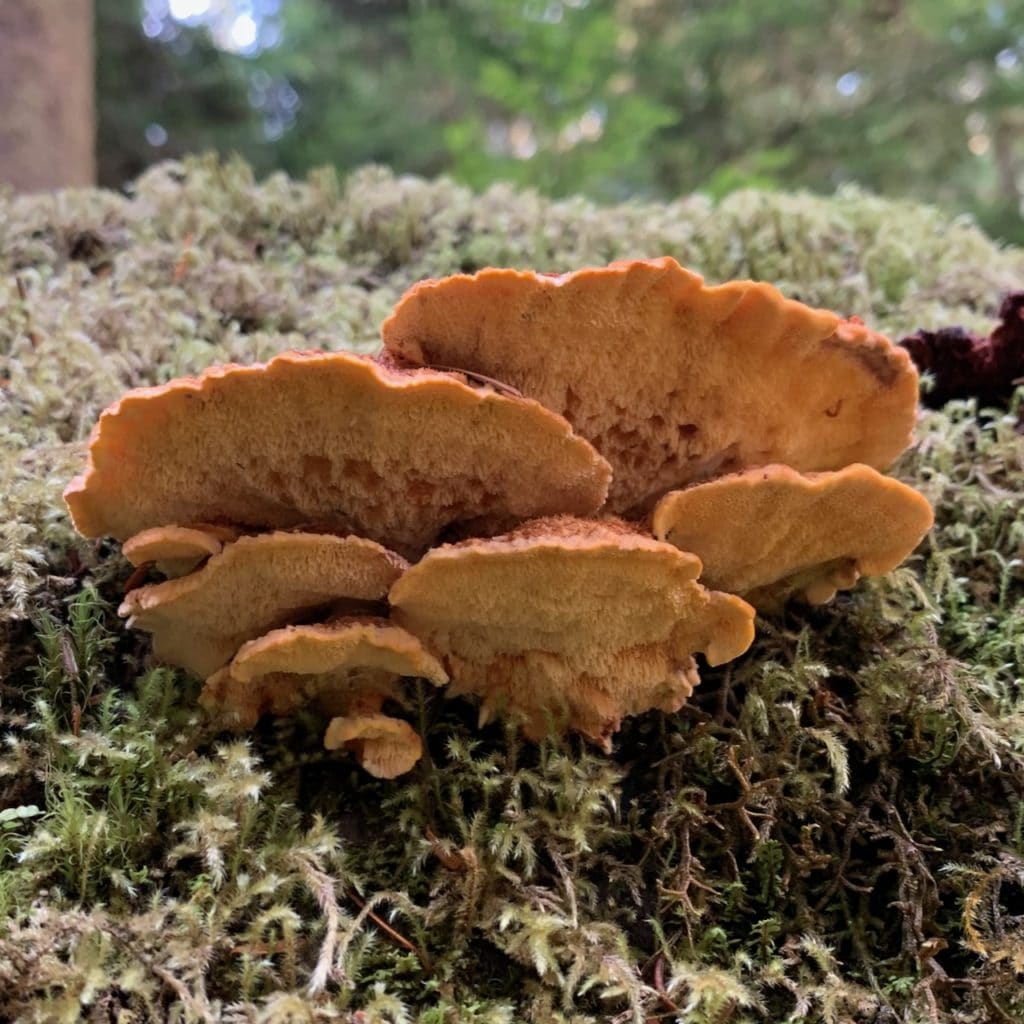
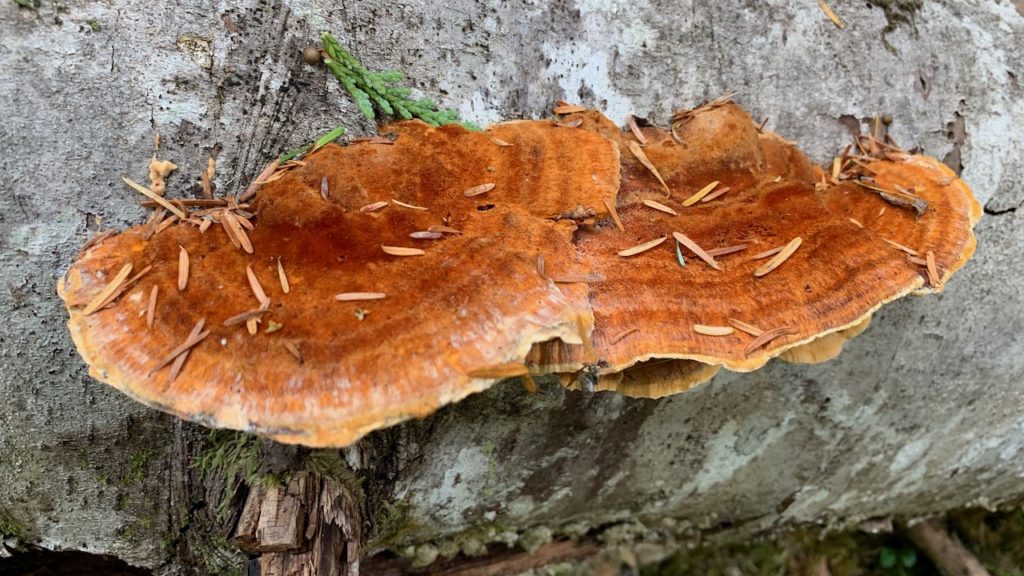
Pycnoporellus fulgens is a small, bright orange bracket fungus that grows on conifer wood throughout the Pacific Northwest. Its hairy, fan-shaped cap and the deep cherry-red color it turns with a drop of KOH make it one of the more distinctive little polypores in the woods, even though it has no common name in general use.
It isn’t eaten — the flesh is tough and corky — but it’s a good one to recognize, since it’s easy to confuse at a glance with chicken of the woods or its own close relative, Pycnoporellus alboluteus.
Scout Conifer Forests on Forayz
Check rainfall, soil moisture and soil temperature in conifer forests near you, free with a Forayz account.
3–10 cm across, an irregularly fan-shaped bracket or shelf. Surface dry and appressed-hairy at first, smoothing out over time. Rusty orange when fresh, sometimes banded in tan or ochre, and fading toward a dull brick color in older specimens (Siegel & Schwarz).
Pores
Small, with short tubes; irregular and angularly shaped, and sometimes forming brief maze-like patterns. Peach to dingy orange, tearing and looking ragged as the bracket ages (Siegel & Schwarz).
Flesh
Yellow to dingy orange in color, ranging in texture from corky to a tougher fibrous-leathery consistency; sometimes two-layered, with a firmer lower zone and a softer, more fibrous zone above it (Siegel & Schwarz; Gilbertson).
Spore print
White.
Odor & Taste
Not distinctive (Siegel & Schwarz).
KOH
Cherry red on flesh and pores (Siegel & Schwarz; Gilbertson).
Bright orange, hairy, and red in KOH
A hairy, fan-shaped orange bracket with paler, angular pores underneath, on conifer wood. A drop of KOH turning the flesh and pores cherry red is a quick confirming test (Siegel & Schwarz).
Similar Species
A few other orange or hairy polypores share its conifer-wood habitat. The features that separate them are shape, size and habitat more than color.
Photo: Jeremy Collison / CC BY-NCPycnoporellus alboluteus: The closest look-alike. It typically grows flat and spread out on the wood rather than forming a real cap, as a frothy layer of elongate pores that break down into ragged teeth, with distinctly larger pores, spores and cystidia, and it’s more common at higher elevations. In our experience it can be pale when freshly emerged and turn orange with age.
Chicken of the woods (Laetiporus conifericola): Also orange and grows on conifers, but is much larger and fleshy-soft rather than tough and corky when fresh, with a sulphur-yellow cap rim and small, round yellow pores (Siegel & Schwarz; D. Miller, Danny’s DNA Discoveries).
Trametes cinnabarina (cinnabar polypore): A more uniform, deeper cinnabar-red throughout, cap and pores alike, rather than orange with paler pores. Its pores are small and round, and it grows on hardwood debris, including small branches, rather than conifer wood (Siegel & Schwarz; D. Miller, Danny’s DNA Discoveries).
Hapalopilus rutilans (often still listed as H. nidulans): Similar in shape, but soft and squishy rather than tough, with a tawny-beige to pinkish brown cap. KOH turns it deep lavender to violet rather than cherry red — a useful field test where the two might be confused. It’s scarce here and grows on hardwoods (Siegel & Schwarz).
Naming
Pycnoporellus fulgens was first described in Europe, and Danny Miller’s DNA survey flags it as one of the polypores whose European name has also been applied to Pacific Northwest material. Unlike many of those cases, though, he reports that the local sequences he’s examined broadly match European ones, so this isn’t a clear case of a misapplied name the way some regional look-alikes are (D. Miller, Danny’s DNA Discoveries). The species name means “shining” or “glowing” (Gilbertson), a nod to its bright color when fresh.
Pycnoporellus fulgens grows solitary or scattered on the trunks, logs and branches of conifers, and occasionally on hardwoods, causing a brown cubical rot. It’s common throughout the region and across much of temperate North America (Siegel & Schwarz; Gilbertson). In a Haida Gwaii survey it turned up almost every time on or near old fruitbodies of the red belt conk, Fomitopsis ‘pinicola’ group, mostly F. mounceae in the Pacific Northwest — occasionally growing right on top of the older conk (Kroeger).
Fruitbodies are annual but persistent: Mushrooms of Cascadia records an early flush in late spring and summer, with the heaviest fruiting in fall (Siegel & Schwarz). Because the tough, corky brackets hold up for months once they’ve formed, we’re not charting a peak month here — iNaturalist reports of it come in at a fairly steady rate across the whole year, which reflects how long a bracket stays visible and how often people are out looking, not a single fruiting event.
Edibility
Inedible (Siegel & Schwarz); the flesh is tough and corky.