
Troll’s Knoll Forest
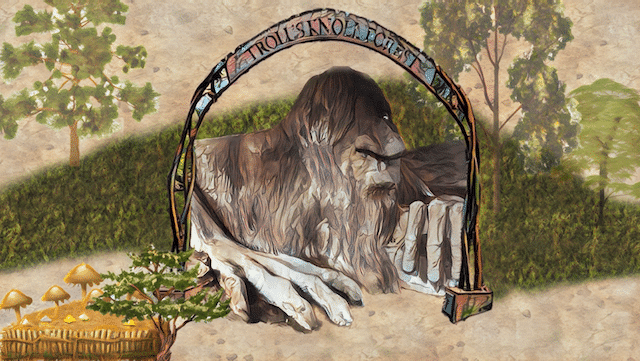
Park Map
Find the Troll’s Knoll mushroom patch, a moss-covered turtle, and information about the specific trees in the park
Mushrooms of the Troll’s Forest
***
Never eat a wild mushroom without proper identification by someone familiar with potential look-alikes
***
This mushroom patch contains a variety of fungi that help to decompose dead plant material, and return their nutrients to the soil
Troll’s Mushroom Patch
A small mushroom patch on the north end of the park includes some commonly cultivated mushroom species
Mushrooms are created by fungi that spend most of their time living quietly underground or inside wood as fine, white threads known as mycelium.
When conditions are just right, the mycelium will create mushrooms on the surface in order to disperse spores.
When spores land on a suitable food source, they will begin to grow as a new mycelial colony.
Pleurotus ostreatus
Oyster
One of the most commonly cultivated, and also wild foraged mushrooms. Like most cultivated species, it is a wood-lover and is found in the wild growing on dead trees and stumps.

Stropharia rugosoannulata
King Stropharia
Also known as the garden giant, this mushroom grows on a range of substrates getting its nutrition as both a primary and secondary decomposer.

Hericium erinaceus
Lion’s Mane
One of 4-5 Hericium species in the US, lion’s mane typically grows from the side of logs and stumps. It grows as a tight rounded pom-pom

Ganoderma lucidum
Reishi
Reishi is a woody polypore mushroom that is cultivated for use in teas, tinctures, and powders. The PNW is home to other Ganoderma species including G. oregonense, and G. applanatum.

Other Common Urban Mushrooms
Below is a selection of wild mushrooms that might be found in urban parks like the Troll’s Knoll. This list includes edible and toxic mushrooms. Many of these mushrooms are decomposers and are often found on dead logs, grass, compost and wood chips. Others are only found growing with specific trees like pine, Douglas fir, or birch.
Trees of the Troll’s Knoll Forest
Deciduous Trees
Deciduous trees are those that lose their leaves in the fall. The Troll’s Forest has 13 different deciduous species including cottonwood, oak, cherry, apple, and maple
Apple
Malus
Apple trees in the park are maintained by City Fruit

Black Cottonwood
Populus trichocarpa
Black cottonwood is one of the most popular trees in the park and is native to the western US. The genus Populus also includes aspen and poplar trees.

Black Locust
Robinia pseudoacacia

Cherry
Prunus

Cherry Laurel
Prunus laurocerasus

Cork Oak
Quercus suber

English Hawthorn
Crataegus monogyna

Magnolia
Magnolia grandiflora

Maples
Japanese Maple
Acer palmatum

Red Maple
Acer rubrum

Oak
Quercus

Quaking Aspen
Populus tremuloides

Sumac
Rhus

Coniferous Trees
Coniferous trees are trees that have cones. They are typically evergreens and do not lose their leaves in the fall. Many conifers have leaves that are long thin needles however others like western redcedar have wide, scaly leaves.
Austrian Pine
Pinus nigra

Douglas Fir
Pseudotsuga menziesii

Juniper
Juniperus communis

Ponderosa Pine
Pinus ponderosa

Scot’s Pine
Pinus sylvestris

Shore Pine
Pinus contorta
