
Lobster Mushroom Hypomyces lactifluorum — A Parasitic Fungus, Not a Species
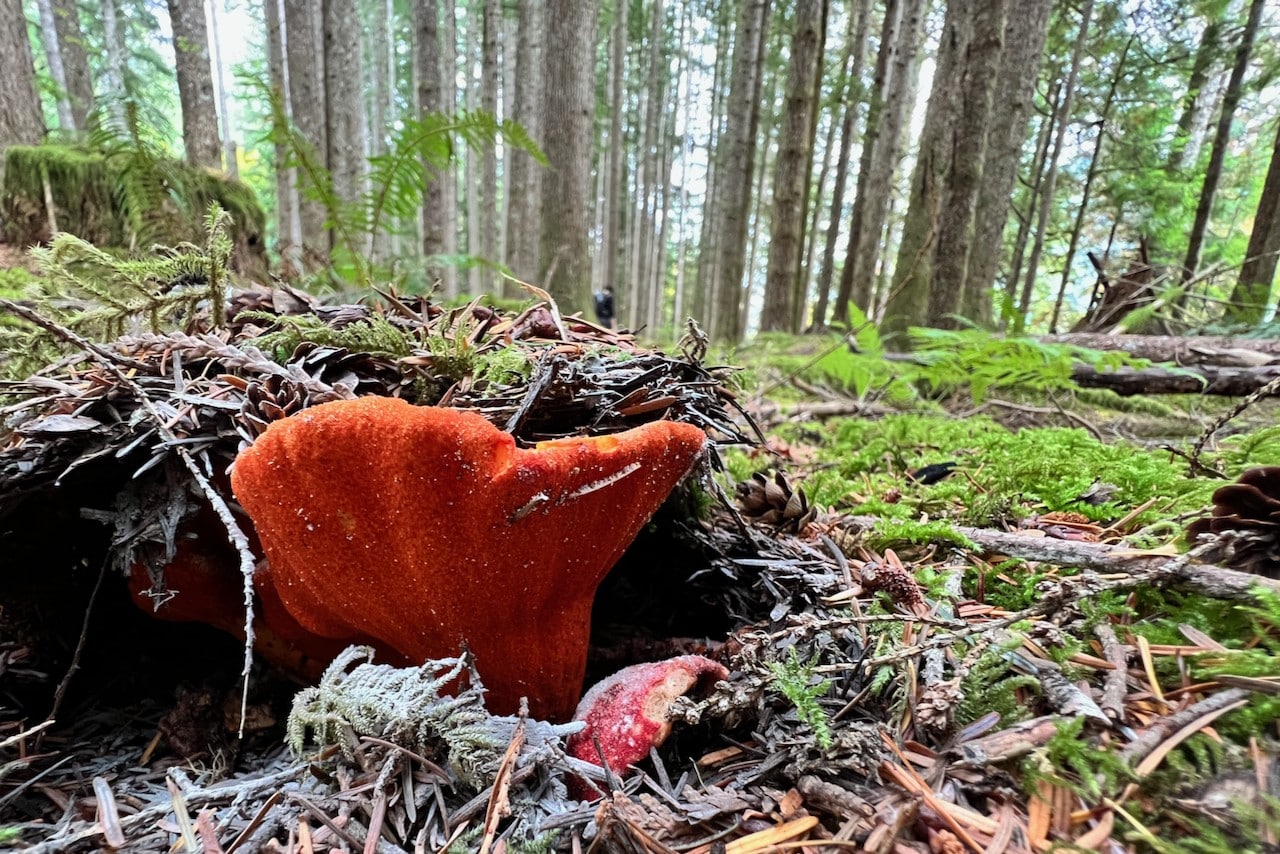
The lobster mushroom is one of the most striking finds in Pacific Northwest forests — and one of the most misunderstood. It is not a mushroom species at all. What you see when you pick up a “lobster” is the result of a parasitic ascomycete fungus, Hypomyces lactifluorum, that has colonized and completely transformed a host mushroom beyond recognition.
In the Pacific Northwest the host is the short-stalked russula, Russula brevipes, almost always and perhaps always (Siegel & Schwarz, Mushrooms of Cascadia); elsewhere other Russula and Lactarius are also reported. The parasite encases the host in a bright orange crust, reduces the gills to blunt ridges, distorts the shape, and leaves very firm white flesh that is good to eat.
Track Lobster Mushroom Conditions
Use Forayz to monitor soil moisture, temperature, and precipitation in your local conifer forests. Environmental layers help you time your late-summer forays.
The Parasitic Relationship
Understanding what a lobster mushroom actually is matters for identification, safety, and knowing where to look. Here is the biology in plain terms.
Hypomyces lactifluorum is a parasitic ascomycete, a sac fungus that attacks other mushrooms. In the PNW it grows on Russula brevipes; elsewhere also on other Russula and on Lactarius. The transformation is dramatic:
- Exterior: A thin, bright orange to deep red crust with a finely pimpled surface — the Hypomyces itself
- Gills: Reduced to blunt ridges or obliterated
- Shape: The host’s form is distorted, often becoming irregular and lumpy
- Texture: Dense and firm throughout, with crisp white flesh when sliced open
- Odor: Indistinct when young, disagreeable with age. The “lobster” name comes from the color, not the smell
Why the Parasite Makes It Better
The host, Russula brevipes, is a variable edible on its own: a complex of several species, some good and some poor. Parasitized, it becomes very firm with a mild taste, and a lobster is generally rated well above its host.
Identification
A fully transformed lobster mushroom is one of the easiest wild mushrooms to identify. Nothing else in PNW forests looks quite like it.
- Color: Bright orange to orange-red exterior, sometimes mottled with white patches where transformation is incomplete
- Interior: Pure white when sliced, firm and dense — like a block of cheese in texture
- Surface: Hard, slightly bumpy, sometimes with tiny pimple-like dots (the Hypomyces perithecia where spores are produced)
- Gills: Absent. The underside is smooth or has faint ridges — this is the single most important diagnostic feature
- Size: 4–20 cm across. Often partly buried in duff before erupting at maturity
- Spore print: White, but not useful for identification
Signs of a Good Specimen
Not all lobster mushrooms are worth collecting. Quality varies significantly:
- Harvest: Firm throughout, bright orange-red, white interior when sliced
- Leave: Soft or spongy, flesh mottled with orange, or a disagreeable smell — signs of age
- Check for insects: Cut a cross-section in the field. Larvae tunnels are common in older specimens and will ruin the mushroom quickly
Season & Timing
Lobster mushrooms start fruiting in mid-summer, often in the middle of the dry season, and continue through fall, with stragglers into winter. Observations in Oregon and Washington peak in October, the same month as chanterelles and hedgehogs, but lobsters get going earlier.
| Month | Status in the PNW |
|---|---|
| July | First lobsters, even in dry weather |
| August | Building |
| September | Strong |
| October | Peak month |
| November | Still common; stragglers into winter |
Unlike many fall mushrooms, lobsters don’t wait for the fall rains: they typically start in mid-summer, during the dry season, so the search can begin well before the chanterelle flush.
Time Your Lobster Mushroom Hunts
Forayz shows real-time soil temperature and 14-day precipitation data for any location. Check conditions in your target conifer forests before heading out.
Habitat & Where to Find Them
Finding lobster mushrooms means finding their host, Russula brevipes, which is mycorrhizal and grows in a wide range of forest types. West of the Cascade crest lobsters are common, sometimes plentiful; they are rare on the east side and mostly missing from the southern Cascades and the Klamath ranges.
- West-side conifer forests: Wherever R. brevipes is common, including Douglas-fir and hemlock stands
- Patches of R. brevipes: Unparasitized short-stalked russulas are usually present in lobster patches, at least later in the season
Within those forests, focus on specific microhabitats:
- Duff mounds: Lobsters are often partially or fully buried. Look for bumps in the needle litter and moss that seem out of place
- Previous finds: Lobster mushrooms return to the same spots year after year. Mark productive locations and revisit them annually
The host mushrooms (Russula brevipes in particular) are extremely common in PNW conifer forests. If you’re finding short-stemmed white russulas, lobsters may be nearby — the parasite often colonizes multiple fruiting bodies in the same patch.
Lookalikes & Safety
A fresh, fully transformed lobster mushroom has no dangerous lookalikes. The combination of bright orange-red exterior, obliterated gills, and dense white interior is unique. However, there are a few things to be aware of.
The Host Identity Question
Because the parasite transforms the host beyond recognition, you can’t confirm what the host was. In the PNW, Siegel & Schwarz say it is almost always, perhaps always, Russula brevipes, which is reassuring. Still, Arora notes there is no absolute assurance that the host is edible, and some people have reported intestinal upset (McKnight). Eat only firm specimens, and a modest amount the first time.
- Partially transformed specimens: If you can still see intact gills or the transformation is minimal (only light orange patches), pass. You want a fully colonized specimen where the Hypomyces has completely taken over
- Old specimens: Aging lobsters soften, the flesh becomes mottled with orange, and the smell turns disagreeable. Only collect firm specimens
- Other Hypomyces: Related species make other colors on other hosts. H. luteovirens forms a yellow to greenish crust on the gills of Russula (reportedly edible, but not recommended because the host is unknown). A white crust on boletes, yellowing with age, is H. chrysospermus; a white crust on Amanita is H. hyalinus — never eat either. H. aurantius is also bright orange, but forms a layer on the undersides of polypores and occasionally oyster mushrooms, not on a gill-less ground mushroom.
For a broader overview of mushroom safety in the region, see our guide to poisonous mushrooms in the Pacific Northwest.
Cooking & Edibility
Lobster mushrooms are good to eat, but eat only firm ones. The dense texture holds up to almost any cooking method.
- Cleaning: Brush off dirt and debris with a stiff brush. The hard exterior handles water better than most mushrooms, so a quick rinse is fine. Slice in half to check for insect damage before committing to a prep
- Sauteing: The go-to method. Slice thickly and cook in butter over medium-high heat. The dense flesh browns well and develops a rich, nutty flavor. Pairs well with garlic, shallots, and white wine
- Seafood dishes: The firm texture and mild taste work well in chowders, bisques and risottos.
- Drying: Dries well; dried lobster powder adds color and flavor to sauces and soups. A fun trick from Cascadia: sauté lobsters in plenty of butter, then cook eggs in that butter — they turn purple.
- Raw: Do not eat raw. Always cook thoroughly
One practical note: the bright orange-red pigment will stain cutting boards, towels, and light-colored cookware. Use a dedicated cutting board or one you do not mind tinting orange. The same pigment makes lobsters a prized dye, giving peach, pink and magenta on wool and silk.
Related Species & Learning More
If you are finding lobster mushrooms, your local forests support the mycorrhizal communities that produce many of the PNW’s best edible species. Here are some to learn alongside the lobster.
Other Species in Lobster Habitat
The conifer forests where lobster mushrooms fruit also host these important edible and mycorrhizal species. Learning the full community helps you read the forest and find productive ground.
- Chanterelles (Cantharellus spp.) — Share many of the same forests and peak in the same month.
- Matsutake (Tricholoma murrillianum) — Another conifer associate, in coastal shore pine on sandy soils and drier inland conifer forest.
- Russula brevipes — The lobster host. Large, white, short-stemmed. If you’re finding these un-parasitized, look harder — lobsters may be nearby
- Hedgehog mushrooms (Hydnum spp.) — Peak in the same month and continue through winter into spring.
Learn Lobster Mushrooms and Other Fall Edibles
Lobsters share the fall woods with chanterelles, hedgehogs, and boletes — learn them all in person. Our last evening intro class of the fall is in Bellevue, and small-group guided tours run in the Cascades through November.
Quick Reference
| Feature | Detail |
|---|---|
| Scientific Name | Hypomyces lactifluorum (parasite) on Russula brevipes (host, in the PNW) |
| Type | Parasitic ascomycete — not a mushroom species itself |
| Edibility | Edible and good when firm. Always cook thoroughly |
| Season | Mid-summer to fall, peaking in October |
| Habitat | West-side forests wherever Russula brevipes grows |
| Key ID Feature | Orange-red exterior, no gills, white interior, dense and firm |
| Lookalikes | None for fully transformed specimens |
| Spore Print | White |
Sources: Mushrooms of Cascadia (Siegel & Schwarz, 2024); MycoMatch (© Ian Gibson), a compilation of published descriptions through which most other field-guide authors named here are quoted.