
Chicken of the Woods Laetiporus conifericola — Identification & Foraging in the Pacific Northwest
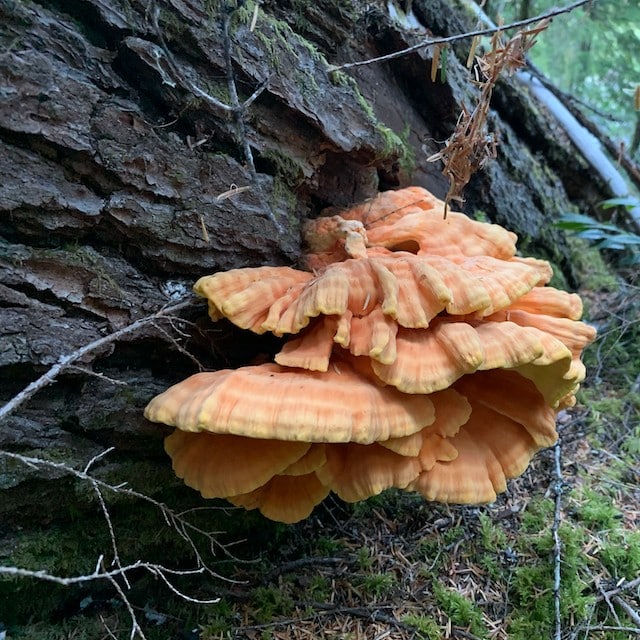
Chicken of the woods is one of the easiest mushrooms to spot in the Pacific Northwest. Its yellow-to-orange shelving brackets are visible from a distance on conifer trunks, stumps and logs. In Washington and Oregon the common species is Laetiporus conifericola, which fruits in summer and fall.
It is a popular beginner mushroom because it has few look-alikes. But easy to identify doesn’t mean safe for everyone: some people get gastrointestinal upset after eating it, it must never be eaten raw, and only young specimens are worth eating.
Track Chicken of the Woods Season on Forayz
Use soil temperature and precipitation layers to time your summer and fall foraging trips. Free with a Forayz account.
Identification
- Fruiting body: Shelving bracket polypore; individual brackets 5–20 (occasionally 30) cm across, usually in overlapping clusters that can be much larger
- Upper surface: Sulfur-yellow at first, turning orange or peach-orange, banded with paler zones; velvety when young, then bald and bumpy; fades to pinkish orange and finally whitish
- Pore surface (underside): Bright sulfur yellow with tiny, round pores; no gills. This is where the “sulfur shelf” nickname comes from
- Flesh: Soft and often juicy when young, becoming firm and corky, and finally chalky and crumbly; pale yellow to whitish
- Spore print: White
- Odor and taste: Odor indistinct when young, unpleasant in age; taste mild to sour
- Substrate: Standing trees, stumps and large logs of many conifers, especially true firs and spruce. Occasionally on hardwoods (see below)
- Season: Summer and fall. Old, chalk-white brackets persist and can be found any time of year
Yellow-to-orange shelves with a sulfur-yellow pore surface, growing on wood, make this one of the more distinctive PNW mushrooms. Only young specimens are worth eating: the edges should be soft and pliable. Once the flesh turns chalky or the edges become brittle, it’s past its prime.

Young vs. Old: Know What to Harvest
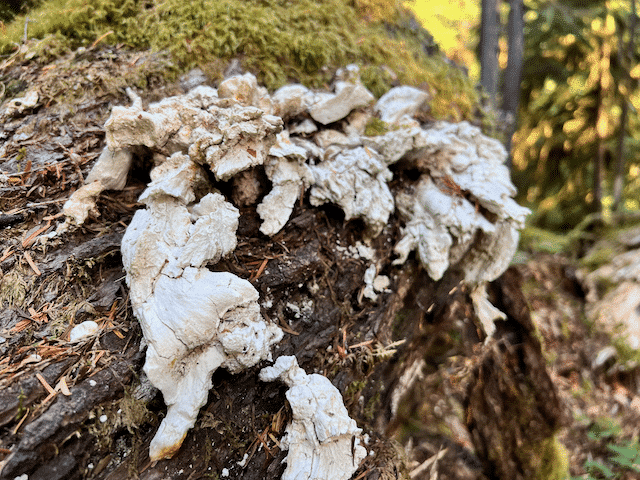
Fresh chicken of the woods has a smooth, bright orange top and lemony yellow pores underneath. The flesh is tender and cuts cleanly with a knife. Old specimens turn pale and chalky and become brittle; by then they are tough and sour (Arora). If it crumbles when you squeeze it, leave it.
Species in the Pacific Northwest
The name “chicken of the woods” covers several Laetiporus species across North America. In the PNW, you’ll primarily encounter one:
PNW Laetiporus Species
Season & Timing
Chicken of the woods is a warm-weather species in the PNW. Unlike chanterelles and hedgehogs, which wait for fall rain, Laetiporus fruits through summer as well as fall. A general guide by month:
| Month | What to Expect |
|---|---|
| June | First fresh brackets appear. |
| July | Fruiting across western Washington and Oregon. |
| August | Fruiting continues. |
| September | Still productive. Many earlier brackets are now past prime. |
| October | End of the season; most brackets are aged out. |
Where to Look
Chicken of the woods is a wood-decay fungus. It rots the heartwood of living conifers and continues in dead trees, stumps and logs. Unlike mycorrhizal species, you’re not looking for specific tree partners; you’re looking for large conifer wood.
- Standing trees and snags: Look on trunks, including higher up, especially of true firs and spruce.
- Stumps: Conifer stumps, including in logged areas.
- Fallen logs: Large-diameter conifer logs.
- Burn areas: Fire-killed conifers are more dead wood for it to colonize.
- Urban and suburban trees: Dead conifers in parks, along streets, and in yards. Hardwood specimens in town may be either species.
Once you find a productive log or stump, mark it. Chicken of the woods often fruits from the same piece of wood in more than one year.
Find Past Burns & Public Land on Forayz
Pro members can overlay recent burn perimeters and timber harvest data to find productive dead-wood habitat for chicken of the woods.
Lookalikes
Chicken of the woods has few look-alikes, which is part of what makes it a good beginner species. These are the ones worth knowing:
- Pycnoporellus fulgens: The closest look-alike and the one most often mistaken for chicken of the woods. An orange bracket on conifer logs, but much smaller (3–10 cm), with a hairy cap, tough, corky flesh, and larger, angular, peach-orange pores. Chicken of the woods is fleshy and soft when fresh, with tiny round yellow pores. Not edible.
- Pycnoporellus alboluteus: Also bright orange on conifer logs, but hard to mistake for chicken of the woods: it forms a frothy layer of ragged pores and teeth on the underside of rotting logs, usually at high elevation after snowmelt, with no fleshy shelves. Not edible.
- Phaeolus (dyer’s polypore): Tiered, rosette-like shelves at or around the base of conifers, with a yellow to orange growing edge when young that soon turns rusty to dark brown. Separated by its velvety to hairy cap, corky flesh, and greenish-yellow to olive pores that quickly stain dark brown when scratched. Rarely mistaken for chicken of the woods. It has long been called P. schweinitzii, but that name covers several species; the common PNW one is likely P. hispidoides, which has been confirmed by DNA in Washington. Possibly toxic.
- Laetiporus past its prime: The most common “identification mistake” is actually just old chicken of the woods. Aged specimens lose their color and become white, chalky, and crumbly. People occasionally mistake these for something else entirely, or fail to recognize that the bleached-out shelf they’re looking at was once a bright orange chicken of the woods.
Phaeolus, not chicken of the woods: tiered shelves at the base of a conifer, with brown centres and a yellow growing edge. Photo: Jeremy Collison / CC BY-NC
Safety & Edibility
Chicken of the woods is a good edible when young, but it comes with caveats.
Digestive reactions
Some people get gastrointestinal upset after eating chicken of the woods, and allergic reactions have also been reported. Both PNW species, the conifer and the hardwood chicken, can cause it, and one death following Laetiporus ingestion has been reported (Benjamin). Sources agree on three precautions: eat only young, soft brackets, cook them thoroughly, and never eat them raw.
The rule: Always try a small amount your first time. Cook a few bites, eat them, and wait a day before eating a full meal. This applies even if you’ve eaten eastern Laetiporus without trouble, since the western species are different.
Tree Hosts to Avoid
Many guides advise against eating Laetiporus from these hosts. Whether the tree’s compounds actually pass into the mushroom hasn’t been established, but the advice is widely given:
- Eucalyptus: Mostly a California concern, as eucalyptus is uncommon in the PNW.
- Yew (Taxus): Yew itself contains taxine alkaloids that are toxic to humans.
Preparation Tips
- Harvest young specimens only. The soft outer margin is the most tender part (Arora). Discard the tougher base where it attaches to the wood.
- Cook thoroughly. Never eat chicken of the woods raw.
- Slice thin. Thin slices cook through evenly; cook until tender throughout.
- Test before feasting. Eat a small portion the first time and wait a day before eating more.
- Best uses: Sauteed with butter and garlic, breaded and fried (the “chicken” comparison), added to stir-fries, or used in tacos and sandwiches. The texture is meaty and holds up well.
Ecology
Chicken of the woods is both a parasite, causing a brown cubical rot in the heartwood of living conifers, and a saprotroph that continues decaying dead trees, stumps and logs. Brown rot breaks down cellulose and leaves behind the brown lignin. This is an important ecological role: brown rot fungi are among the primary recyclers of dead conifer wood in Pacific Northwest forests.
A single colony can produce fruiting bodies from the same log in more than one year. A cluster takes about four weeks to develop (Schalkwijk-Barendsen), and the dead, chalk-white brackets persist long after.
Brown Rot vs. White Rot
Laetiporus causes brown rot, which breaks down cellulose and hemicellulose but leaves lignin behind. The result is dark, crumbly, cube-shaped wood fragments. White rot fungi (like oyster mushrooms) break down lignin as well as cellulose, leaving the wood pale and stringy. Both processes are essential to forest nutrient cycling.
Sources: Mushrooms of Cascadia (Siegel & Schwarz, 2024); MycoMatch (© Ian Gibson), a compilation of published descriptions through which most other field-guide authors named here are quoted.
Related Reading
For a broader look at edible species, tree-mushroom associations, and foraging strategy in our region, explore the links below.