
Forayz: Mushroom Foraging Map for the Pacific Northwest Burn perimeters, soil conditions, snowmelt, wildfire smoke, tree species, and habitat models for Washington, Oregon, and the wider Western US
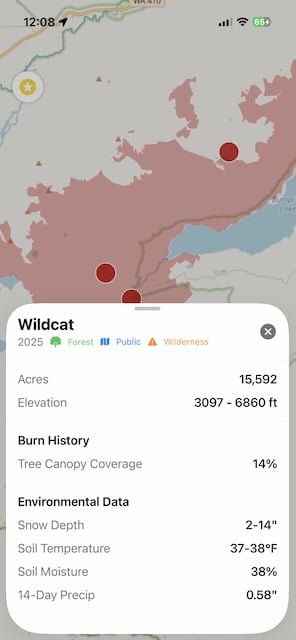
Forayz combines a dozen government data feeds into one map you can plan a trip from: where it burned, where the soil is warm and damp, where snow has just melted, which trees are growing, whether the air is smoky, and whether the land is open to foraging.
Tap anywhere on the map to read the conditions at that exact spot. Save waypoints, record your tracks, and download regions for offline use in the apps.
A free account gets you soil temperature and moisture at regional scale, the past week of rain, snow, wildfire smoke, active fires, historical burns, and a free year of recent burns. Pro adds full-detail soil zoom, 14- and 30-day rainfall, the newest burn years, timber harvests, tree species density, habitat models, town fruiting calendars, and offline downloads.
At a Glance
Burn perimeters
Wildfires and managed burns across the Western US, filterable by year, with a soil and vegetation severity overlay for recent fires.
Active wildfires
Current NIFC fire perimeters and incident points, updated through the season. Active fires show separately from contained ones.
Wildfire smoke & forecast
Near-surface smoke right now, plus peak smoke forecast 24 and 48 hours out. A blank map means clear air.
Soil temp & moisture
Both at the surface (0–3 in) and down in the root zone (3–11 in). Updated daily. In spring, watch for the mid-40s°F, where studies elsewhere put morel fruiting onset.
Snow & snowmelt
Current snow coverage for elevation timing, and a recent-melt mode showing where snow came off in the past two weeks.
Precipitation: 7, 14 or 30 days
The past week of rain is free. Pro opens the 14- and 30-day windows for longer soaks, and 30-year normals give regional context.
Tree species density
22 species mapped by live tree density — Douglas-fir, cottonwood, the firs, hemlocks, ponderosa, oak, madrone, redcedar and more — plus a forest-age layer in the apps, from recent clearcuts to old growth.
Habitat models (experimental)
Matsutake habitat zones, in season. Where the mycelium probably lives — not a fruiting forecast.
Public lands, roads & trails
PAD-US (US) and CPCAD (Canada), the numbered USFS road network, maintained trails, and recreation sites.
Tap for conditions
Long-press anywhere (click on the web) for elevation, soil temp and moisture, snow, recent rain, and the dominant trees at that spot.
Area fruiting calendars
Open a town or pass and see which species typically fruit in which months there, plus its ecoregion, forest composition and climate normals.
Waypoints, tracks & offline
Save spots with custom icons or any emoji, sort them into folders, record GPS tracks, move them in and out as GPX, and download regions to use with no signal.
Try it free
Soil temperature and moisture, the past week of rain, snow, smoke, active fires and historical burns are all free with a registered account. No credit card.
Map Layer Catalog
The layer panel has three tabs: Conditions, Overlays and Forest. Most layers need a free Forayz account. On the web, Public Access Lands and Events also work with no account; the apps ask you to sign in first.
Conditions (one at a time, plus Active Wildfires)
- Active Wildfires (NIFC, current season) Free
- Snow Free Coverage · Recent Melt (Pro)
- Soil Temperature Free + Pro Surface 0–3 in · Root Zone 3–11 in · free at regional zoom, Pro zooms in
- Soil Moisture Free + Pro Surface 0–3 in · Root Zone 3–11 in · free at regional zoom, Pro zooms in
- Precipitation Free + Pro 7-day (free) · 14-day & 30-day (Pro)
- Wildfire Smoke Free Now · +24h peak · +48h peak
- Precipitation Zones (30-yr normals) Free
- Ecoregions (tap for habitat notes) Free
Overlays: Foraging Signals
- Recent Burns Free + Pro One sample fire year free · newest years and managed burns with Pro
- Burn Severity (BAER / RAVG) Pro
- Historical Burns (25K+ perimeters, 2005–2023) Free
- Timber Harvests Pro
- Disturbed Forests (NASA OPERA, non-fire loss) Pro
- Matsutake Habitat (experimental, Jul–Dec) Pro
Overlays: Explore & Navigate
- Forest Roads (USFS, paved / gravel / closed) Free
- Trails (USFS maintained) Free
- Recreation Sites (trailheads, campgrounds) Free
- Events (classes, forays & meetups) Free
Overlays: Land Access
- Public Access Lands (US + Canada) Free
- Land Use (WA) (parcels by category) Pro
Forest: Tree Species (22, by live density)
- Alder Pro
- Maple Pro
- Aspen Pro
- Cottonwood Pro
- Douglas-fir Pro
- Grand Fir Pro
- White Fir Pro
- Red Fir Pro
- Pacific Silver Fir Pro
- Other Firs Pro
- Western Hemlock Pro
- Mountain Hemlock Pro
- Western Redcedar Pro
- Larch Pro
- Madrone Pro
- Oak Pro
- Tanoak Pro
- Lodgepole Pine Pro
- Ponderosa Pine Pro
- Western White Pine Pro
- Engelmann Spruce Pro
- Sitka Spruce Pro
Forest: Stand Age (iOS & Android)
- Forest Maturity (recently disturbed to old growth) Pro
Beyond the Layers
Some of the most useful parts of Forayz aren’t toggles in the layer panel.
Tap the map for conditions Pro
Long-press anywhere in the apps and a pin drops with the elevation and the dominant tree species there; Pro adds soil temperature and moisture, snow, and 14-day rainfall for the area around the pin. On the web, Pro members click any empty spot for the same readout. It answers “is this drainage worth the drive?” without toggling five layers on and off.
Area fruiting calendars Free + Pro
Every town and mountain pass is marked on the map for free accounts. Pro opens its full profile: a species-by-month fruiting grid built from iNaturalist records for that area, current soil and rain readings (each with its own data date), the ecoregion, the forest around it, and 30-year climate normals. Useful for a place you’ve never foraged.
Waypoints & folders Pro · iOS & Android
Save patches, parking spots, gates and downed trees with 14 built-in icons or any emoji, add colors, notes and dates, organize them into folders, import GPX, and sync across your devices. If you saved waypoints before they became Pro, they stay yours on the free plan: view, edit and export them any time.
Track recording Pro · iOS & Android
Record your GPS track as you walk so you can retrace it, see which slopes you actually covered, and export the whole thing as GPX. Recording keeps running in the background while the screen is off. Tracks you’ve already recorded stay usable on the free plan.
Offline downloads Pro
Drag a box over the area you’re heading to and download it before you leave home: basemap and terrain, forest roads and trails, land boundaries, tree species, burns and timber harvests, with optional aerial imagery where it’s available. Live conditions like soil and rain need a signal. Most good burns have no cell service.
Search & go
Search for a town, place or address, an active fire, or a burn by name, or paste coordinates to drop a pin. Then read the conditions at the pin before you commit to the drive.
Free vs. Pro
One account works across web, iOS, and Android.
| Feature | Free | Pro |
|---|---|---|
| Base maps (standard, terrain, satellite) | ✓ | ✓ |
| Soil temperature & moisture (surface + root zone) | ✓ regional zoom | ✓ full zoom |
| Precipitation: past 7 days | ✓ | ✓ |
| Precipitation zones (30-year normals) | ✓ | ✓ |
| Snow coverage | ✓ | ✓ |
| Wildfire smoke, now and 24/48-hour forecast | ✓ | ✓ |
| Active wildfires (NIFC) | ✓ | ✓ |
| Ecoregions | ✓ | ✓ |
| Historical burns (2005–2023) | ✓ | ✓ |
| Recent burns | ✓ one sample year | ✓ all years |
| Public lands (US + Canada) | ✓ | ✓ |
| Forest roads, trails & recreation sites | ✓ | ✓ |
| Events layer | ✓ | ✓ |
| Town & pass markers | ✓ | ✓ |
| Keep, edit & export waypoints and tracks you already saved | ✓ | ✓ |
| Precipitation: 14 & 30-day windows | — | ✓ |
| Newest burn years, managed burns & burn severity | — | ✓ |
| Recent snowmelt mode | — | ✓ |
| Timber harvests | — | ✓ |
| Disturbed forests (NASA OPERA) | — | ✓ |
| Tree species density (22 species) | — | ✓ |
| Forest maturity (iOS & Android) | — | ✓ |
| Matsutake habitat model | — | ✓ |
| WA land use parcels | — | ✓ |
| Tap-the-map condition readout | — | ✓ |
| Area fruiting calendars & town conditions | — | ✓ |
| New waypoints, track recording & GPX import (iOS & Android) | — | ✓ |
| Waypoint sync across devices | — | ✓ |
| Offline map downloads | — | ✓ |
Pricing & no auto-renewal
Forayz Pro is a one-year, non-renewing membership. $29.99 on the web, $29.99 in the App Store and Google Play (Apple and Google take a cut). When the year ends, you decide whether to renew.
How Foragers Use It Through the Year
| Window | What to check |
|---|---|
| March – AprilLandscape morels | Surface soil temperature in urban areas. When it crosses the mid-40s, woodchip beds in parks and neighborhoods start producing. |
| April – MayRiver-valley naturals | 7-day precipitation along cottonwood corridors — the short window shows which valleys just got wet. Use the Cottonwood tree layer to find candidate stands. |
| May – JuneMid-elevation burns | Recent Burns filtered to last year’s fires, with root-zone soil temperature on top — the root zone lags the surface and tracks fruiting better than a warm afternoon does. Check snow coverage for access. |
| June – JulyHigh-elevation burns | Snow set to Recent Melt, layered over burn perimeters. North-facing slopes hold out longer; watch for late-spring rain in the 14-day window. |
| July – SeptemberFire season | Active Wildfires before you drive, and Wildfire Smoke +24h / +48h to pick a day worth breathing. Long-press a spot to check soil moisture before committing. |
| September – NovemberFall chanterelle & matsutake | 30-day precipitation for the season’s total soak, plus the tree layers — western hemlock and Douglas-fir for chanterelles, the Matsutake Habitat model for matsi. Open a nearby town for its fruiting calendar. |
Why burn maps matter
When wildfire kills conifer trees, mycorrhizal fungi in the root systems can fruit heavily the following spring. First-year burns are the most productive. The harder problem is knowing which burns to drive to and when conditions are right — burn perimeters paired with soil temperature and snow coverage answer both. For more on burn strategy, see the guide to finding morels in Washington.
Fall season is here
Fall rain sets the timing for chanterelles and matsutake. Track the rain as it lands, check the Matsutake Habitat model, and open a nearby town to see what typically fruits there in October.
Three Platforms, One Account
- Web at salishmushrooms.com/forayz. No install. Works on desktop, tablet, and phone browsers.
- iOS on the App Store. Adds waypoints, track recording, GPX, forest maturity, and offline downloads.
- Android on Google Play. Feature parity with iOS.
FAQ
What does Forayz cost?
A free account covers soil temperature and moisture at regional zoom, the past 7 days of rain, snow, wildfire smoke, active wildfires, historical burns, one sample year of recent burns, public lands, roads, trails, recreation sites and town markers. Pro is $29.99/year on the web, $29.99/year in the App Store and Google Play.
Where does Forayz work?
The full Western US plus most of Western Canada. Some layers (active wildfires, smoke, burn perimeters, tree species) extend across the lower 48; a few (WA parcels) are state-specific.
What can I see by tapping the map?
Long-press anywhere in the apps and Forayz drops a pin with the elevation and dominant tree species at that point. Pro adds soil temperature and moisture, snow, and 14-day rainfall for the surrounding area. On the web, the whole readout is a Pro feature: click any empty spot on the map.
Can I save spots and record where I walked?
Yes, with Pro in the iOS and Android apps. Waypoints support custom icons, emoji and folders, tracks record in the background, both import and export as GPX, and waypoints sync across your devices. If you saved waypoints or tracks before this became Pro, they stay yours on the free plan: you can still view, edit, delete and export them.
Can I use it offline?
Pro members can download a map region in the iOS or Android app and use it without cell service. Downloads include the basemap and terrain, roads, trails, land boundaries, tree species, burns and timber harvests. Live conditions (soil, rain, snow, active fires) need a connection.
Does the Pro membership auto-renew?
No. It’s a one-year membership. When it ends, you choose whether to renew.
How is it different from other mushroom foraging apps?
Forayz focuses on the conditions that drive fruiting — soil temperature and moisture at two depths, recent rain over three windows, snowmelt, burn perimeters, tree species — instead of crowd-sourced pins. The question it’s built to answer is when and where to go, not what someone else found last week.
Is it useful outside of morel season?
Yes. Smoke and active-fire layers cover mid-summer. The matsutake habitat model and the 30-day precipitation window cover fall, and the tree species layers help locate chanterelle, hedgehog, and bolete habitat. Area fruiting calendars show which species are in season near any town on the map.
From Salish Mushrooms
Forayz is built by Salish Mushrooms, a Seattle-based mushroom education company. We also run guided tours, in-person classes, and free online lessons. Forayz started as a tool we made for ourselves to answer the question every tour begins with: how did you know to come here?