
Cup Fungi Bowl-shaped ascomycetes of the Pacific Northwest — open-faced, spore-bearing, and often overlooked
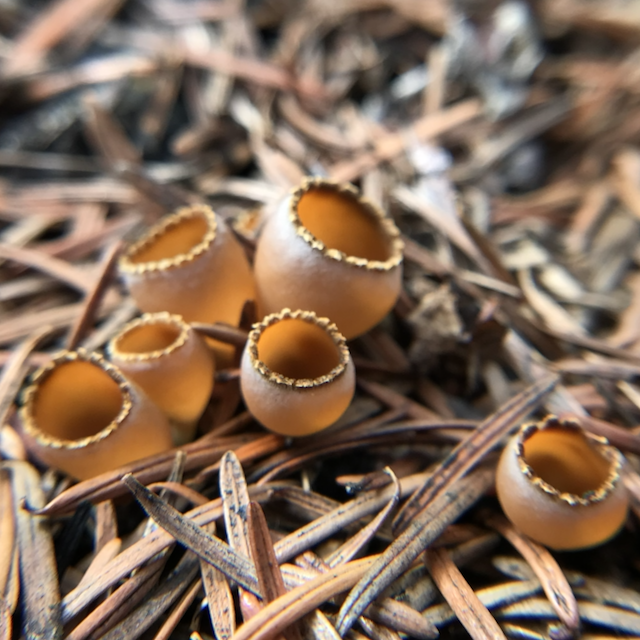
Cup fungi are ascomycetes — they produce spores in microscopic sacs (asci) that line the inner surface of the cup. The defining form is a bowl or disc, open-faced and oriented upward to launch spores into the air. Most are small and go unnoticed, but several PNW species reach impressive sizes and are hard to miss once you start looking.
These fungi are primarily saprobic, decomposing organic matter in soil, duff, and decayed wood. A few appear soon after snowmelt in mountain conifer forests. Others fruit through the wet season at lower elevations. None of the species covered here are choice edibles, but they’re worth knowing — they’re common, distinctive, and part of the spring and winter fungal landscape across Cascadia.
Explore Conifer Forests on Forayz
Most cup fungi fruit under conifers, especially true fir. Use ecoregion data and forest type layers to find conifer-dominated habitat near you. Environmental layers are free for all users.
Notable PNW Species
Pink Crown Cup — Sarcosphaera coronaria
One of the largest and most striking cup fungi in the PNW. Fruitbody 3–15 (20) cm across, starting as a buried sphere with a small opening at the top, then splitting into a star-like cup with ragged lobes. Inner surface smooth, whitish at first, becoming lilac to violet as it matures. Outer surface scurfy and whitish, often encrusted with soil debris. Found under conifers, especially true fir, often forming under the duff layer and not visible until fully open. Common and sometimes abundant east of the Cascades. Fruits in spring and early summer. Mildly toxic — do not eat.
Disc Fungus — Gyromitra ancilis
A broad, disc-like to shallowly cup-shaped ascomycete, 2–10 (15) cm across. Upper surface smooth to conspicuously wrinkled, tan to brown. Underside smooth or finely pubescent, often ribbed near the short, stout stem. Found on soil, duff, or well-decayed wood in conifer forests. Common on the east side of the Cascades, less frequent west. Fruits soon after snowmelt, often alongside morels and Sarcosphaera. Edible when thoroughly cooked, but easily confused with toxic Gyromitra species — careful identification is essential.
Thick Cup — Dissingia crassitunicata
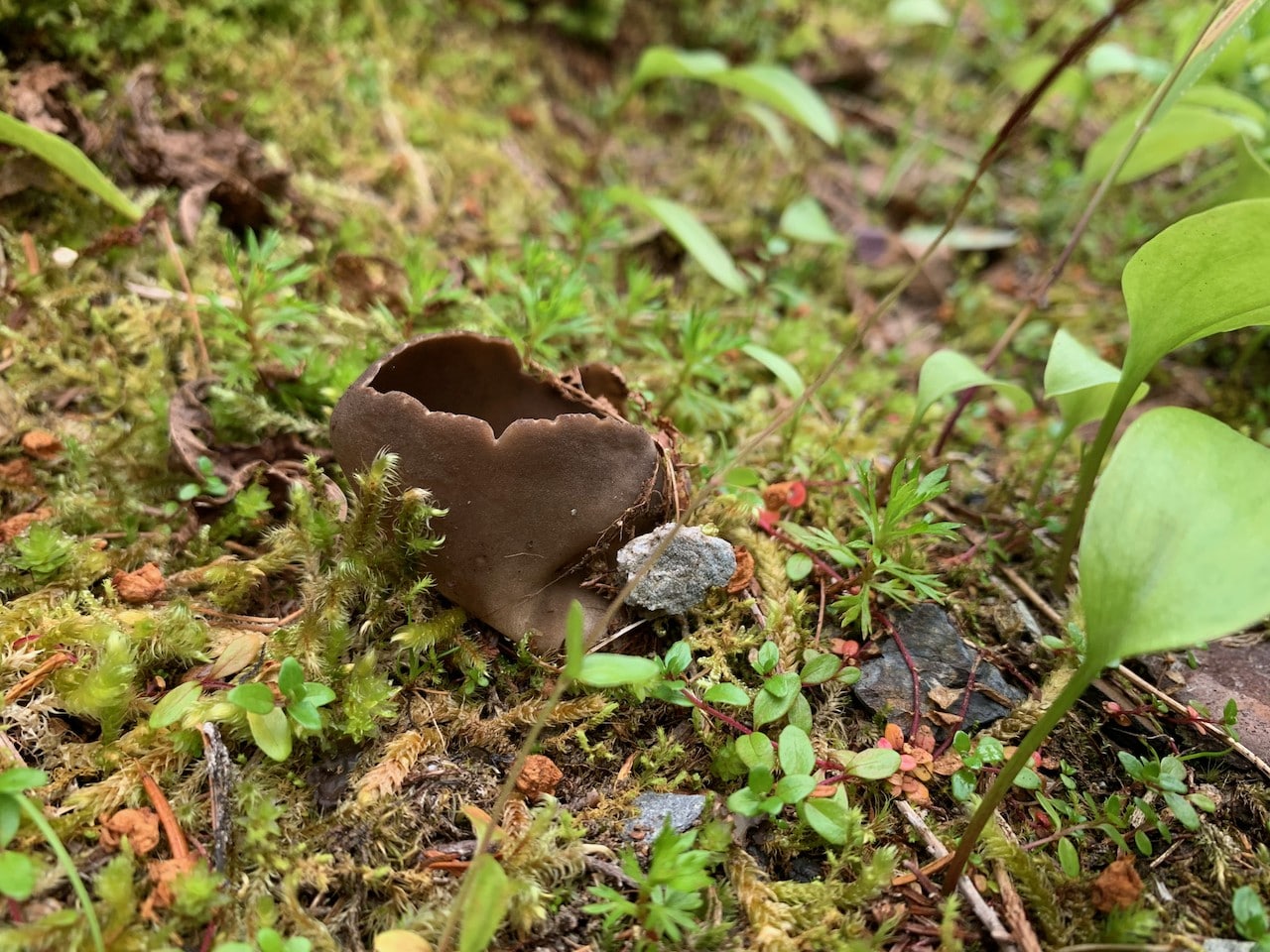
Cup-shaped to broadly bowl-shaped, 0.5–5 cm across, with ribs and veins running up the short stout stem but rarely extending onto the cup. Upper surface smooth, brown to dark brown. Outer surface pubescent to smooth, slightly paler. Found on soil, moss, and duff under conifers, especially true firs. Common and widespread east of the Cascades, rare to absent on the west side. Fruits in spring after snowmelt. Edibility unknown.
Black Cup — Pseudoplectania melaena
Shallowly cup-shaped at first, expanding to broadly cup-shaped or irregularly disc-shaped, 2–5 (8) cm across, with an undulating margin. Entirely black, inside and out. Outer surface sparsely hairy. Stem indistinct or up to 3 cm, black, fibrillose. Flesh thin and somewhat tough. Found on woody debris and surrounding duff. Common throughout much of western Cascadia. Fruits from midwinter into spring. Edibility unknown. Easy to identify by the combination of all-black coloring and cup shape.
Black Jelly Jug — Urnula padeniana
Cup-shaped with an incurved margin at first, expanding to broadly cup-shaped, 5–12 cm across. Dark gray to black, with a finely velvety, often wrinkled outer surface. Stem 2–8 cm, stout, tapered downward, often ribbed, black. The distinctive feature is the flesh: thick, rubbery, with a gelatinous core that is translucent gray when young. Found on buried woody debris or duff. Common and widespread. Fruits in winter and early spring at lower elevations, spring through early summer on the east side. Edibility unknown.
Large Brown Cup — Peziza varia
Irregularly cup-shaped, 3–12 cm across, soon flaring out and becoming ragged in age. Upper surface smooth, light ochre to brown. Flesh thin and fragile. Found clustered or occasionally solitary on rich soil, well-rotted woody debris, or wood chips. Widespread and common. Fruits throughout the wet season, most abundant in spring. Edibility unknown. Peziza is a large genus with many similar brown-cupped species — microscopy is often needed for confident species-level identification.
Spores in Sacs, Not on Clubs
Cup fungi are ascomycetes: their spores develop inside microscopic sacs called asci, which line the inner surface of the cup. When mature, the asci burst and release spores — sometimes visibly, in a faint puff. This is fundamentally different from gilled mushrooms and polypores (basidiomycetes), which produce spores on the outside of specialized cells. The distinction matters because it puts cup fungi in a completely different branch of the fungal tree.
Sarcosphaera Is Mildly Toxic
Sarcosphaera coronaria has been reported as mildly toxic and should not be eaten. Some older references list it as edible, but current consensus treats it as a species to avoid. If you find a large, star-shaped purple cup emerging from the duff under fir — admire it, photograph it, leave it.
Track Spring Conditions
Many cup fungi fruit soon after snowmelt. Use the soil temperature and 14-day precipitation layers on Forayz to track when conditions are right in mountain conifer forests. Environmental layers are free for all users.
Habitat & Season
Most PNW cup fungi are tied to conifer forests. Sarcosphaera, Gyromitra ancilis, and Dissingia are all spring fruiters associated with true fir and other conifers, most common east of the Cascades where they appear soon after snowmelt. Pseudoplectania and Urnula fruit earlier — midwinter into spring — and are more common in the wet forests of western Cascadia. Peziza is the generalist, appearing on disturbed soil, wood chips, and rich ground throughout the wet season. All are saprobic, decomposing dead organic matter in soil and wood.