
Lobster Mushroom Guide 2026 | Identification & Foraging
Lobster Mushroom Hypomyces lactifluorum — A Parasitic Fungus, Not a Species
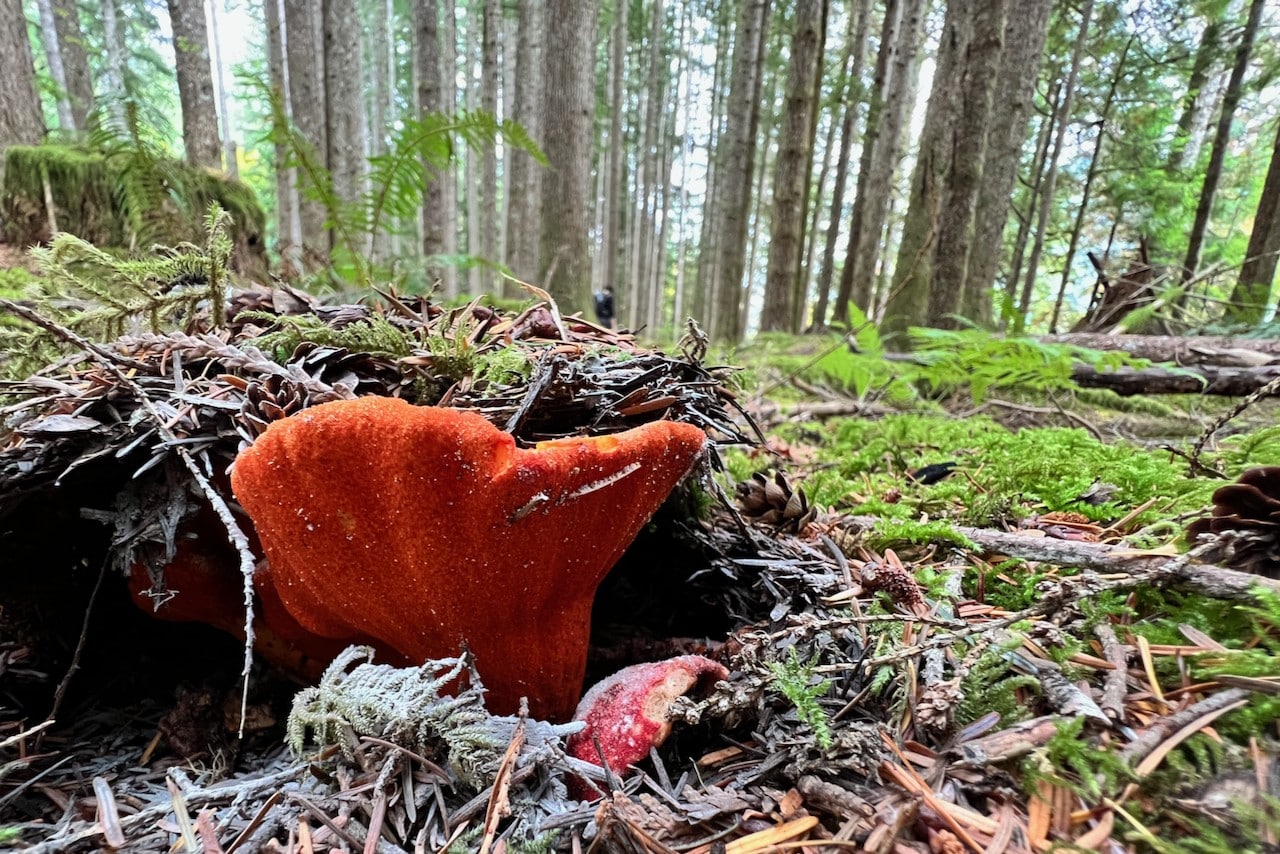
The lobster mushroom is one of the most striking finds in Pacific Northwest forests — and one of the most misunderstood. It is not a mushroom species at all. What you see when you pick up a “lobster” is the result of a parasitic ascomycete fungus, Hypomyces lactifluorum, that has colonized and completely transformed a host mushroom beyond recognition.
The hosts are typically Russula brevipes (short-stemmed russula) or Lactarius piperatus (peppery milkcap) — bland, unremarkable mushrooms on their own. The parasite encases the host in a hard, bright orange-red shell, obliterates the gills, and transforms the texture into something dense, firm, and genuinely excellent to eat. It is one of the few cases in mycology where a parasite improves the edibility of its host.
Track Lobster Mushroom Conditions
Use Forayz to monitor soil moisture, temperature, and precipitation in your local conifer forests. Environmental layers help you time your late-summer forays.
The Parasitic Relationship
Understanding what a lobster mushroom actually is matters for identification, safety, and knowing where to look. Here is the biology in plain terms.
Hypomyces lactifluorum is a parasitic ascomycete — a type of sac fungus that attacks other mushrooms. When it encounters a suitable host (almost always Russula or Lactarius), it colonizes the fruiting body completely. The transformation is dramatic:
- Exterior: The host’s surface is replaced by a hard, bumpy, bright orange-red coating — the Hypomyces itself
- Gills: Completely obliterated. Where the host once had gills, you’ll find a smooth or slightly ridged surface
- Shape: The host’s form is distorted, often becoming irregular and lumpy
- Texture: Dense and firm throughout, with crisp white flesh when sliced open
- Odor: Mild, pleasant, faintly seafood-like (hence the “lobster” name)
Why the Parasite Makes It Better
The most common hosts — Russula brevipes and Lactarius piperatus — are mediocre edibles at best. R. brevipes is bland and crumbly; L. piperatus is acrid and peppery. The parasitic transformation eliminates these undesirable qualities and replaces them with a firm texture and mild, nutty-seafood flavor. The parasite is doing the culinary work here.
Identification
A fully transformed lobster mushroom is one of the easiest wild mushrooms to identify. There is nothing else in the PNW forest that looks quite like it.
- Color: Bright orange to orange-red exterior, sometimes mottled with white patches where transformation is incomplete
- Interior: Pure white when sliced, firm and dense — like a block of cheese in texture
- Surface: Hard, slightly bumpy, sometimes with tiny pimple-like dots (the Hypomyces perithecia where spores are produced)
- Gills: Absent. The underside is smooth or has faint ridges — this is the single most important diagnostic feature
- Size: Large, typically 10–20 cm across. Often partially buried in duff
- Spore print: Not useful — you’re looking at the parasite’s surface, not a typical mushroom cap
Signs of a Good Specimen
Not all lobster mushrooms are worth collecting. Quality varies significantly:
- Harvest: Firm throughout, bright orange-red, white interior when sliced
- Leave: Soft or spongy texture, purple-red discoloration on the surface, off smells, interior turning yellow or pink
- Check for insects: Cut a cross-section in the field. Larvae tunnels are common in older specimens and will ruin the mushroom quickly
Season & Timing
Lobster mushrooms are a late-summer to fall species in the Pacific Northwest. They appear later than chanterelles and earlier than hedgehogs, filling a productive window in August and September.
| Month | Status in the PNW |
|---|---|
| July | Rare. Possible at lower elevations in wet years, but uncommon |
| August | Peak season begins. Best month in most of western Washington and Oregon |
| September | Still productive, especially at higher elevations and in the Cascades |
| October | Tail end. Late specimens possible, but quality drops as fall rains increase |
The key trigger is soil moisture after summer heat. Lobsters need enough moisture for the host mushroom to fruit, but they tend to appear during the warm-soil window before the heavy fall rains arrive. In practice, this means the first significant rains of late summer or early fall, when soil temperatures are still above 55°F (13°C).
Time Your Lobster Mushroom Hunts
Forayz shows real-time soil temperature and 14-day precipitation data for any location. Check conditions in your target conifer forests before heading out.
Habitat & Where to Find Them
Finding lobster mushrooms means finding their hosts. Since Russula brevipes and Lactarius species are mycorrhizal — forming root partnerships with conifers — you need to be in the right forest type.
- Douglas fir forests: The single most productive habitat in western Washington and Oregon. Look in mature second-growth stands with deep duff layers
- Western hemlock stands: Often mixed with Douglas fir, these provide excellent host habitat. Shaded, moist understories are ideal
- Spruce forests: Coastal Sitka spruce forests can be productive, especially in wetter microclimates
- Mixed conifer forests: Transition zones between forest types often concentrate mycorrhizal hosts
Within those forests, focus on specific microhabitats:
- Duff mounds: Lobsters are often partially or fully buried. Look for bumps in the needle litter and moss that seem out of place
- North-facing slopes: Retain moisture longer through the summer dry period
- Trail edges and old roads: The disturbed soil margins often host productive Russula patches
- Previous finds: Lobster mushrooms return to the same spots year after year. Mark productive locations and revisit them annually
The host mushrooms (Russula brevipes in particular) are extremely common in PNW conifer forests. If you’re finding short-stemmed white russulas, lobsters may be nearby — the parasite often colonizes multiple fruiting bodies in the same patch.
Lookalikes & Safety
A fresh, fully transformed lobster mushroom has no dangerous lookalikes. The combination of bright orange-red exterior, obliterated gills, and dense white interior is unique. However, there are a few things to be aware of.
The Host Identity Question
Since the parasite transforms the host beyond recognition, you cannot confirm which species was parasitized. The vast majority of PNW lobster mushrooms are former Russula brevipes or Lactarius piperatus — both edible. The theoretical concern is that a toxic Russula could serve as a host. In practice, reports of illness from properly identified, fresh lobster mushrooms are essentially nonexistent in the mycological literature. This is a widely consumed wild mushroom with a long safety record.
- Partially transformed specimens: If you can still see intact gills or the transformation is minimal (only light orange patches), pass. You want a fully colonized specimen where the Hypomyces has completely taken over
- Old specimens: Deteriorating lobsters turn purple-red, become soft, and develop off flavors. These can cause stomach upset. Only collect firm, bright-colored specimens
- Hypomyces on other hosts: Other Hypomyces species parasitize different mushrooms (boletes, Amanita). These produce different colors — green (H. luteovirens), white, or other shades. If it is not orange-red on a gill-less, distorted mushroom, it is not a lobster
For a broader overview of mushroom safety in the region, see our guide to poisonous mushrooms in the Pacific Northwest.
Cooking & Edibility
Lobster mushrooms are a choice edible — firm, flavorful, and versatile. The dense texture holds up to almost any cooking method, and the mild seafood-like flavor makes them one of the most approachable wild mushrooms for new foragers.
- Cleaning: Brush off dirt and debris with a stiff brush. The hard exterior handles water better than most mushrooms, so a quick rinse is fine. Slice in half to check for insect damage before committing to a prep
- Sauteing: The go-to method. Slice thick (6mm+) and cook in butter over medium-high heat. The dense flesh browns well and develops a rich, nutty flavor. Pairs well with garlic, shallots, and white wine
- Seafood substitution: The texture and subtle flavor make lobster mushrooms an excellent stand-in for shellfish in chowders, bisques, and risottos. This is where the common name earns its keep
- Drying: Excellent for preservation. Dried lobster mushroom powder adds color and umami to sauces, soups, and pasta. The orange-red color holds through drying and rehydration
- Raw: Do not eat raw. Always cook thoroughly
One practical note: the bright orange-red pigment will stain cutting boards, towels, and light-colored cookware. Use a dedicated cutting board or one you do not mind tinting orange.
Related Species & Learning More
If you are finding lobster mushrooms, your local forests support the mycorrhizal communities that produce many of the PNW’s best edible species. Here are some to learn alongside the lobster.
Other Species in Lobster Habitat
The conifer forests where lobster mushrooms fruit also host these important edible and mycorrhizal species. Learning the full community helps you read the forest and find productive ground.
- Chanterelles (Cantharellus spp.) — Mycorrhizal with Douglas fir and hemlock, overlapping habitat. Often fruit earlier in the same forests
- Matsutake (Tricholoma murrillianum) — Another mycorrhizal conifer associate. Sandy soils and lodgepole pine stands are prime habitat
- Russula brevipes — The primary lobster host. Large, white, short-stemmed. If you’re finding these un-parasitized, look harder — lobsters may be nearby
- Hedgehog mushrooms (Hydnum spp.) — Fruit slightly later in the same forests, extending the conifer-forest season into late fall
Quick Reference
| Feature | Detail |
|---|---|
| Scientific Name | Hypomyces lactifluorum (parasite) on Russula / Lactarius (hosts) |
| Type | Parasitic ascomycete — not a mushroom species itself |
| Edibility | Choice edible. Always cook thoroughly |
| Season | August–October (PNW) |
| Habitat | Conifer forests: Douglas fir, hemlock, spruce |
| Key ID Feature | Orange-red exterior, no gills, white interior, dense and firm |
| Lookalikes | None for fully transformed specimens |
| Spore Print | Not applicable (parasite surface) |