
Hericium Mushrooms Bear’s head, lion’s mane, and coral tooth fungi in the Pacific Northwest
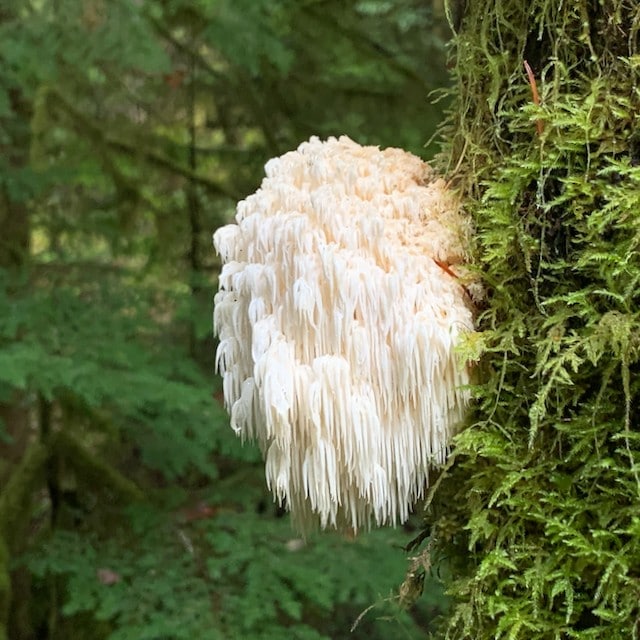
Hericium are tooth fungi — instead of gills or pores, they produce their spores on cascading, icicle-like teeth that hang from a fleshy base. They grow on dead and dying wood, and they’re among the most beginner-friendly edible mushrooms you can find. There are no dangerous look-alikes. If it’s white, growing on wood, and covered in soft teeth, it’s a Hericium.
Three species occur in the Pacific Northwest. Hericium abietis, the bear’s head tooth fungus, is by far the most common here. It grows on large-diameter dead conifers, especially hemlock and true fir, and is common through the Cascade Range and Olympic Mountains but rare at low elevations. The other two, lion’s mane and coral tooth, grow on hardwoods and are much less frequent finds.
Scout Hericium Habitat on Forayz
Use precipitation and soil moisture layers to track fall conditions in conifer forests. Check ecoregion data to find productive zones. Free with a Forayz account.
Identification
All Hericium share the same basic plan: a white to cream fleshy body with soft, hanging teeth. The differences between species come down to structure and substrate.
- Color: White to cream when fresh, yellowing to tan with age or after frost
- Teeth: Soft, hanging spines — short (about 0.5–1.5 cm) in H. abietis, long in lion’s mane
- Flesh: White, firm, does not change color when cut
- Spore print: White
- Substrate: Always on wood — dead standing trees, fallen logs, stumps, or living trees with heart rot
- Season: Fall
No dangerous look-alikes
No toxic mushroom in North America resembles a Hericium: the combination of soft teeth, white flesh and growth on wood is unique. Coral fungi (Ramaria and relatives) can look superficially similar, but they grow from the ground and their branches point upward, rather than hanging as spines. If you can confirm teeth (not gills, not pores) on wood, you have a Hericium; the only question is which species.
PNW Hericium Species
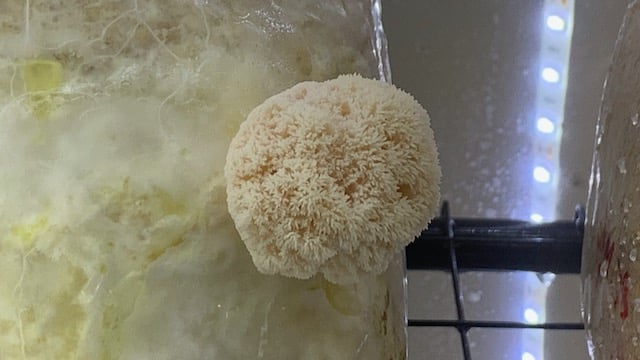
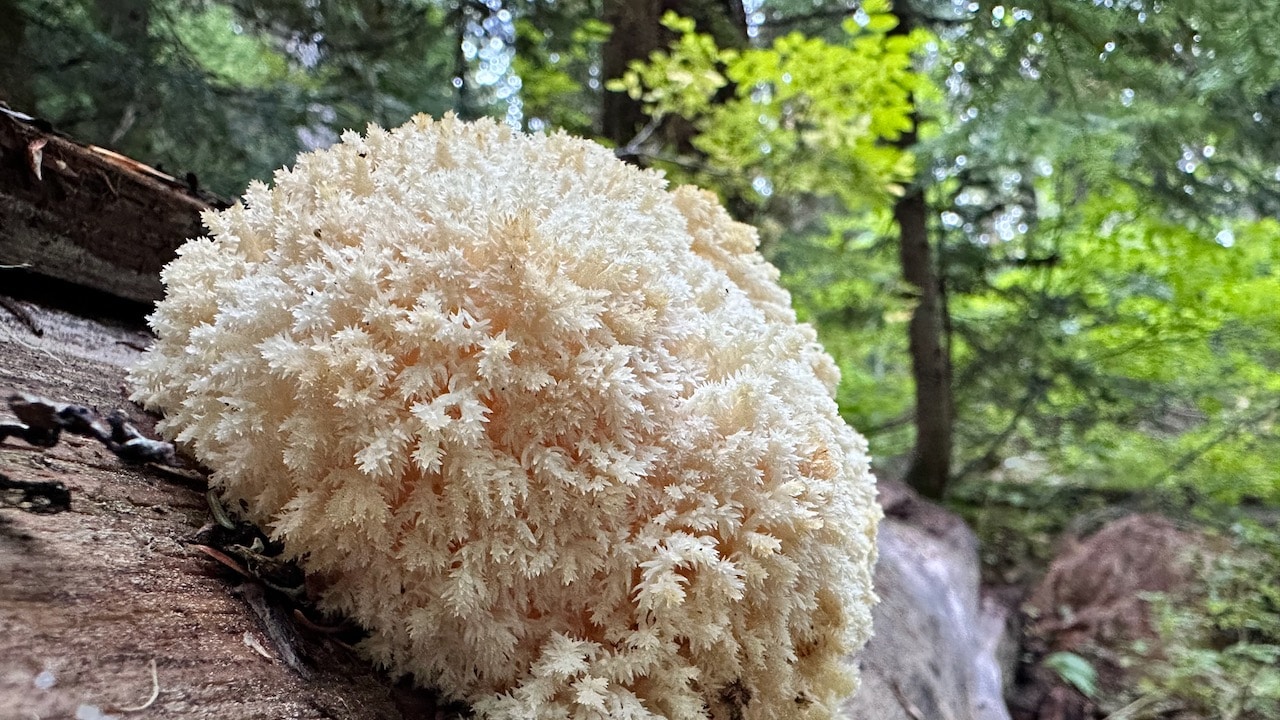
Three species occur in Washington, Oregon, and British Columbia. H. abietis accounts for the vast majority of PNW finds.
How to Tell Them Apart
In practice, separating the three species comes down to two things: structure and substrate.
| Species | Structure | Substrate |
|---|---|---|
| H. abietis | Branched, teeth hang from multiple branches | Dead conifers, especially hemlock and true fir |
| H. erinaceus | Single unbranched clump, long cascading teeth | Hardwoods (oak, maple, beech) |
| H. coralloides | Branched, spines spaced along the branches | Hardwood logs and stumps |
If you find a branched Hericium on a conifer in the PNW, it’s almost certainly H. abietis. If it’s on a hardwood, you’re looking at either H. erinaceus (unbranched, long teeth) or H. coralloides (branched, short teeth). That’s really all there is to it.
Where to Find Hericium
Hericium are saprotrophic — they decompose dead wood. Unlike chanterelles or matsutake, they don’t need living tree roots. They need dead or dying wood with enough moisture to sustain fruiting. Here’s what to look for:
- Standing dead conifers: The classic H. abietis substrate, especially large-diameter hemlock and true fir snags. Fruitings are often well above eye level, so look up.
- Fallen conifer logs: Large-diameter conifer logs.
- Higher-elevation old growth: H. abietis especially likes higher-elevation old-growth forest in the Cascade Range, and is rare at low elevations.
- Hardwood stands (less common): For H. erinaceus and H. coralloides, check oak woodlands and other hardwoods, including urban trees. Lion’s mane often fruits from wounds on living trees.
Look up
Many foragers walk past Hericium because they are scanning the ground. H. abietis frequently fruits high on standing dead conifers, well above eye level. A white clump partway up a snag is worth a second look.
Season & Timing
Hericium are fall mushrooms in the PNW. They need sustained moisture and cool temperatures to fruit. Here’s a general timeline for western Washington and Oregon:
| Window | Where to Look | What to Expect |
|---|---|---|
| Aug–Early Oct | Conifer snags and logs, mainly at elevation | First Hericium of the season if early rains arrive. Scattered finds. |
| October | Western Cascades, Coast Range, Olympic Peninsula | Main season begins. H. abietis on conifer snags and logs. |
| November | Low to mid elevations throughout western WA/OR | Still fruiting in the mountains before hard freezes |
| December | Low elevations, sheltered sites | Late finds possible before hard frost. Quality declines — check for yellowing or softness. |
Hericium fruit on the same logs and snags year after year, so a productive spot is worth marking. The mycelium persists in the wood for multiple seasons until the substrate is fully decomposed.
Track Fall Conditions for Hericium
Check rainfall and soil moisture to time your hunts, free with a Forayz account. Pro adds the newest burn years and tree species maps.
Cooking & Edibility
All three Hericium are excellent edibles with a mild, slightly sweet flavor and a stringy, meaty texture often compared to crab. Lion’s mane is the toughest of the three and can turn sour with age; a significant gastrointestinal reaction to it has also been reported (Benjamin), so eat a modest portion the first time.
- Tear, don’t slice: Pull Hericium apart along the grain into bite-sized pieces rather than cutting. This gives better texture and more surface area for browning.
- Sear hard: Cook in butter or oil over medium-high heat until the edges are deeply golden. Hericium holds a lot of water — let it cook off before adding anything else. Under-cooked Hericium is spongy and disappointing.
- Crab cake substitute: The classic preparation. Season torn, seared Hericium with Old Bay, bind with egg and breadcrumbs, and pan-fry into cakes. The texture is remarkably close to crab.
- Simple sauté: Butter, garlic, salt, finish with lemon. Lets the natural flavor come through.
- Drying: Hericium dry well and rehydrate with good texture. Slice or tear into thin pieces before dehydrating.
Medicinal Interest
Hericium erinaceus (lion’s mane) has attracted significant research attention for potential neurological benefits. A few things to know:
- Research focus: Compounds called hericenones and erinacines may stimulate nerve growth factor (NGF) production. Most studies are in vitro or in animal models — human clinical data is still limited.
- Supplements vs. wild mushrooms: Most lion’s mane supplements use cultivated mycelium or fruiting bodies, not wild-harvested material. If you’re interested in the medicinal angle, cultivated lion’s mane is widely available and doesn’t require finding the uncommon wild form.
- All Hericium species: While H. erinaceus gets the attention, preliminary research suggests other Hericium species contain similar bioactive compounds. The science is still early.
Cultivation
Lion’s mane is one of the easiest gourmet mushrooms to grow at home. Pre-made fruiting blocks are available from multiple PNW suppliers. If you want a reliable supply for cooking or medicinal use, growing your own is far more practical than hunting for the uncommon wild form in our region.
Harvesting Tips
- Cut at the base. Use a knife to cut the fruiting body where it meets the wood. This leaves the mycelium intact for future fruitings from the same spot.
- Check for bugs. Hericium are popular with insects. Tear open a small piece before committing to the harvest — if the interior is riddled with larvae tunnels, it’s not worth taking.
- Harvest young. Fresh Hericium is white and firm. As it ages, it yellows and becomes sour-tasting. Once it’s significantly yellow or brown, leave it.
- Paper bags, not plastic. Hericium holds a lot of moisture. Plastic bags trap humidity and accelerate spoilage. Use paper bags or a basket.
- High specimens: For bear’s head growing out of reach on standing snags, a long stick or extendable pole saw can work. Don’t climb dead trees.
Learn More
Sources: Mushrooms of Cascadia (Siegel & Schwarz, 2024); MycoMatch (© Ian Gibson), a compilation of published descriptions through which most other field-guide authors named here are quoted.