
Dusky Bolete Porphyrellus porphyrosporus — the dark, velvety bolete of coastal forests
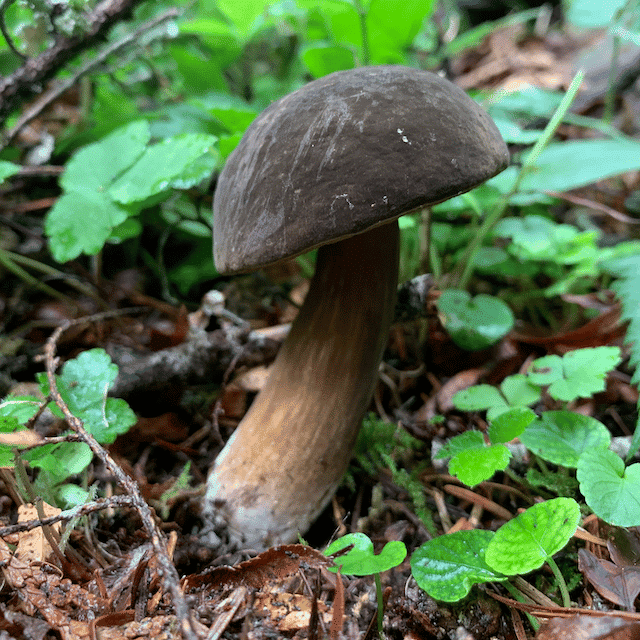
The dusky bolete is a dark bolete of Pacific Northwest conifer forests, common in coastal forest, especially with Sitka spruce, and rare elsewhere. Almost every part of it is dark: a dry, velvety cap in grayish black to deep wine-brown or gray-brown, dark reddish-brown pores, and a dark stem, set off by white flesh that stains blue and then reddish when cut.
It is reportedly edible, but there is little local experience eating it (Siegel & Schwarz, Mushrooms of Cascadia), and whether the western mushroom is really the European P. porphyrosporus is still an open question.
Scout Fall Conditions on Forayz
Use rainfall, soil moisture, and soil temperature layers to see when fall mushroom season is starting in the coastal forests near you.
Identification
| Feature | Description |
|---|---|
| Cap | 5–15 cm across (occasionally 18), rounded at first, flattening with age. Dry and finely velvety, like suede. Grayish black to dark wine-brown when young, fading to gray-brown or dark gray. Often attacked by a white mold (Hypomyces) that starts as a pale bloom on the cap. |
| Pores | Small and angular at first, larger and irregular later. Deep reddish brown to almost black when young, fading to gray-brown. Bruise dull greenish blue to blue-black, then maroon-brown (sometimes skipping the blue). |
| Stem | 6–15 cm long, often swollen low down and narrowing at the very base. Dark gray-black to reddish or gray-brown with a whitish base, sometimes with a net pattern near the top; often turns reddish when scraped. |
| Flesh | Thick and firm; white, contrasting with the dark surfaces. Often stains blue in the cap, then reddish brown; the stem flesh may redden. |
| Spore print | Reddish brown. |
| Odor & taste | Not distinctive. |
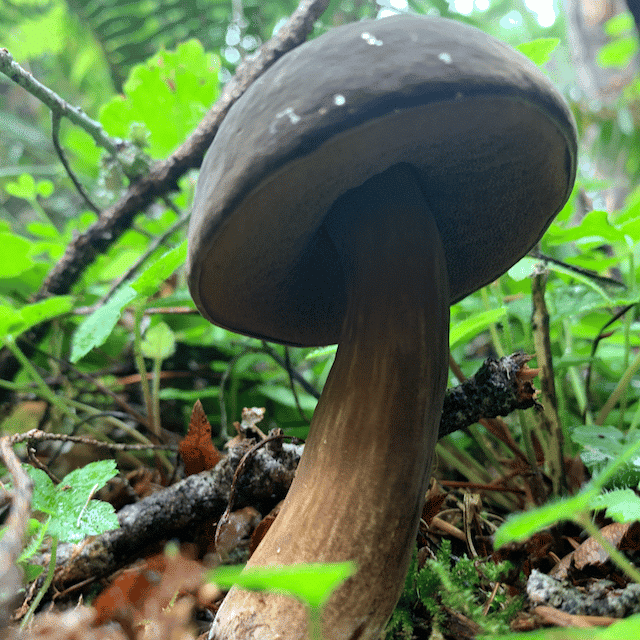
Dark all over, white inside
The dark colors alone set the dusky bolete apart from most PNW boletes: a velvety grayish-black to wine-brown cap, dark pores, and a dark stem. Cut it open to confirm — the white flesh turns blue and then reddish brown.
Similar Species
- Deep purple bolete (Xerocomellus atropurpureus): Also dark-capped, but the pores are pale to greenish yellow and the stem is red or red-dotted over yellow.
- Admirable bolete (Aureoboletus mirabilis): A plush, maroon-brown cap too, but with yellow pores that don’t stain blue, a long club-shaped stem, and growth on rotting logs. See the admirable bolete guide.
- Fib king (Boletus fibrillosus): Dark brown cap, but white pores when young and flesh that doesn’t stain. See the king bolete guide.
Which Species Is It?
The name Porphyrellus porphyrosporus comes from Europe, and it isn’t yet settled whether the western North American mushroom is the same species. If it turns out to be distinct, P. olivaceobrunneus, described from Oregon, would be the name for ours (Siegel & Schwarz). Older guides also use Tylopilus porphyrosporus, T. pseudoscaber, and T. pacificus (described from Washington) for this or closely related mushrooms (MycoMatch).
Habitat & Season
The dusky bolete grows alone or scattered in troops on the ground, in moss or duff, and occasionally on rotting logs and stumps, in conifer forest. It is common in coastal forests, especially with Sitka spruce, and rare elsewhere. It fruits from late summer into early winter, which matches iNaturalist records from Oregon and Washington:
Based on 246 research-grade iNaturalist observations from Oregon and Washington
Edibility
Reportedly edible, but there is little local experience eating it (Siegel & Schwarz), and Bessette lists its edibility as unknown. Don’t eat specimens covered in white Hypomyces mold.
Find Coastal Spruce Forest on Forayz
Use ecoregion and public land layers to find coastal conifer forest near you, and check recent rainfall before you go.
Sources: Mushrooms of Cascadia (Siegel & Schwarz, 2024); MycoMatch (© Ian Gibson), a compilation of published descriptions through which most other field-guide authors named here are quoted; iNaturalist observations.