
Pacific Madrone Arbutus menziesii
Pacific madrone is a broadleaf evergreen tree with smooth, reddish-orange bark, shiny green leaves, and colorful berries (USFS Silvics of North America). Madrone forms arbutoid mycorrhizae, a variant of ectomycorrhiza, and shares fungal partners with Douglas-fir (Molina & Trappe 1982). That makes madrone-conifer stands worth checking, though the best-documented madrone associates, such as the fall coccora (Amanita calyptroderma), are mostly southern Oregon and California records.
Madrone is found most often on south- and west-facing slopes (Silvics). After fire, trees die back to the root crown but are rarely killed, and fast-growing sprouts take over where fire has damaged competing conifers (Silvics).
Pacific madrone ranges from the east coast of Vancouver Island and the adjacent British Columbia mainland south to near San Diego, and it grows on the western slopes of the Coast Ranges in Washington, Oregon, and California (Silvics). In these areas, madrone often grows in mixed stands with Douglas-fir and Oregon white oak.
Madrone canker (Fusicoccum aesculi) is a major cause of dieback, and Phytophthora cactorum causes a serious basal canker (Silvics). The tree is also important to Coast Salish and other Indigenous peoples of the Pacific Northwest, who have long used its berries, bark, and wood.
Associated Mushrooms
Pacific madrone is an arbutoid-mycorrhizal host that shares fungi with Douglas-fir. Several species below are recorded with madrone mainly in southern Oregon and California, so in the Pacific Northwest they may be tied as much to the conifers or oaks beside it.
Coccora
Amanita calyptroderma
The fall coccora. In the Pacific Northwest it grows with Douglas-fir, and more commonly with madrone and other hardwoods in southern Oregon and California (Lindgren). It is uncommon or absent in Washington outside the Columbia River Gorge (Siegel & Schwarz, Mushrooms of Cascadia). Because it is an Amanita — the genus that also contains the deadly destroying angels — only eat it if you can identify it with complete confidence.
Mycorrhizal Edible with Caution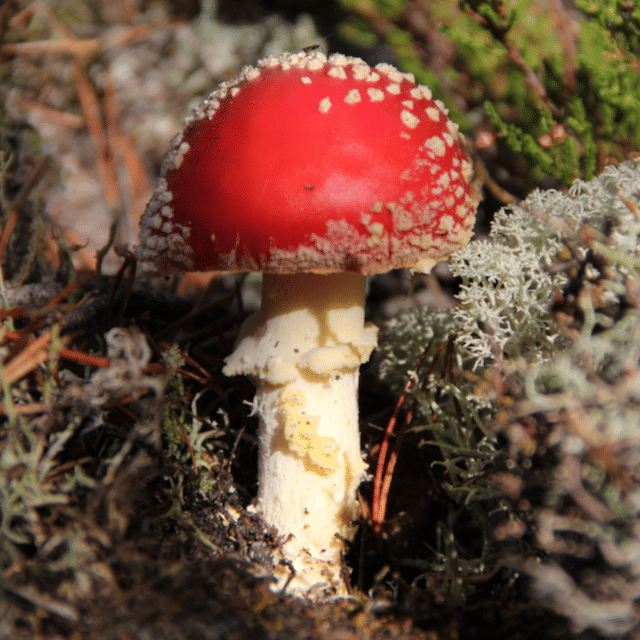
Fly Agaric
Amanita muscaria
The red-and-white toadstool associates with almost any ectomycorrhizal plant, including madrone (Lincoff, for California). Toxic if eaten without special preparation.
MycorrhizalFind Madrone Forests on Forayz
Layer forest types, soil conditions, and precipitation data to locate productive madrone-conifer foraging zones in western Oregon. Free environmental layers included.
Also on iOS: ForayzU
Practice identifying Pacific Northwest trees and mushrooms with spaced-repetition flashcards — including a dedicated tree identification deck.
Distribution in Washington & Oregon
Photos: Pacific madrone bark peeling to reveal smooth red-orange wood underneath — Erin Springinotic (CC0) · Coccora — Alex Heyman (CC0) · White Chanterelle — Christopher (CC0).
Sources: Mushrooms of Cascadia (Siegel & Schwarz, 2024); MycoMatch (© Ian Gibson), a compilation of published descriptions through which most other field-guide authors named here are quoted.