
Poisonous Mushrooms Identifying dangerous species in the Pacific Northwest and what to do if someone eats one

Most mushrooms won’t kill you. Of the thousands of species in the Pacific Northwest, only a handful contain toxins capable of causing serious organ damage or death. But those few species are responsible for nearly all fatal mushroom poisonings worldwide — and they grow right here in Western Washington and Oregon.
This page covers two things: which PNW mushrooms are genuinely dangerous, and exactly what to do if you suspect someone has eaten one. Knowing both could save a life.
Foraging in Oregon? See the Oregon edition of this guide — the same species, with the Oregon Poison Center and where death caps are now established around Portland, Eugene, Salem, and Corvallis.
If Someone Ate a Poisonous Mushroom
Time is critical. Amatoxin poisoning symptoms are typically delayed 6–24 hours, sometimes longer (NAMA). Don’t wait for symptoms to appear.
- Save a specimen. Collect a complete mushroom including the base (dig it up — the volva may be underground). Take clear photos of the top, gills, stem, and base. If no whole mushroom is available, save any leftover pieces.
- Call Poison Control immediately. 1-800-222-1222 (US) or visit poison.org. For pets, call your vet or the ASPCA Animal Poison Control.
- Get an ID. Post clear photos to Mushroom Poisoning Identification on Facebook — toxicologists and experienced identifiers monitor this group. For PNW-specific help: PNW Mushroom ID.
- Go to the ER if you suspect amatoxin-containing species (death cap, destroying angel, or deadly Lepiota). Early treatment dramatically improves outcomes.
Learn Mushrooms with Confidence
Forayz courses and field guides help you build real identification skills — not just memorizing names, but understanding the features that matter for safety.
Know the Dangerous Look-Alikes
The ForayzU Morels & Look-alikes deck drills the exact features that separate prized edibles from toxic mimics like false morels (Gyromitra) — photo flashcards that build real recognition, free to download.
Amatoxin-Containing Mushrooms: The Deadly Ones
Amatoxins cause delayed liver and kidney failure. These are the species responsible for nearly all mushroom fatalities. They share a key trait: symptoms usually don’t appear for 6–24 hours after eating (NAMA; Siegel & Schwarz, Mushrooms of Cascadia), by which time significant organ damage may have already begun.
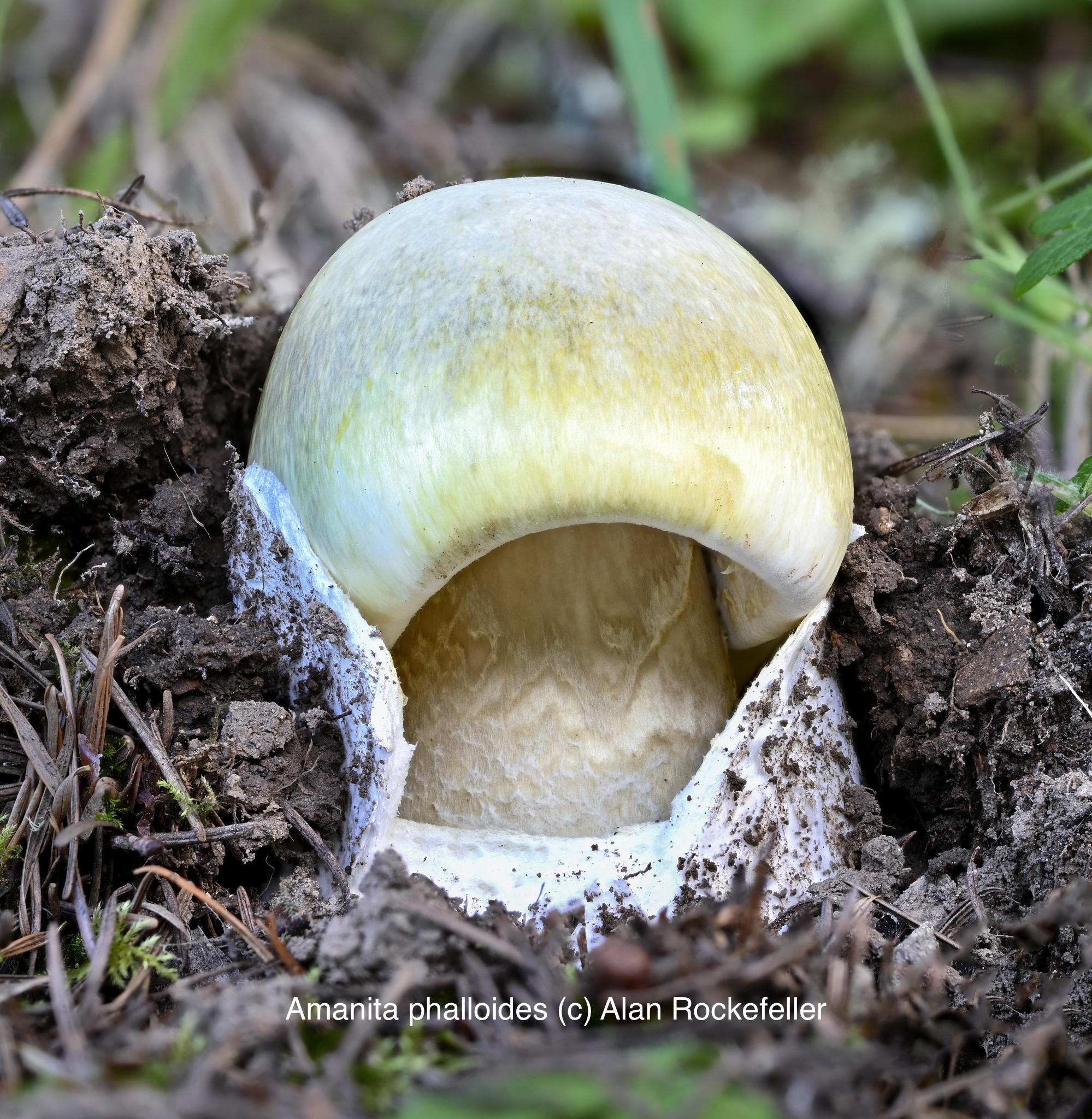

Death Cap
Amanita phalloides
Responsible for more mushroom deaths worldwide than any other species. Now established in the Pacific Northwest, especially in urban areas under planted European hardwoods such as linden, oak, chestnut and beech (Siegel & Schwarz).
- Greenish-yellow to olive cap (can appear pale or white)
- White, free gills (not attached to stem)
- Bulbous base with a cup-like sac (volva) — often buried underground
- White ring (annulus) on the upper stem
- No distinctive smell when fresh
Destroying Angel
Amanita ocreata group
Photos: Alan Rockefeller / iNaturalist / CC BY; Thomas Laxton / iNaturalist / CC BY-SA (California)
White to pale pinkish or yellowish, and easily mistaken for edible species like meadow mushrooms or puffballs by beginners. True A. ocreata turns up far more often south of here, in California, than in the Pacific Northwest; most local white destroying-angel-type Amanita are an unresolved species complex more closely related to the death cap than to true A. ocreata (Siegel & Schwarz, Mushrooms of Cascadia; D. Miller, Danny’s DNA Discoveries).
- White cap, gills, stem, and base, sometimes with pale pinkish or yellowish tints
- Free gills (not attached to stem)
- Bulbous base with volva sac
- Ring on upper stem (may disappear with age)
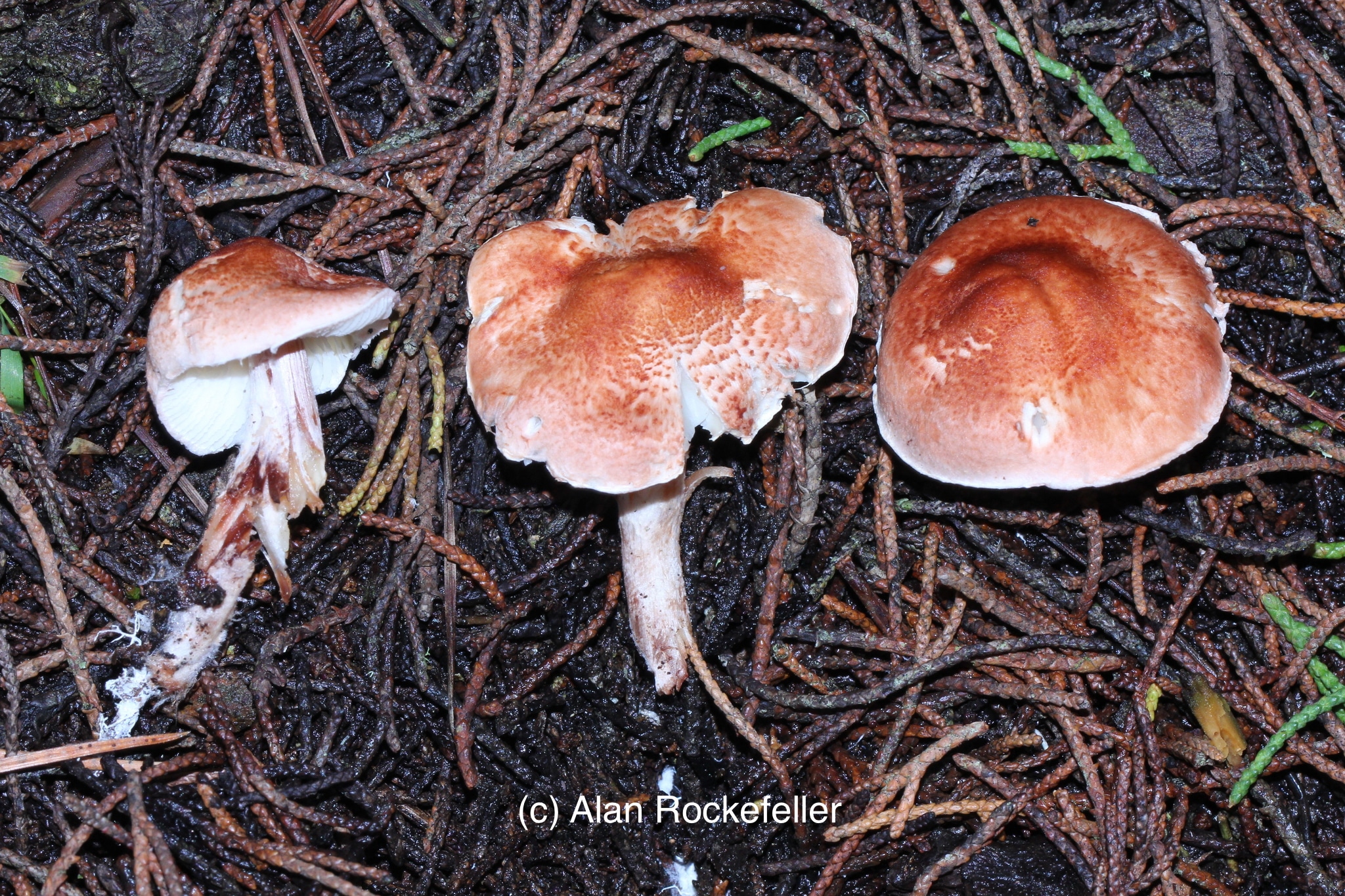
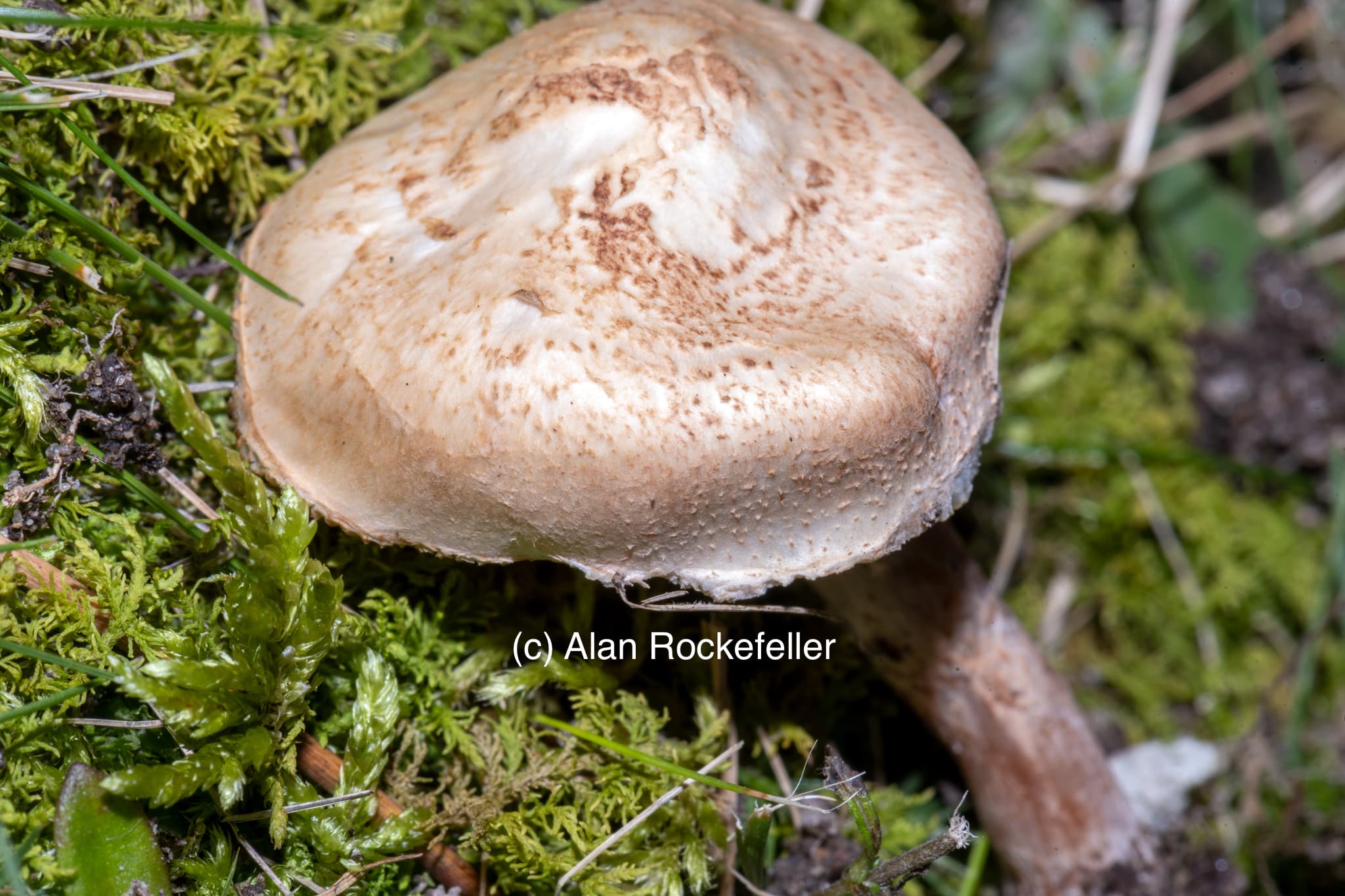
Deadly Lepiota
Lepiota subincarnata (=L. josserandii)
A small, easily overlooked mushroom that contains lethal doses of amatoxins. Found in wood chips, lawns, and disturbed urban soil, and occasionally in mossy duff under conifers (Siegel & Schwarz) — places where people might casually pick mushrooms.
- Small (cap 1.5–6 cm) with a pinkish to pinkish-brown, scaly cap
- White, free gills
- No true ring — just a faint, cobwebby zone on the stem that soon disappears
- Grows in wood chips, lawns, and other disturbed, nutrient-rich ground
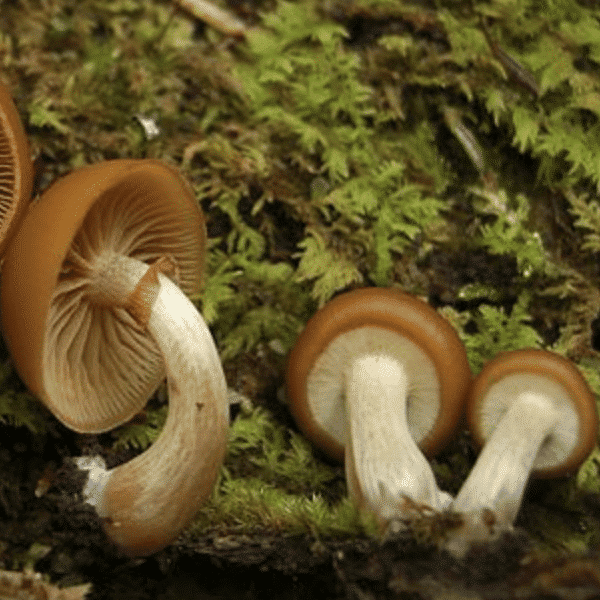
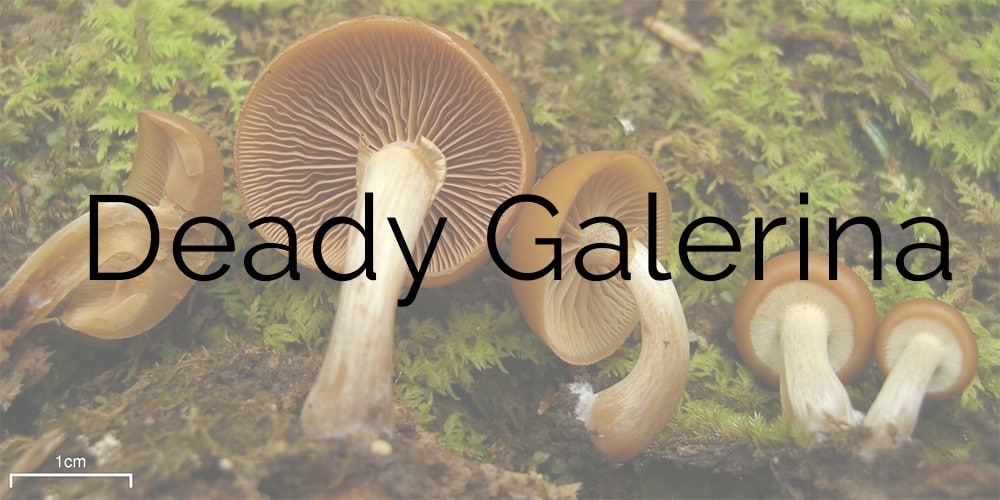
Deadly Galerina
Galerina marginata
A small brown mushroom that grows on decaying wood — sometimes mistaken for edible species or psychoactive Psilocybe. Common and widespread, fruiting mainly late summer through fall and occasionally into winter (Siegel & Schwarz).
- Small brown cap, usually under 2 cm but occasionally much larger, smooth and slightly sticky when wet
- Brownish gills, attached to stem
- Ring on stem (may be faint or disappear)
- Grows on rotting wood (logs, stumps, buried wood)
- Can fruit alongside edible species on the same log
The Amatoxin Pattern
Notice what these species share: they’re all small to medium, “normal looking” gilled mushrooms — no bright colors, no obvious warning signs. That similarity is exactly what makes them dangerous, but there’s no single visual shortcut that catches all of them. Only the two Amanita species have a volva (sac) at the base; Lepiota and Galerina don’t, and the Lepiota’s stem doesn’t even have a true ring. Amatoxins also occur in Pholiotina rugosa, a small brown mushroom common in wood chips, garden beds, and potted plants throughout the region (Siegel & Schwarz) — treat any unidentified small brown mushroom in a garden bed with the same caution as these four.
Other Toxic Mushrooms in the PNW
The amatoxin species above are the most dangerous, but other PNW mushrooms can cause significant illness:
- Panther Cap (Amanita pantherina) — Contains ibotenic acid and muscimol, and is a frequent cause of reported PNW poisonings (MycoMatch). Within about four hours causes nausea, confusion, and clumsiness, sometimes progressing to deep sleep, altered perception, or muscle twitching; coma can occur but deaths are rare (Benjamin). Brown cap with white, removable warts, white gills, and a bulbous base with a distinct rim.
- Smith’s Amanita (Amanita smithiana) — Causes kidney failure. Large, white, and found under conifers, mostly at mid-to-higher Cascade elevations. Has been mistaken for matsutake by foragers.
- Angel Wings (Pleurocybella porrigens) — White shelf fungus on decaying conifer logs, especially western hemlock. A 2004 outbreak in Japan linked acute encephalopathy (17 deaths) to this species or a very close relative, nearly all in people with chronic kidney disease; our local population hasn’t been tied to poisonings but is best avoided (Siegel & Schwarz).
- Jack O’Lantern (Omphalotus olivascens) — Bioluminescent orange shelf fungus sometimes confused with chanterelles, causing severe GI distress but not organ damage. Mainly a California species that only occasionally reaches southern Oregon (D. Miller, Danny’s DNA Discoveries) — not an established Washington hazard.
- Deadly Webcap (Cortinarius rubellus) — Contains orellanine; symptoms can take one to two weeks to appear, by which time kidney damage may already be irreversible. Grows in PNW conifer forests. Cortinarius is a large, hard-to-key genus — we don’t recommend eating any species in it.
- Muscarine-Containing Species (Clitocybe rivulosa, also called Collybia rivulosa; many Inocybe species) — A different, fast-acting syndrome: sweating, tearing, salivation, and GI distress within 15–30 minutes (NAMA). Rarely fatal, but get medical help promptly. C. rivulosa is common in PNW lawns and pastures, sometimes growing alongside the edible fairy ring mushroom.
- Green-Spored Parasol (Chlorophyllum molybdites) — Blamed for more reported mushroom poisonings than any other species in the US, though the reaction is severe vomiting and diarrhea, not organ damage. Grows in rings on lawns; still uncommon in Cascadia but has been expanding north with a warming climate (Siegel & Schwarz).
- False Morels (Gyromitra esculenta) — Contains gyromitrin, which the body converts to a toxic hydrazine compound; can cause liver failure. In the Pacific Northwest this name covers a small species complex (Siegel & Schwarz) — treat all of them as toxic. Brain-like, wrinkled cap, not honeycomb-pitted like a true morel. Full ID and look-alikes: Gyromitra guide.
Edible Mushroom Reactions
Even well-known edible species can cause reactions in some people. Morels must be thoroughly cooked — raw or undercooked morels can cause GI upset. Some people report reactions when eating morels with alcohol, though the evidence is mixed. Chicken of the woods — both PNW species — can cause GI upset or allergic reactions in some people even when properly cooked. When trying any wild mushroom for the first time, cook a small amount, eat it, and wait 24 hours before a full meal.
Build Your Identification Skills
Our in-person mushroom classes and guided forays teach safe identification in the field — including how to recognize and avoid the dangerous species on this page.
Know Where You’re Foraging
Forayz shows ecoregion data, public land boundaries, and habitat information to help you understand what species to expect in your area.
How to Avoid Poisonous Mushrooms
There are no shortcuts or folk tests that reliably separate edible from poisonous species. Silver spoons, peeling the cap, and animal behavior are all myths. What actually works:
- Learn specific species, not general rules. Know the exact features of each species you plan to eat. Don’t eat anything based on “it looks like” a photo.
- Always check the base. Dig up the entire mushroom. The volva (sac) at the base of deadly Amanita is the single most important safety feature to look for — and it’s often hidden underground.
- Take a class. In-person instruction from an experienced mycologist is the fastest way to build safe identification skills. Salish Mushrooms classes cover dangerous lookalikes alongside edible species.
- Start with distinctive species. Chanterelles, hedgehogs, oyster mushrooms, and chicken of the woods have few dangerous lookalikes compared to “little brown mushrooms” or white-gilled ground mushrooms.
- When in doubt, don’t eat it. No mushroom meal is worth the risk. If you can’t confidently identify a mushroom to species, leave it.
Learn the Look-Alikes with an Expert
The safest way to start foraging is alongside someone who already knows the dangerous mimics. Our last evening intro class of the fall is in Bellevue, and small-group guided tours run in the Cascades through November.
Resources
- Poison Control (poison.org) Call 1-800-222-1222 for immediate poisoning guidance — 24/7
- Mushroom Poisoning Identification (Facebook) Emergency ID group monitored by toxicologists and experienced identifiers
- PNW Mushroom ID (Facebook) Pacific Northwest regional identification help
- NAMA: Mushroom Poisoning in Dogs and Cats North American Mycological Association guide for pet owners
- Bay Area Mycological Society: Amatoxins Detailed overview of amatoxin chemistry and treatment
- NAMA Poisoning Reports Summary (2018–2020) Data on mushroom poisoning incidents across North America
Sources: Mushrooms of Cascadia (Siegel & Schwarz, 2024); MycoMatch (© Ian Gibson), a compilation of published descriptions through which most other field-guide authors named here are quoted; Danny’s DNA Discoveries and the PNW Pictorial Key (© Danny Miller).