
Hedgehog Mushrooms Hydnum spp. — Identification, Season & Foraging in the PNW
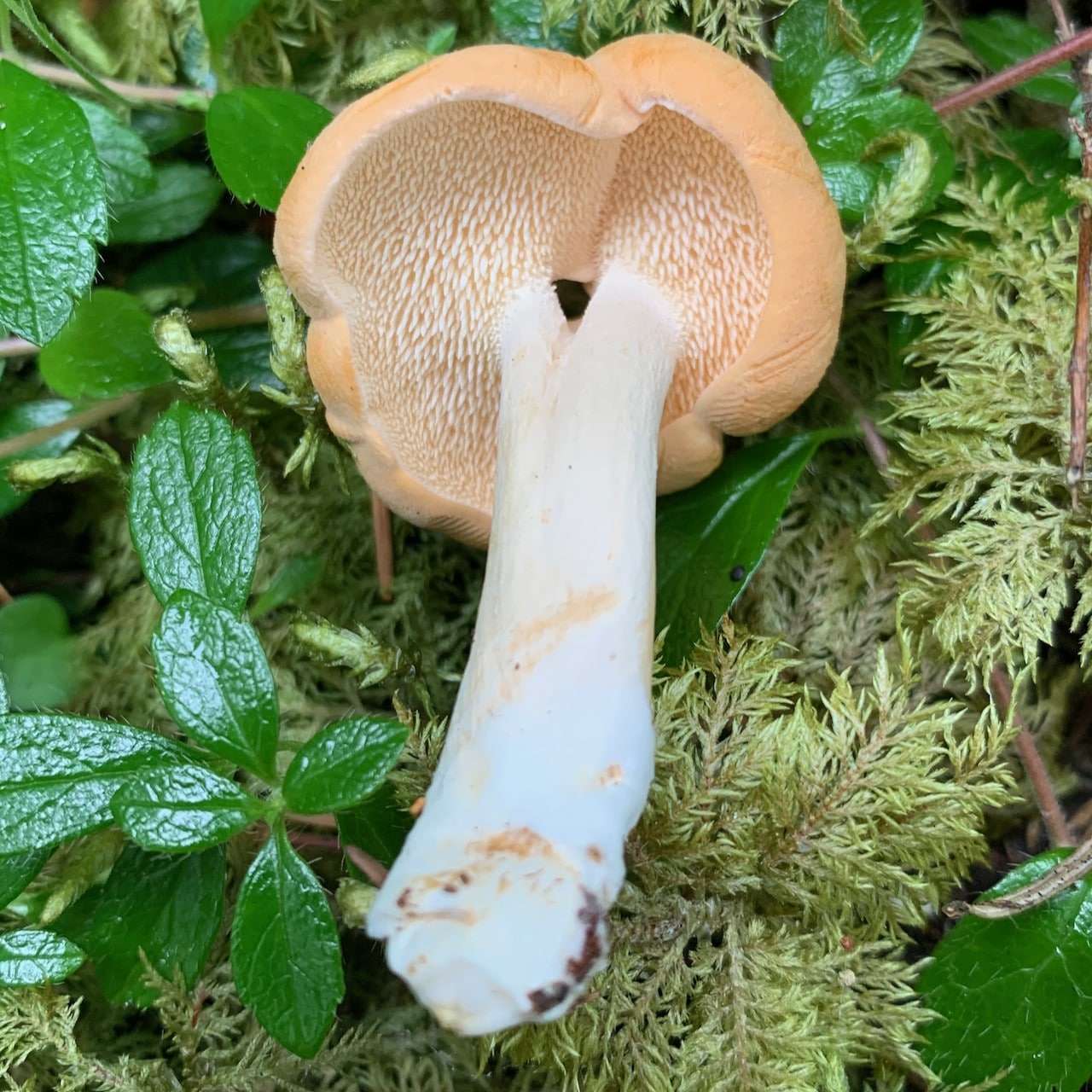
Hedgehog mushrooms are one of the best species for beginning foragers in the Pacific Northwest. Flip one over and the identification is obvious: instead of gills or pores, the underside of the cap is covered in small, tooth-like spines that brush off easily with a fingertip. No other edible mushroom in our region looks like this, and nothing dangerous shares the feature.
In the PNW, hedgehogs appear from late summer or early fall through winter, and on the coast can keep going into spring in wet years. They often share forests with chanterelles. They’re mycorrhizal with a range of conifers — especially spruce and pine for the large hedgehogs, and hemlock for the small bellybutton hedgehogs. The flavor is mild and sweet, the texture firm. Note: the European Hydnum repandum does not occur in North America — PNW hedgehogs belong to several closely related species described below.
Find Hedgehog Habitat on Forayz
Check soil moisture, temperature, and precipitation data to find productive conifer forests near you. Free with a Forayz account.
Identification
- Cap: 4–12 cm (up to 20) in the large hedgehogs, 2–6 cm in bellybutton hedgehogs; convex to irregularly wavy; cream to pale orange-tan, sometimes with darker spots where bruised
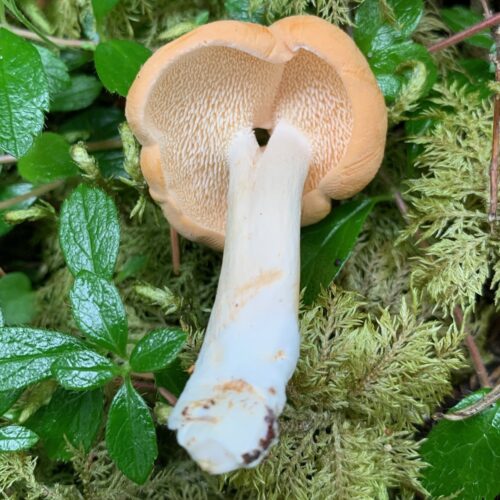
- Underside: Dense layer of soft, downward-pointing spines (teeth) instead of gills. Cream to pale orange. The teeth detach easily when rubbed — this is the defining feature of the genus.
- Stipe: 3–8 cm tall, stout and often off-center; same color as cap or slightly paler; solid and firm
- Flesh: Creamy white, thick and firm, slightly brittle in the cap. Stains slowly orangish.
- Spore Print: White to cream
- Odor: Indistinct to fruity
- Taste: Mild to sweet. Some collections taste acrid or peppery raw; this disappears with cooking.
The Beginner-Friendly ID
Hedgehog mushrooms are widely recommended as a first wild mushroom for new foragers. The teeth on the underside are unique among edible species in the PNW — no gilled or pored mushroom will have them. If it has teeth, grows from the ground (not wood), and is pale cream to orange, you have a hedgehog.
PNW Hedgehog Species
Molecular work by Niskanen et al. (2018) showed that Hydnum repandum in the strict sense is exclusive to Europe. The hedgehogs in Pacific Northwest forests belong to several closely related species, and there are still undescribed ones here. Telling them apart past species complexes usually takes a DNA sequence. For foraging purposes, all PNW Hydnum are good edibles.
Species You’ll Find
All of the species below are good edibles, and are interchangeable in the kitchen.
Washington Hedgehog
Hydnum washingtonianum
The large, common hedgehog: cap 4–12 cm (up to 20), pale peachy orange to creamy beige, thick firm flesh that stains slowly orange, fragile spines, and a stem that can be stubby or long and rooting. Mycorrhizal with many trees, especially spruce and pine, often in mossy areas. Slow-growing: a single fruitbody can last for months, growing larger and more irregular through the season. This is what most PNW foragers have been calling H. repandum.
Mycorrhizal Choice Edible Fall
Olympic Hedgehog
Hydnum olympicum
Practically indistinguishable from H. washingtonianum by eye, perhaps with slightly paler caps; separated by its larger spores. Under conifers, fruiting in fall.
Mycorrhizal Choice Edible FallHoney-Pale Hedgehog
Hydnum melleopallidum
Slightly smaller than H. washingtonianum and more peach-colored, with whitish, decurrent spines and a stem that bruises pale yellowish brown. Under conifers in the second half of the year. Like the others, reliably separated only by microscopy or DNA.
Mycorrhizal Choice Edible FallBelly Button Hedgehog
Hydnum umbilicatum
The bellybutton hedgehogs are the easy ones to recognize in the field: smaller (caps 2–6 cm), ocher to orange, with a deep dimple (“belly button”) in the cap center and a slender stem. Thin, brittle flesh. In ground, duff and moss or near well-decayed logs, and especially common in hemlock forests in the Cascade foothills. This is a species complex rather than one species. Edible and very good, if dainty.
Mycorrhizal Choice Edible FallHabitat & Where to Find Them
Hedgehog mushrooms are mycorrhizal — they form partnerships with living tree roots, trading soil nutrients for sugars. In the Pacific Northwest they grow mainly with conifers:
- Spruce and pine: The large hedgehog (H. washingtonianum) grows with many trees but especially spruce and pine.
- Hemlock: Bellybutton hedgehogs are especially common in hemlock forests in the Cascade foothills.
- Douglas-fir, fir and hemlock: Also recorded in duff and moss under these (Hall).
- Moss: Hedgehogs are often in mossy areas; bellybutton hedgehogs also near well-decayed logs and stump rings.
Hedgehogs and chanterelles often share forests. Both peak in October, but hedgehogs keep fruiting through winter and into spring, well after chanterelles have tapered off.
Look Down, Then Look Around
Hedgehogs can be easy to walk past. Their pale cream-orange caps blend well with duff and fallen leaves. When you find one, stop and scan the area carefully — they tend to grow in scattered groups, and there are usually more within a few meters of the first.
Season & Timing
The season runs from late summer or early fall through winter, and on the coast sometimes into spring. Observations in Oregon and Washington peak in October and continue at lower levels from December through April.
| Month | Status | Notes |
|---|---|---|
| September | Early season | First flushes after sustained rain |
| October | Peak | The peak month, the same as chanterelles. |
| November | Strong | Still fruiting well as chanterelles taper off. |
| December | Late season | Still fruiting. Individual fruitbodies can persist for months. |
| Jan–Apr | Continuing | Regularly recorded through winter and into spring, especially on the coast in wet years. |
Track Conditions Through the Season
Use Forayz to monitor soil moisture and recent precipitation in your target forests.
Lookalikes & Safety
This is where hedgehog mushrooms really shine for beginners: there are no dangerous lookalikes in the Pacific Northwest. The tooth-bearing underside is distinctive enough that confusion with toxic species is essentially a non-issue.
That said, here are the few species you might compare:
- Hydnum species (other hedgehogs): All edible. Whether you have H. washingtonianum, H. olympicum, H. melleopallidum, or H. umbilicatum, they’re all safe and good to eat. Distinguishing between the large-capped species requires microscopy or DNA sequencing.
- Sarcodon species (scaly hedgehogs): Also toothed, but brown with coarse, dark, shingled scales on the cap. S. imbricatus (with spruce, mostly east of the Cascade crest) is edible, though some collections are bitter; the similar S. squamosus is often bitter. Not dangerous.
- Bankera and Phellodon: Toothed fungi that grow on the ground, but they’re typically dark-colored, tough-fleshed, and clearly different from the pale, fleshy Hydnum.
For a broader overview of species to avoid, see our guide to poisonous mushrooms in the Pacific Northwest.
The No-Lookalike Advantage
Hedgehog mushrooms, along with chanterelles and oyster mushrooms, are among the safest wild mushrooms for new foragers. The teeth are unmistakable. If you’re teaching someone to forage for the first time, hedgehogs are an excellent species to start with.
Cooking & Edibility
Hedgehog mushrooms are a choice edible with a mild, slightly sweet, nutty flavor and a firm texture that holds up well in any cooking method. They’re less assertive than chanterelles — more of a supporting player that takes on the flavors around it.
- Prep: Brush off debris and trim the base. The teeth can trap dirt — a soft brush works better than rinsing. Some collections taste acrid raw; cooking removes it.
- Sauteing: The go-to method. Cook in butter over medium heat until golden. They pair well with thyme, shallots, and cream. Excellent on toast or stirred into pasta.
- Soups and risotto: Their firm texture holds up in liquid without turning mushy. Dice and add to any recipe where you’d use chanterelles.
- Drying: Hedgehogs can be dried and used in soups.
- Freezing: Sauté first, then freeze.
Hedgehogs & Chanterelles: The Fall Pairing
If you hunt chanterelles in the PNW, you’re already in hedgehog territory. The two often share forests and much of the same season, though their preferred trees differ. The practical differences for foragers:
- Same peak, longer tail. Both peak in October, but hedgehogs keep fruiting through winter into spring.
- Check the moss. Hedgehogs are often in mossy areas.
- Hedgehogs are easier to confirm. While chanterelles have lookalikes (false chanterelles, jack-o-lanterns), hedgehogs have none.
- Both store well. A mixed basket of chanterelles and hedgehogs is a perfect fall haul. Cook them together or separately — they complement each other in the pan.
Use the Forayz map to find productive conifer forests and check current environmental conditions. Learn more about Forayz features for foraging planning.
Hedgehog Mushroom FAQ
Is the hedgehog mushroom edible?
Yes. Hedgehog mushrooms are a good edible and one of the safest wild mushrooms for a beginner. Every Hydnum in the Pacific Northwest is edible and none has a dangerous look-alike. Some collections taste acrid raw, which cooking removes.
What does hedgehog mushroom taste like?
Mild and sweet, with a firm texture that holds up in the pan, in soup and in risotto; the flavor is often compared to chanterelles. Some collections are acrid raw, but that disappears with cooking.
How can you tell if a mushroom is a hedgehog mushroom?
Flip it over. A hedgehog has soft, pale spines hanging under the cap instead of gills or pores. The cap is cream to pale orange, the flesh is creamy white, and it grows from the ground, not from wood. If the spines are there and the cap is pale and fleshy, it is a Hydnum. Brown caps with coarse scales are the Sarcodon hedgehogs; not dangerous, but sometimes bitter.
Are there hedgehog mushroom look-alikes?
No dangerous ones in the Pacific Northwest. The other toothed mushrooms you might compare are all either edible (other Hydnum species), scaly and sometimes bitter (Sarcodon), or tough and dark (Bankera, Phellodon). Nothing toxic in the region carries teeth under a pale, fleshy cap, which is exactly why hedgehogs are the species we recommend new foragers learn first.
Learn More
Hedgehog mushrooms reward patience and careful scanning. Once you learn to spot their pale caps against the forest duff, you’ll start finding them everywhere your chanterelle spots are.
Sources: Mushrooms of Cascadia (Siegel & Schwarz, 2024); MycoMatch (© Ian Gibson), a compilation of published descriptions through which most other field-guide authors named here are quoted.