
Boletes of the Pacific Northwest The sponge-pored mushrooms: identification, key genera, and when to find them
Boletes are big, fleshy mushrooms, and the spongy pore surface under the cap sets them apart from gilled mushrooms. The Pacific Northwest has dozens of bolete species in nearly 20 genera — from the prized king bolete to slippery Suillus to the toxic red-pored Rubroboletus.
This page covers the major bolete groups you’ll encounter in Washington, Oregon, and British Columbia: what they look like, where they fruit, and which ones to eat, avoid, or just appreciate.
Scout Bolete Habitat on Forayz
Track soil moisture, ecoregions, and elevation to find productive mountain conifer forests. Free with a Forayz account.
What Is a Bolete?
A bolete is a fleshy mushroom with a spongy pore surface instead of gills under the cap. Flip one over and you’ll see tiny tubes packed together rather than blade-like gills. This pore layer peels away from the cap flesh easily — that’s what separates boletes from polypores, which also have pores but are tough or leathery and usually grow on wood.
Most boletes are mycorrhizal, meaning they form partnerships with living tree roots. A few, like the admirable bolete, grow from rotting wood. Knowing which trees associate with which bolete genera is one of the fastest ways to narrow down what you’ve found.
The Quick Field Test
Fleshy mushroom + spongy pores that peel away from the cap = bolete. If the pores are fused to the flesh and the mushroom is tough or woody, it’s a polypore. If it has gills, it’s almost certainly not a bolete (with the rare exception of Phylloporus, the gilled bolete).
Key Bolete Groups
You don’t need to know every species. These six groups include most of the boletes you’ll encounter in the PNW, and the ones to avoid. Learning to recognize each group at a glance is more useful than memorizing individual species.
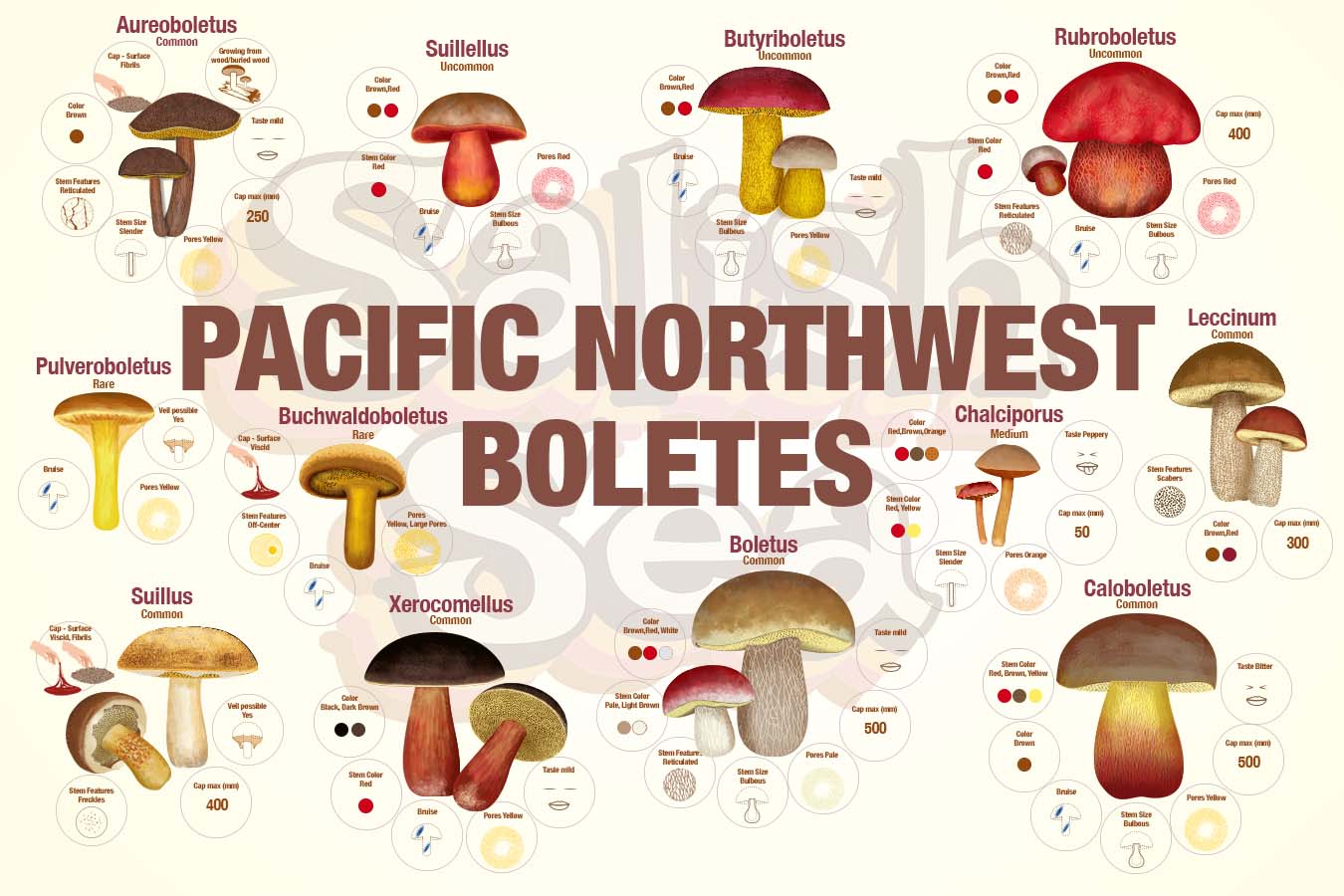
Scaber-Stalks
Leccinum spp.
Boletes with dark scabers (rough dots) on the stem instead of reticulation. Found under birch, aspen, madrone and conifers. Orange-capped species have made some people sick, so cook them well and try a small portion first. Flesh often stains when cut.
Edible Summer–FallSlippery Jacks
Suillus spp.
Slimy or sticky caps are the giveaway. Many have a partial veil or ring on the stem. Strongly associated with specific conifers — pine, larch, or Douglas-fir depending on species. Edible but slimy texture puts many foragers off. Peel the cap skin first.
Edible FallCracked-Cap Boletes
Xerocomellus spp.
Small to medium boletes with dry caps, often cracking with age, and yellow pores that usually bruise blue. Common in forests and in town, with conifers and hardwoods; X. diffractus is often abundant under urban Douglas-fir (Siegel & Schwarz, Mushrooms of Cascadia). Edible, but soft and often buggy with age.
Edible Fall Urban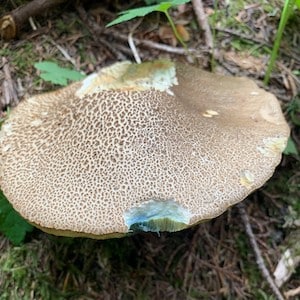
Bitter Boletes
Caloboletus spp.
Look like king boletes at first glance, but their yellow pores bruise blue. C. frustosus is intensely bitter; the common red-stemmed C. rubripes is only mildly bitter, so a taste test won’t always catch it. Not recommended: minor stomach upset has been reported from Caloboletus.
Not Edible Fall
Red-Pored Boletes
Rubroboletus pulcherrimus
The group to avoid. Red to orange pores, instant blue bruising, a red-netted stem and a rosy to reddish-brown cap. Rare in the PNW. Causes severe gastrointestinal poisoning and has been linked to at least one death (Bessette). If the pores are red, put it back.
Toxic Summer–FallNot Sure What You Found?
Our Bolete Finder tool walks you through identification step by step — cap color, pore color, bruising reaction, stem texture — and narrows down your find from more than 90 PNW species. It covers all the genera above plus several less common ones.
Which Boletes Are Edible? (And Which to Avoid)
Most boletes are edible, and the group has only a handful of genuinely toxic species — which is why beginners are often steered toward them. But “edible” ranges from the choice king bolete to species that are technically safe and not worth carrying home. Here is how the PNW groups sort out, with the one field mark that tells each apart.
| Bolete group | Edibility | How to tell it |
|---|---|---|
| King boletesBoletus edulis, B. rex-veris, B. fibrillosus | Choice edible | Brown cap, net-like reticulation on the upper stem, whitish pores aging to yellow or olive. Flesh stays white — no blue bruising. |
| Butter boletesButyriboletus spp. | Edible | Yellow pores over a yellow, netted stem, bruising blue; cap often pink to red; mild taste. Mountain conifer species fruit in spring and fall, and a few grow with oak. Uncommon, and rarer the farther north of California you go (Danny Miller). |
| Admirable boleteAureoboletus mirabilis | Edible | Dark maroon velvety cap, yellow pores, grows on or beside rotting hemlock wood. Often a lemony taste. |
| Slippery jacksSuillus spp. | Edible — peel the cap | Slimy or sticky cap, often a ring or glandular dots on the stem, always with conifers: pine, larch, or Douglas-fir. The slime upsets some stomachs; peel it and cook well. |
| Scaber-stalksLeccinum spp. | Edible — cook thoroughly | Dark, rough scabers dotting the stem; flesh often stains when cut. Orange-capped species have made some people sick, even when cooked, so cook them through and start with a small portion. |
| Cracked-cap boletesXerocomellus spp. | Edible | Dry cap, often cracking with age; yellow pores that usually bruise blue; common in forests and in town. Best young: soft and often buggy with age. |
| Bitter boletesCaloboletus spp. | Not recommended | A king-bolete look-alike with yellow pores that bruise blue. C. frustosus has a finely netted yellow stem and is intensely bitter; C. rubripes has a smooth stem with a red base and is only mildly bitter. |
| Peppery boleteChalciporus piperatus | Avoid | Small, with a cinnamon-brown cap and pores, bright yellow at the stem base, and a hot peppery taste. Usually near fly amanitas. Best avoided: possibly toxic, at least raw (Siegel & Schwarz). |
| Red-pored boletesRubroboletus pulcherrimus, R. eastwoodiae, R. haematinus | Toxic | Red to orange pores, red-netted stem, instant blue bruising. All three are rare here. R. haematinus pores start yellow and redden with age, often staying yellow at the edge (Danny Miller). Causes severe GI poisoning; R. pulcherrimus has been linked to at least one death (Bessette). |
The Four-Part Safety Rule for Boletes
Skip anything with red or orange pores. Taste-test a raw sliver of cap for bitterness (and spit it out). Cook boletes thoroughly; cooking often lowers the chance of a reaction. And eat a small portion the first time you try a new species, because individual sensitivities to Suillus and Leccinum are real even when the species is “edible.”
King Bolete Look-Alikes: Bitter, Red-Pored, and Slippery
No king bolete look-alike in the PNW is as dangerous as a deadly Amanita, but the red-pored bolete causes severe poisoning and has been linked to a death, and a bitter bolete will ruin a meal. This is the bitter bolete vs. king bolete comparison foragers ask about most, plus three other boletes that get mistaken for porcini.
| Species | Cap | Pores | Stem | Bruising | Taste | Verdict |
|---|---|---|---|---|---|---|
| King boleteBoletus edulis | Brown, dry to slightly tacky | White, aging olive-yellow | White-to-tan reticulation, club-shaped | None | Mild, nutty | Choice |
| Bitter boleteCaloboletus frustosus (= C. conifericola), C. rubripes | Dark olive-gray to brown (C. frustosus); buff to tan (C. rubripes) | Yellow | Yellow; finely netted, no red (C. frustosus), or smooth with a red base (C. rubripes) | Blue, quickly | Intensely bitter (C. frustosus); mildly bitter (C. rubripes) | Inedible |
| Red-pored boleteRubroboletus pulcherrimus | Rosy red to olive-gray, dry | Deep red to orange | Red netting, club-shaped to somewhat bulbous | Blue-black, instantly | Mild (never taste it) | Toxic |
| Slippery jackSuillus spp. | Slimy or sticky | Yellow, often angular | Glandular dots or a ring, no reticulation | Varies: some stain brown, a few slowly blue | Mild | Edible, peel |
| Scaber-stalkLeccinum spp. | Orange, red-brown, or dull brown | White to gray-tan | Dark scabers (rough dots), no reticulation | Flesh often stains pink or red, then gray to blue-gray | Mild | Edible, cook well |
Confirm a king bolete with several checks together: netting on the upper stem, white flesh that doesn’t change color when cut, pores that don’t bruise blue, and a mild taste. Netting alone isn’t enough: C. frustosus has a netted stem too, and the red-pored bolete has red netting. If any check fails, you are holding something else — usually one of the four rows above.
When to Hunt: Bolete Season
Bolete season in the Pacific Northwest runs from late spring through fall. The spring king starts things off east of the Cascade crest a few weeks after snowmelt, while the main flush of king boletes and other genera arrives with the fall rains.
| Window | Where to Look | What to Find |
|---|---|---|
| May–July | East side of the Cascades, a few weeks after snowmelt, moving upslope into summer | Spring king boletes (B. rex-veris) under fir and pine |
| Aug–Sep | Higher-elevation mountain forests after summer rains | Early king boletes with true firs (and spruce on the east slopes), Suillus under pines, Leccinum under birch |
| Sep–Nov | Coastal Sitka spruce forest and mountain conifer forest as fall rains arrive | Peak king bolete season (October has the most iNaturalist records); most bolete genera fruiting; Xerocomellus in lowland forests and parks |
| Nov–Dec | Lower elevations, mild coastal areas | Late-season Suillus and Xerocomellus; king boletes wind down with frost |
The Rain Trigger
Fall boletes need the transition from dry to wet: the main flush follows the first soaking rains after summer drought. In spring, the spring king appears a few weeks after snowmelt. Track soil moisture on Forayz rather than relying on calendar dates.
Identification Tips
When you find a bolete you don’t recognize, note these features before anything else:
- Cap texture: Slimy or sticky? Dry and cracked? Smooth? Fuzzy? This alone narrows the genus. Slimy = likely Suillus. Small, dry and cracked = often Xerocomellus.
- Pore color: White, yellow, red, or brown? Red pores are a warning sign.
- Bruising: Press the pores — do they bruise blue? Blue bruising occurs in many genera and does not indicate toxicity on its own. But red pores + blue bruising = a red-pored bolete (Rubroboletus, or the rarer Neoboletus and Suillellus): leave it.
- Stem surface: Reticulated (net pattern)? Scabrous (rough dark dots)? Smooth? Ring or veil remnant?
- Taste: A tiny raw nibble (spit it out) — mild, bitter, or peppery? Bitter points to Caloboletus (though C. rubripes is only mildly bitter); peppery to Chalciporus.
- Tree associates: What’s growing overhead? Boletes are mycorrhizal, so the tree tells you a lot.
FAQ
Are all boletes edible?
No. Most are, but Rubroboletus pulcherrimus (red-pored bolete) is genuinely toxic and has been linked to at least one death (Bessette). Several other species cause GI distress, especially raw or undercooked. Always cook boletes thoroughly, and never eat anything you haven’t identified with confidence.
Why do some boletes bruise blue?
Blue bruising in boletes is caused by oxidation of compounds in the flesh when tissue is damaged — it has nothing to do with psilocybin (which causes blue bruising in a completely different group of mushrooms). Blue bruising alone does not indicate toxicity. Many edible boletes bruise blue, and some to avoid, like the peppery bolete, don’t. Use it as one identification feature among several, not as a safety indicator.
What’s the difference between a bolete and a polypore?
Both have pores, but boletes are fleshy, usually grow from the ground, and have pore layers that peel away from the cap easily. Polypores are tough or woody, usually grow on wood, and have pore surfaces fused to the flesh. Think soft and squishy vs. hard and bracket-like.
Which boletes are poisonous?
In the Pacific Northwest, the seriously toxic boletes are the red-pored species in Rubroboletus — R. pulcherrimus, R. eastwoodiae (California Satan’s bolete, found here only rarely, with oak), and R. haematinus (high-elevation fir forests). All three are rare in the PNW. R. pulcherrimus and R. eastwoodiae cause severe vomiting and diarrhea, and R. pulcherrimus has been linked to at least one death (Bessette); treat R. haematinus the same way. The peppery bolete (Chalciporus piperatus) is possibly toxic, at least raw. Beyond those, orange-capped Leccinum and some Suillus cause stomach upset in some people. No bolete contains the amatoxins that make death cap and destroying angel deadly.
Are boletes hallucinogenic?
Not in the PNW. No bolete is known to contain psilocybin. The one well-documented exception is far from here: in Yunnan, China, eating undercooked Lanmaoa asiatica causes hallucinations, often of tiny people, and the compound responsible hasn’t been identified. People ask because many boletes bruise blue, and blue bruising is a famous field mark of psilocybin mushrooms — but those are small, gilled, dark-spored mushrooms in a completely different group. In boletes the blue is a harmless oxidation reaction, nothing more.
Is porcini the same as a bolete?
Porcini is a bolete, but not every bolete is a porcini. “Porcini” (Italian for “little pigs”) means the king bolete group — Boletus edulis and its close relatives. The PNW has several: the king bolete, spring king and fib king are the most common, and the queen bolete and white king are found less often. The other boletes here are relatives, not porcini.
How can I tell if a mushroom is a bolete?
Flip it over. A bolete has a sponge-like layer of tiny pores under the cap instead of gills, the whole mushroom is soft and fleshy, and it grows from the ground (or occasionally from very rotten wood) rather than shelving off a log. Press a thumbnail into the pore layer near the cap edge — on a bolete it separates from the cap flesh easily. If the pores are fused to a tough, woody body on a tree, it’s a polypore.
Track Soil Moisture for Bolete Season
Real-time soil moisture, soil temperature, snow cover, and recent rainfall — the data you need to time bolete hunts. Free with a Forayz account.
Learn PNW Boletes on Your Phone
The PNW Boletes deck in ForayzU covers king boletes, Suillus, Leccinum, and look-alikes. Swipeable flashcards with photos and key features — free, no subscription.
Bolete Resources
Guides, tools, and courses to help you find and identify boletes in the PNW.
King Bolete & Porcini
In-depth guide to the PNW porcini species — ID, habitat, timing, cooking, and where to hunt.
ToolBolete Finder
Step-by-step identification tool covering more than 90 PNW bolete species. Answer questions, narrow it down.
MapForayz Guide
How to use Forayz for scouting — soil moisture, ecoregions, elevation layers, and offline downloads.
GuideEdible Mushrooms Guide
Overview of the best edible species in the PNW — boletes, chanterelles, morels, and more.
SafetyPoisonous Mushrooms
Know the dangerous species before you forage. Includes toxic boletes, amanitas, and look-alikes.
CourseOnline Bolete Course
In-depth e-learning module on bolete identification, ecology, and hunting techniques.
In-PersonMushroom Classes
Live workshops on mushroom identification, foraging skills, and local species.
In-PersonGuided Mushroom Tours
Expert-led forays in the field. Fall tours focus on bolete habitat in mountain forests.