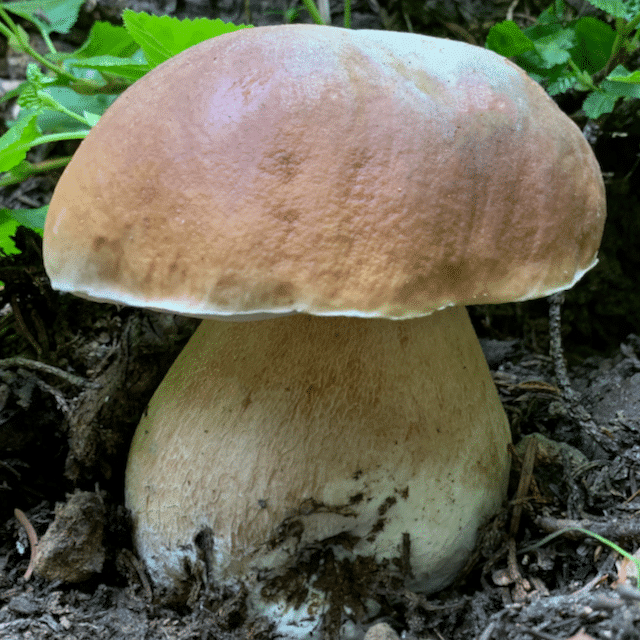
The red-pored bolete is a large bolete of Pacific Northwest conifer forests, rare here, and one of the few local boletes that is dangerous to eat. Red pores and a red stem covered in red netting are unusual among PNW boletes, and every part of this one stains blue-black as soon as it is cut or bruised.
Mushrooms of Cascadia (Siegel & Schwarz) rates it extremely toxic, causing severe gastrointestinal illness, and it has been linked to at least one death (Bessette).
Scout Fall Conditions on Forayz
Check rainfall, soil moisture and soil temperature to see when fall mushroom season is starting near you, free with a Forayz account.
8–20 cm across (occasionally 25), rounded at first, then broadly convex, with a thin band of sterile tissue overhanging the pores at the edge. Dry, smooth to finely velvety, cracking with age. Young caps are usually rosy red, burgundy or reddish brown, though some are olive to gray with a pink edge; older caps turn grayish olive.
Pores
Small and round. Deep red, becoming orange-red to reddish brown with age. Turn blue-black instantly when touched.
Stem
7–15 cm long (up to 20), 3–7 cm thick at the top and swelling to 5–12 cm at the base. Red to pink or orange-red, covered in dark red netting (reticulation). Bruises dark blue when handled.
Flesh
Thick and firm, pale yellow, quickly turning blue when cut and then fading to grayish yellow. Often reddish in the lower stem.
Spore print
Dark olive-brown.
Odor
Not distinctive.
Rosy cap, red pores, swollen base. Photo: Drew Henderson / CC BY-SADark red netting on the stem. Photo: Drew Henderson / CC BY-SA
Red pores, red net, blue-black bruising
Few PNW boletes have red pores. Together with a thick, red, netted stem and instant blue-black staining on every part, they identify this species.
Similar Species
All three look-alikes below are red-pored boletes that also stain blue, and none is safe to eat.
R. eastwoodiae. Photo: Ron Pastorino / CC BY-SACalifornia Satan’s bolete (Rubroboletus eastwoodiae): Pinkish cap that fades to gray, and a stout stem with a massive, abruptly swollen bulb under a narrow top. Grows with oaks, not conifers. Mainly a California species; in Oregon and Washington it is rare, with records from Oregon white oak (MycoMatch). Arora reports vomiting, diarrhea and severe cramps.
Mountain Satan’s bolete (Rubroboletus haematinus): Pinkish cap that soon turns brown, and paler, orange-red pores that are yellow when very young and often stay yellow at the cap edge. Its stem is yellow with red netting. It grows in high-elevation fir forests in the Cascades (Siegel & Schwarz). Bessette lists its edibility as unknown but possibly dangerous.
Neoboletus ‘luridiformis’: Dark brown cap, bright red to orange pores, and a stem that is dotted with red granules rather than netted and not bulbous. The European name is misapplied here; the Pacific Northwest mushrooms under it are probably two undescribed species (Siegel, via MycoMatch). Bessette calls it poisonous, causing gastrointestinal distress.
Older Names
Older guides may call this mushroom Boletus eastwoodiae. In 1976 Thiers and Halling found that the original B. eastwoodiae specimen was the oak-loving species, so the conifer mushroom got a new name, Boletus pulcherrimus, now Rubroboletus pulcherrimus. The oak species, long called Boletus satanas in the West, is now R. eastwoodiae (MycoMatch).
Habitat & Season
The red-pored bolete grows singly or a few together on the forest floor with conifers, most often grand fir and western hemlock. It is rare in the region, found mostly in coastal forests and the Cascade foothills (Siegel & Schwarz). It fruits in late summer and fall; iNaturalist observations from Oregon and Washington run from August through October:
Based on 89 iNaturalist observations from Oregon and Washington
Edibility
Poisonous — do not eat
Mushrooms of Cascadia rates the red-pored bolete extremely toxic, causing severe gastric distress, and Bessette records at least one fatality. Benjamin (Mushrooms: Poisons and Panaceas, 1995) describes a 1994 case in which a couple fell ill after eating it and the husband died; the autopsy found an infarction of the midgut, meaning part of the intestine had lost its blood supply.
Interactive Tool
Try the Bolete Finder
Identify Pacific Northwest boletes with our step-by-step guide.
Answer questions about cap color, pore characteristics, and staining
reactions to narrow down your find.