Yellow flowerpot parasol mushroom

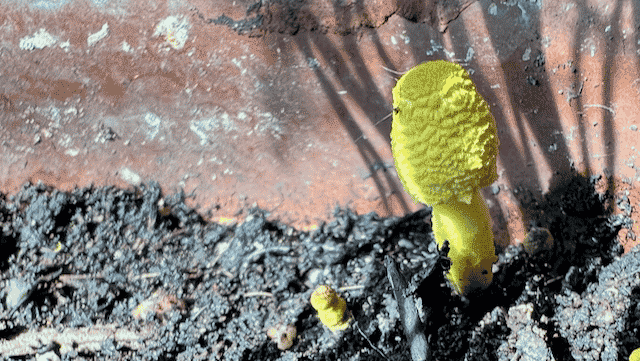
Have you found a small yellow mushroom growing with a houseplant? It is quite likely to be a mushroom native to tropical areas but found throughout the US with potted plants.

This mushroom known as Leucocoprinus birnbaumii

Leucocoprinus birnbaumii

more
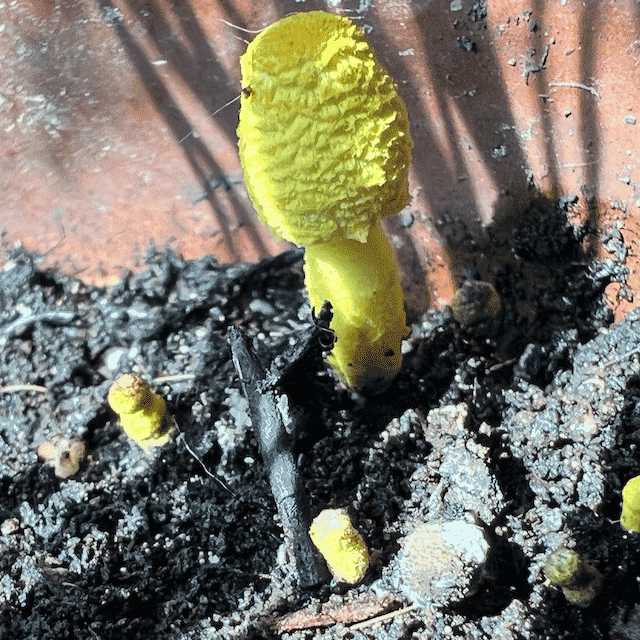
leucocoprinus birnbaumii square

Where did it come from?

These mushrooms are native to the tropics however they are now dispersed globally. The fungus is likely established in the soil of tripical houseplants. The fungus can live in the soil without creating mushrooms so it may go undetected. Heavy watering seems to promote mushroom fruiting.

How to kill mushrooms in houseplants?

There is much more to a mushroom than what you see above ground. Mushrooms grow from an interconnected web of mycelium that is often invisible to the naked eye. Unlike with plants, pulling out a mushroom has very little impact on the mycelial ‘roots’ which can regenerate from the smallest amount of tissue. Killing fungi in soil is incredibly difficult. One might try applying a fungicide, repotting in new soil, and reducing watering frequency. 

The mushroom is not harmful to the plant, and is only harmful to humans if eaten. If one is really concerned about pets or children eating the mushrooms, they could remove the mushrooms when they appear but expect them to return again in the future.

Edibility of Leucocoprinus birnbaumii

Toxic however so small and insubstantial that it is very unlikely one would eat enough to cause serious issues

Pro Membership

Get the data serious foragers use to find more mushrooms

Free members get soil temps, precipitation, and ecoregion data. Pro unlocks the layers that help you narrow down exactly where to look.

  • Historical burn perimeters — find morel habitat fast
  • Timber harvest boundaries across OR & WA
  • Detailed foraging area summaries with conditions
  • Offline maps in the Forayz iOS app

Similar Posts

  • Late Summer Recap

    Here is a brief summary of the my summer mushrooming. You can see additional photos and locations here on iNaturalist. Summer Wrap Up On average, the Seattle area will receive about 2in of rain over the summer. This year, the region received just 10% of that.The key to finding mushrooms in the summer is to…

  • Pacific Northwest Trees

    Finding specific tree species in Washington and Oregon Finding specific mushrooms can require finding specific trees. Mushrooms like chanterelles, boletes, hedgehogs, at matsutake all depend on intimate connections with certain tree species. When you browse a mushroom guide you will often find these trees listed in the Habitat section. Learning about the environment a specific…

  • |

    Scaly Chanterelle

    Pro Membership Get the data serious foragers use to find more mushrooms Free members get soil temps, precipitation, and ecoregion data. Pro unlocks the layers that help you narrow down exactly where to look. Historical burn perimeters — find morel habitat fast Timber harvest boundaries across OR & WA Detailed foraging area summaries with conditions…

  • |

    PNW Boletes

    I just finished the first version of a PNW Boletes illustration. These are organized into general groups by Genus which should help to simplify things. Beginners intersted in edible boletes should focus on the Boletus genus first since these are more common, tasty, and easier to identify. Aureoboletus mirabilis known commonly as the Admirable Bolete…

  • Intro to Mushrooms Mar 23

    Here is.a recording of the Intro to Mushrooms talk from Mar 23. Pro Membership Get the data serious foragers use to find more mushrooms Free members get soil temps, precipitation, and ecoregion data. Pro unlocks the layers that help you narrow down exactly where to look. Historical burn perimeters — find morel habitat fast Timber…