Ink Caps Coprinoid fungi — the dissolving mushrooms of the Pacific Northwest
Ink caps are some of the most distinctive mushrooms you can find in the Pacific Northwest. The gills dissolve into a black inky fluid as the cap matures — a process called autodigestion, or deliquescence. It’s not decay; it’s the mushroom actively digesting itself to release spores as the cap expands.
Most ink caps are saprobic, breaking down dead wood, rich soil, or dung. They tend to prefer disturbed and urban habitats — wood chip beds, lawns, roadsides, and parks — rather than old-growth forest. The group includes some good edibles, some species with serious safety considerations, and many that are simply too small or fleeting to bother with.
Map Urban & Disturbed Habitat on Forayz
Use public land overlays and ecoregion data to explore where wood chip beds, parks, and riparian zones concentrate around trails and access points. Environmental layers are free for all users.
What Makes a Coprinoid Mushroom
The defining feature is autodigestion: the gills dissolve from the margin inward, turning black and inky as the cap opens. This spreads the dark spores rather than dropping them, an effective strategy for small-capped species that fruit in dense clusters.
“Coprinoid” is a field grouping, not a formal taxonomic one. DNA work has shown that ink caps evolved in multiple lineages. The genera involved are:
| Genus | Key Traits | Notes |
|---|---|---|
| Coprinus | True ink caps with strong autodigestion. Tall cylindrical caps, mostly large-bodied. | Now restricted to C. comatus and a few close relatives after DNA reclassification. |
| Coprinellus | Smaller ink caps with glistening granules on young caps. Clustered on dead wood. | The mica cap group; formerly lumped into Coprinus. |
| Coprinopsis | Highly variable; many are woolly or mealy when young. Includes the alcohol inky cap. | The largest and most diverse reclassified genus. |
| Parasola | Small umbrella-like caps, strongly pleated, no real autodigestion. Grassland and wood chips. | Formerly Coprinus plicatilis and relatives. |
| Lacrymaria | Shaggy or finely fibrous. Dark gills with “weeping” water droplets visible on gill edges. | Not a true ink cap — gills don’t dissolve, but the dark spore print groups it here. |
| Psathyrella | Brittlestems. Very fragile, hygrophanous caps that fade dramatically when drying. | 100+ species in Cascadia; most require microscopy for ID. Not true ink caps. |
| Panaeolus | Mottled gills from uneven spore maturation. On dung or enriched grass. | Some closely resemble hallucinogenic Psilocybe species — use caution. |
Eat Ink Caps Fresh or Not At All
Autodigestion begins as soon as the cap starts to open. Shaggy manes that look perfect in the morning can be a puddle of black ink by afternoon. Harvest them young — before the cap edge begins to lift — and cook them the same day. They don’t keep.
Notable PNW Species
Shaggy Mane — Coprinus comatus
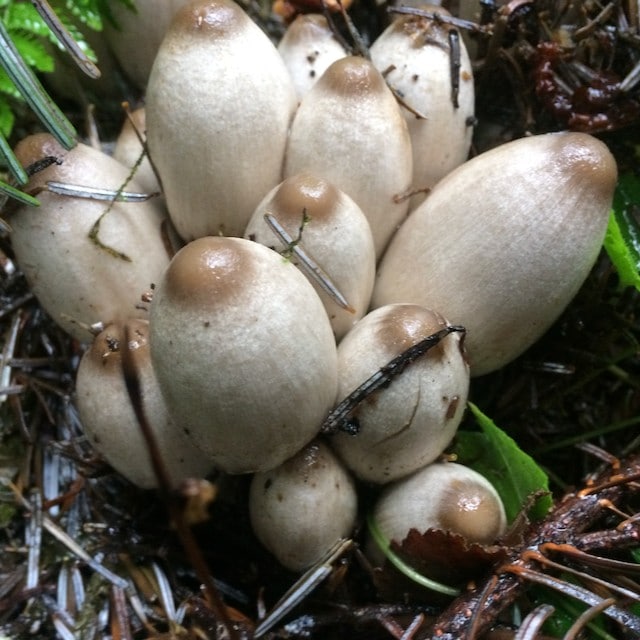
The most recognizable and widely eaten ink cap. The cap is tall and cylindrical when young, covered in shaggy white scales that give it a distinctive scruffy appearance. It can grow to 12 cm across as it expands and deliquesces. Found in wood chips, lawns, disturbed soil along trails and roads, and campgrounds — almost anywhere the soil has been churned or enriched. Fruits any time conditions are wet enough, from spring through late fall. Pick when the cap is still firmly cylindrical and cook immediately. The flavor is mild and pleasant.
Alcohol Inky Cap — Coprinopsis atramentaria
Similar to shaggy mane but with a smoother, more brownish-gray cap and no shaggy scales. Grows in clusters around buried woody debris, stumps, and dead tree roots in lawns and disturbed areas. Very common and widespread.
Alcohol Warning — This Species is Dangerous with Drink
Coprinopsis atramentaria contains coprine, a compound that blocks alcohol metabolism. Consuming alcohol within a few days of eating this mushroom — before or after — can cause flushing, nausea, rapid heartbeat, and severe headaches. The reaction has been compared to the drug disulfiram (Antabuse).
The mushroom is technically edible on its own, but the interaction window lasts up to 72 hours. Unless you can be certain no alcohol will be consumed in the days following the meal, avoid this species entirely. Shaggy mane (Coprinus comatus) does not contain coprine and is safe.
Mica Cap — Coprinellus micaceus
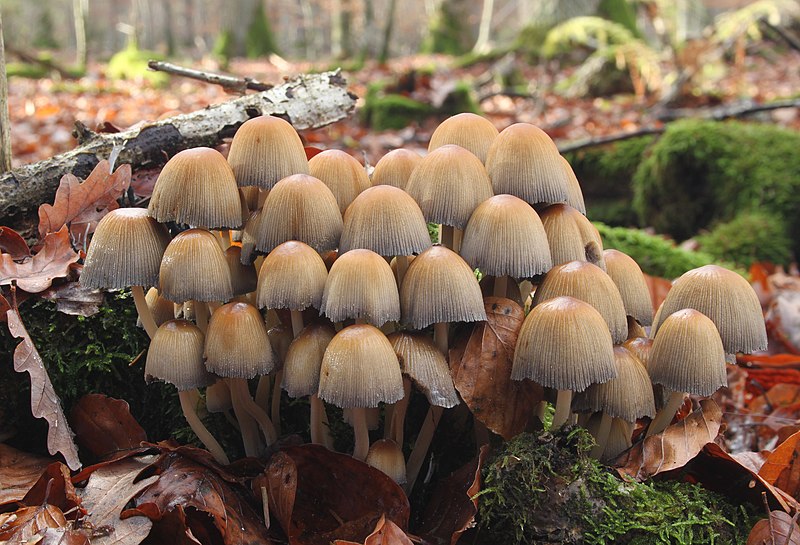
A very common clustered species growing on stumps, dead logs, and buried woody debris throughout Cascadia. The cap is 1.5–4 cm across, bell-shaped, with fine glistening granules on the surface when young — the “mica” of the name. These granules wash off in rain. Edible and flavorful but almost meatless; best used for sauces and gravies where the flavor can concentrate. Fruits year-round in mild areas.
Hare’s Foot Inkcap — Coprinopsis lagopus group
One of the most common ink caps in urban wood chip beds across western Cascadia. The young cap is densely covered in long, soft white fibers that give it a fuzzy, foot-like appearance — these wither as the cap expands and begins to dissolve. 1–5 cm across when open. Edibility is unknown; pass on it. Fruits throughout the year in irrigated areas.
Snowy Inkcap — Coprinopsis nivea
Smaller and chalky white all over, including the cap surface. Found on dung — mostly horse and cow — in spring and fall. Not an eating species; harmless. The white color and dung substrate make it easy to recognize.
Umbrella Inky Caps — Parasola species
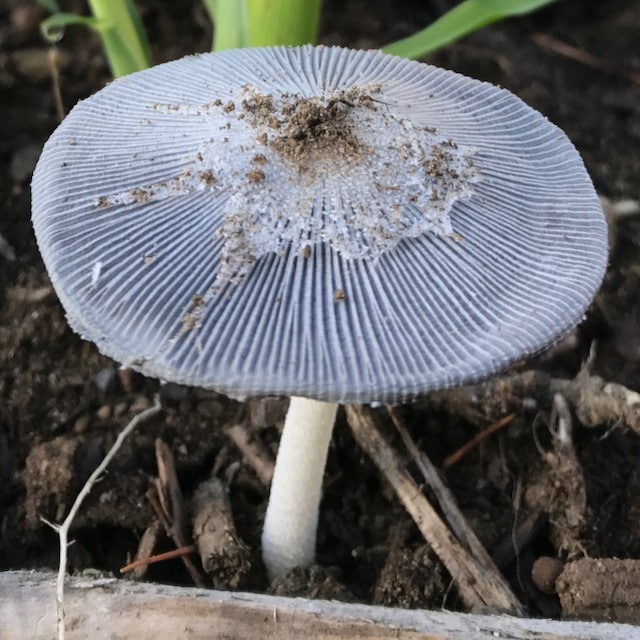
Tiny pleated mushrooms, 0.5–3.5 cm across, that look like opening parasols. They grow on grass, bare soil, and wood chips and fruit overnight, often collapsing before noon. No autodigestion in the true sense — the cap just flattens and withers. Common and widespread in lawns and gardens. Harmless, but too small and ephemeral to be worth eating.
Weeping Widow — Lacrymaria velutina
Not a true ink cap but often grouped here due to the dark spore print and similar habitat. Cap 3–9 cm, ovoid to broadly convex, with a distinctive shaggy-fibrous surface. Gills don’t autodigest but do “weep” — small droplets form on gill edges in humid conditions. Found on wood chips and nutrient-rich disturbed soil. Occasional in urban areas across western Cascadia. Non-toxic but not used as food.
Brittlestems — Psathyrella species
A vast and difficult genus with close to 100 species in Cascadia. All are fragile — the stem snaps cleanly — and most are strongly hygrophanous: caps fade from dark brown when wet to pale tan when dry, sometimes dramatically. Most grow on woody debris, duff, or alder forest litter. Identification to species almost always requires microscopy. Treat the whole genus as inedible by default; edibility is unknown for most species and the look-alike risks aren’t worth it.
Mottlegills — Panaeolus species
Found on dung or enriched grass. The gills have a mottled, irregular dark-and-pale pattern caused by uneven spore maturation. The lawnmower’s mushroom (P. foenisecii) is common in watered lawns. Mottlegills are not closely related to ink caps but are grouped here in field guides due to the dark spores and open grassland habitat. Do not eat any Panaeolus — several look nearly identical to hallucinogenic Psilocybe species, and the distinctions are not field-reliable for beginners.
Track Fall Fruiting Conditions
Shaggy manes and mica caps flush after warm-season rains. Use 14-day precipitation and soil moisture layers on Forayz to anticipate when conditions are right at your local spots. Free for all users.
Habitat & Season
Most coprinoid fungi are urban and suburban specialists. They thrive in the disturbed, nutrient-rich environments that exclude more sensitive forest species:
- Wood chip beds: The richest urban habitat for ink caps. Freshly laid wood chips around trees, in parking strips, and in parks support shaggy manes, hare’s foot inkcap, mica cap, and brittlestems simultaneously.
- Lawns and grassy areas: Shaggy manes push up in campgrounds, roadsides, and lawn edges. Umbrella inky caps and mottlegills prefer irrigated turf.
- Stumps and buried roots: Mica caps and alcohol inky caps fruit densely from stumps and dead root systems, often appearing to grow from bare soil when the wood is buried.
- Dung: Snowy inkcap and related species fruit on horse, cow, and occasionally bear or dog dung in spring and fall.
- Alder forests and riparian zones: Psathyrella brittlestems are most abundant in moist alder forest litter and cottonwood riparian zones.
These fungi fruit in the cooler, wetter parts of the year — primarily fall and spring — though shaggy mane and mica cap can appear any time conditions are wet in irrigated areas. Many species emerge overnight and are gone within hours, especially in warm weather.