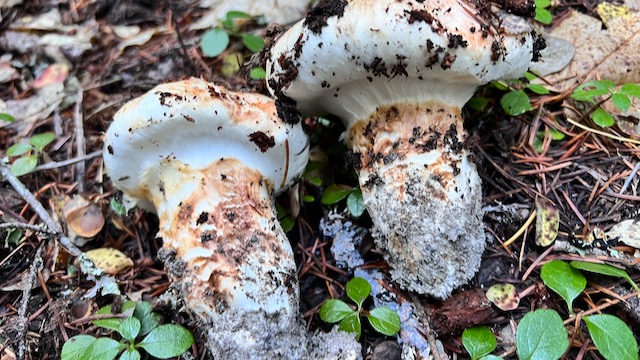

Matsutake mushrooms, highly valued for their unique aroma and culinary applications, can be identified by several key features:
- Cap: The cap of a matsutake mushroom starts white and transitions from a rounded shape to a flatter form as it matures. Fibrils on the surface of the cap are typically flat so the cap will appear mostly smooth.
- Gills: Initially white, the gills develop orangish spots and stains with age. They are narrowly to broadly attached — squared off or with a small notch — but never decurrent: they do not run down the stem, which separates matsutake from the look-alike Catathelasma ventricosum below.
- Veil and Stem: The thick, cottony veil often shows orangish stains and flares upward on the stem when fresh, flattening into a ring with age. The stem tapers to a point at the base, often dusted with pale, sandy soil, with no volva or bulb.
- Flesh: Very firm to rubbery — the stem barely gives when squeezed. A soft or spongy mushroom is not a matsutake, but firmness does not rule out the toxic look-alike below, which can also be quite firm.
- Scent: A spicy-sweet, cinnamon-like smell with an underlying mustiness is the fastest way to flag a candidate — people describe it anywhere from appealing to repellent. It narrows things down but is not a safe test on its own: people vary widely in what they smell, and young specimens of the toxic look-alike below can smell similar too.
- Taste: Indistinct to mild — it’s the aroma, not the taste, that carries into cooking.
Together, these characteristics are essential for accurately identifying matsutake mushrooms in the wild.
The Pacific matsutake’s current scientific name is Tricholoma murrillianum. Until 2017 it was known as Tricholoma magnivelare, a name that belongs to a separate eastern North American species, so many books and websites still use it.
Similar in Appearance:
Smith’s Amanita
Amanita smithiana
Key features of Amanita smithiana:
1. Veil remnants: Tissue on the surface of the cap is often fluffy and white. This contrasts with the fine fibrils of a matsutake that lay flat against the surface of the cap
2. Powdery veil: The veil of Amanita smithiana is fragile and very powdery, and often comes off on your fingers (Siegel & Schwarz). This contrasts with the thick, cottony veil of matsutake. Don’t rely on firmness: Amanita smithiana can be quite firm too.
3. Base and scales: Amanita smithiana has a swollen bulb topping a long, easily-broken root, and its stem is scruffy with soft, powdery scales. But matsutake’s base also tapers and roots into the soil, so base shape alone doesn’t settle it — matsutake never has a volva or ring of tissue at the very base, and its stem scales are flat brown fibrils, not fluffy white ones.
4. Scent: Amanita smithiana usually smells fishy or unpleasant rather than spicy-sweet — but young specimens are reported to occasionally smell like matsutake, people vary in what they can smell at all, and matsutake’s smell rubs off on your hands and other mushrooms in the basket. Don’t decide on scent alone.
When gathering matsutake, take real care not to mistake them for the seriously toxic Amanita smithiana, which fruits in the same habitats at the same time of year. Reading about the differences is not enough: get experience in the field, and have every mushroom checked in hand by someone who can reliably tell matsutake from other Tricholoma and from Amanita before you eat any. If you have any doubt, don’t eat it.
Catathelasma ventricosum
Very similar in appearance but not seriously toxic like Amanita smithiana. The clearest differences are the gills and the smell: C. ventricosum has decurrent gills that run down the stem (matsutake’s never do) and a strong, mealy odor and taste, where matsutake smells spicy-sweet. Edible, but tough.
A third look-alike is worth knowing: Tricholoma dulciolens shares matsutake’s cinnamon-spicy smell — which is exactly why scent alone isn’t a safe test. It’s usually smaller, with darker brown scales on cap and stem, and tastes noticeably bitter where matsutake does not. Edible, but the bitterness varies and can ruin a dish.
Sources: Mushrooms of Cascadia (Siegel & Schwarz, 2024); MycoMatch (© Ian Gibson), a compilation of published descriptions through which most other field-guide authors named here are quoted.
Get the data serious foragers use to find more mushrooms
Free members get soil conditions, the past week of rain, snow, smoke and historical burns. Pro unlocks the layers that help you narrow down exactly where to look.
- Newest burn years, managed burns & burn severity
- Tree species maps (22 species) & timber harvests
- Town and mountain pass fruiting calendars with current conditions
- Offline map downloads in the iOS & Android apps
- 14- and 30-day rainfall windows
- Soil temperature & moisture at full zoom