
Coral Mushrooms Ramaria and related genera — the branching fungi of PNW forests
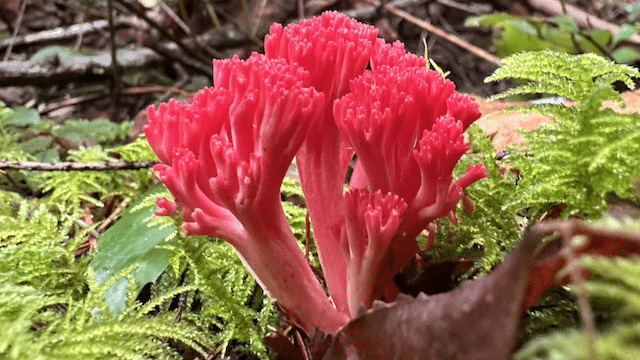
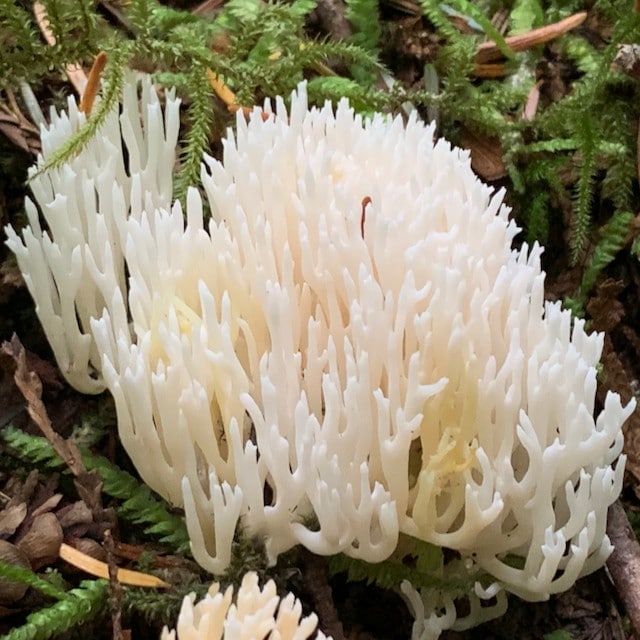
Coral mushrooms are some of the most visually striking fungi in the Pacific Northwest. They look like underwater corals transplanted to the forest floor — clusters of branching, upright fingers in colors ranging from bright orange and crimson to pale yellow and purple. Most belong to the genus Ramaria, but several other genera produce coral-like forms.
They’re also some of the hardest mushrooms to identify to species. Many Ramaria species look nearly identical in the field, several PNW species are still unnamed, and confident identification often requires microscopy, chemical tests, or DNA sequencing.
Explore Coral Mushroom Habitat on Forayz
Use ecoregion and public land layers to find the conifer forests where corals fruit in fall. Free with a Forayz account.
What Makes a Coral Mushroom
Coral mushrooms share a distinctive growth form: upright, branching fruitbodies that emerge from the ground or from decaying wood. They lack caps and gills entirely. Instead, spores are produced on the outer surface of the branches.
Several genera produce coral-like fruitbodies in the PNW:
| Genus | Key Features | Common Species |
|---|---|---|
| Ramaria | Large, fleshy, repeatedly branching from a thick base. Most grow from the ground and are mycorrhizal with conifers. The dominant coral genus, with many PNW species, some still unnamed. | Pink-tipped corals (R. botrytis group), red coral (R. araiospora), R. rasilispora, R. sandaracina, R. cystidiophora |
| Clavulina | Smaller, with blunt or crested branch tips. Often white to grayish. Frequently infected by a parasitic fungus that turns it gray to blackish; discard infected ones (Ammirati). | White coral fungus (C. coralloides) |
| Clavariadelphus | Club-shaped rather than branching — single or clustered upright columns. The candy club tastes sweet. | Candy club (C. truncatus), strap-shaped club (C. ligula); see the club & coral fungi page |
| Artomyces | Grows on rotting conifer logs. Crown-shaped branch tips. Uncommon in Oregon and Washington. | A. piperatus, known only west of the Rockies (Lickey) |
| Alloclavaria | Unbranched clusters of slender clubs, purple to lilac or purplish gray. The western species may need its own name. | Purple spindles (A. purpurea group) |
Ground vs. Wood
Most Ramaria species grow from the ground and are mycorrhizal — connected to living tree roots. If you find a coral growing directly on a log or dead wood, it’s likely Artomyces, Ramaria stricta, R. rubella, or another wood-decomposing species. This is one of the first things to check in the field.
Field Identification Tips
Getting coral mushrooms to species is genuinely difficult, even for experienced mycologists. But a few field observations can narrow things down considerably:
- Branch tip color: One of the most useful field characters. Pink, red, purple, yellow, orange, or white tips point to different species groups — but in some species the tip color fades quickly with age or after picking.
- Base/stipe color: Some species have a distinctly different color at the base than the branches. A white base with yellow branches is different from a yellow base throughout.
- Bruising reaction: Cut or handle the base and branches and watch for color changes. Some species stain brown or wine-red; others don’t change.
- Taste: Chew a small piece and spit it out. Bitter, acrid, or mild? This eliminates many species. (Bitter corals are not worth eating regardless of ID.)
- Size and stature: Some Ramaria species reach 25 cm tall with chunky bases. Others are small and delicate. Overall architecture matters.
- Substrate: Ground (mycorrhizal), duff/litter, or wood? Ground-dwelling species are usually Ramaria. Wood-dwelling species are different genera.
- Associated trees: Hemlock, spruce, fir, and tanoak associations help narrow down Ramaria species.
Notable PNW Coral Species
Pink-Tipped Corals (Ramaria botrytis group)
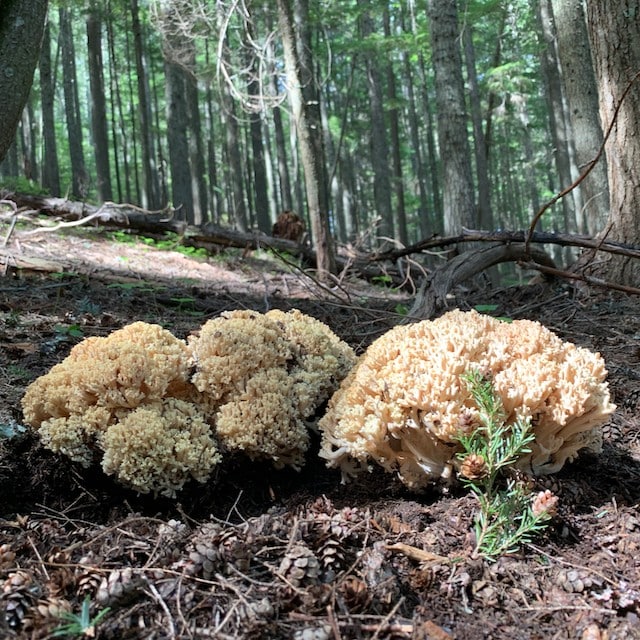
Pale, cream to pinkish beige corals on a thick white base, with pink to wine-colored branch tips when young. The pink doesn’t last — in R. rubrievanescens it can vanish within a day of picking (MycoMatch) — and several similar species occur here, some undescribed. Siegel & Schwarz (Mushrooms of Cascadia) call R. botrytis locally common across western Cascadia, yet these corals are seldom confirmed to species: iNaturalist has no Oregon or Washington records of R. botrytis and only 9 of R. rubrievanescens (September 2026), so treat a pink-tipped find as the group, not a named species. For edibility, Siegel & Schwarz rate R. botrytis edible and good but very easily mistaken for bitter or bland species, and Scates-Barnhart rates R. rubrievanescens choice. Under conifers in fall; R. rubrievanescens with western hemlock (Marr).
Ramaria sandaracina
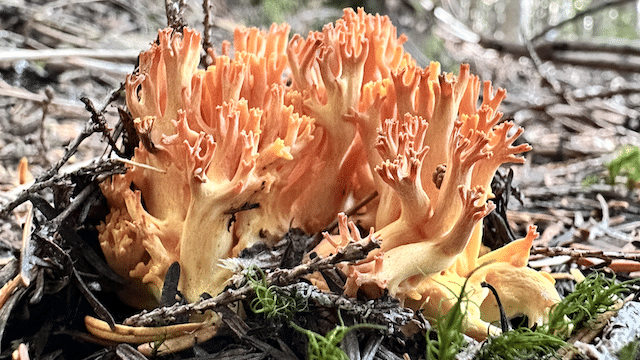
A crowded clump of slender upright branches, 7–15 cm tall. The tips are bright orange and stay that way; the branches are duller orange, often with a yellow band low down, over a short whitish stem. The flesh is thin and a little rubbery. Common in the wetter parts of Cascadia, above all in coastal spruce and west-side hemlock forest. Fall. Edibility unknown. It is one of several bright orange Ramaria here.
Red Coral (Ramaria araiospora)
A small, compact coral whose many branches rise from a slender base. Young branches are bright crimson to neon pink, fading a little but staying pinkish red. Edible but bland. Locally common in low-elevation hemlock and spruce forest west of the Cascades. Fall.
Ramaria cystidiophora
A slender, upright coral with lemon-yellow tips and paler yellow branches. It often smells sweet or lemony. Grows under conifers, especially hemlock; locally common west of the Cascades. Fall. Likely edible.
Ramaria rasilispora
A big spring coral: a stout, pale stem under short branches that are pale yellow to greenish yellow, turning ocher as the spores ripen. It grows in troops or arcs and usually stays hidden under the duff until mature. Common east of the Cascades and in dry pockets of the Coast Range; mainly spring and early summer. Edible and good, and in season with morels. But it belongs to a difficult group: R. magnipes and R. thiersii also fruit in spring, and there are about ten more unnamed look-alikes. Cook it well and eat only a little the first time; some people get mild stomach upset from Ramaria.
Candy Club (Clavariadelphus truncatus)
Not a branching coral but a fat, flat-topped club. Its flesh tastes sweet, an unusual trait. Edible in moderation; some people report stomach upset from large amounts. Found under conifers in fall. See the club & coral fungi page.
Ramaria acrisiccescens
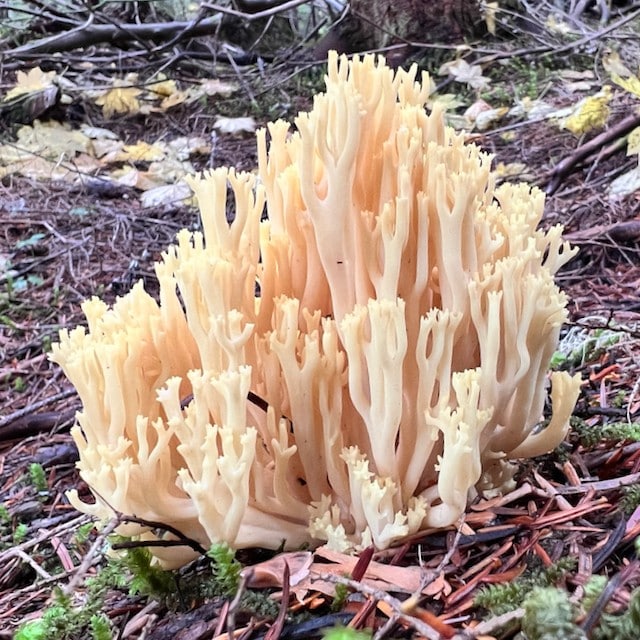
Clumps of tall, slender, upright branches, whitish to pale beige, browning with age, with no chunky base. It tastes acrid and bitter. Common under conifers, especially hemlock, across western Cascadia in fall. Edibility unknown; possibly mildly poisonous (Scates-Barnhart). Worth knowing so you don’t waste time on it.



Season & Timing
Most coral mushrooms in the PNW fruit in fall, with the same fall rains that bring chanterelles. iNaturalist records of Ramaria in Oregon and Washington are concentrated from September to November, with smaller numbers from May through August. East of the Cascades, R. rasilispora and its relatives come up in spring and early summer.
Based on 907 research-grade iNaturalist observations of Ramaria from Oregon and Washington
Time Your Hunt with Soil Data
Coral mushrooms respond to the same fall rain triggers as chanterelles. Track rainfall, soil moisture, and soil temperature on Forayz to time your visits. Free with a Forayz account.
Edibility
The edibility situation with coral mushrooms is complicated. A handful of Ramaria species are genuinely good edibles. Many others are bland, bitter, or have unknown safety profiles. Some cause GI upset.
- Good edibles: the pink-tipped corals (R. botrytis group, if you can be sure of the group), R. rubiginosa (pale yellow, staining wine-red), R. rasilispora, and the candy club (Clavariadelphus truncatus) are considered edible and good.
- Likely edible: R. cystidiophora and R. velocimutans are considered likely edible, but their edibility is less established.
- GI risk: The R. formosa group (peach-pink branches, yellowish tips) has been linked to gastrointestinal upset (McKnight). The name has been used for many different species, so which one causes it is unclear.
- Unknown: Many species, including common ones like R. sandaracina and the bitter R. acrisiccescens, have unknown edibility.
The Identification Problem
The practical challenge with eating coral mushrooms isn’t serious toxicity — no Ramaria is known to be deadly. The problem is confident identification. The edible species look very similar to the bland, bitter, or GI-causing species. Unless you can reliably distinguish your target species, it’s safer to admire corals than to eat them.
If you do try eating a coral mushroom, cook it well and start with a small portion. Don’t assume that a spring date narrows things down: R. rasilispora shares the spring season with R. magnipes, R. thiersii, and several unnamed look-alikes.
Habitat & Ecology
Most Ramaria species are mycorrhizal — they form underground partnerships with living tree roots, just like chanterelles and boletes. This means they’re tied to specific forest types and tree associations.
- Western hemlock forests: Many fall corals in western Cascadia grow with hemlock, including R. cystidiophora, R. acrisiccescens, R. araiospora, and R. rubrievanescens.
- Spruce forests: Coastal Sitka spruce stands are especially good for R. sandaracina.
- Hemlock and fir at mid to high elevation: R. velocimutans favors older hemlock and fir forest at these elevations.
- East-side forests: R. rasilispora is most common on the east side of the Cascades, in mixed conifer forest with true fir (Scates-Barnhart).
- Tanoak forests: In southern Oregon, R. rubiginosa (red-staining yellow coral) is locally common with tanoak.
Look in moss and duff under conifers. Many fruit in troops or arcs, so finding one often means more are nearby.
Sources: Mushrooms of Cascadia (Siegel & Schwarz, 2024); MycoMatch (© Ian Gibson), a compilation of published descriptions through which most other field-guide authors named here are quoted; iNaturalist observations.