
Oyster Mushrooms Pleurotus — the PNW’s most accessible wild edible
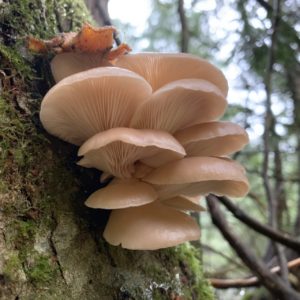
Oyster mushrooms are among the easiest wild mushrooms to recognize and one of the best to eat. They grow in shelf-like clusters on dead and dying hardwoods — especially red alder — throughout western Washington, Oregon, and British Columbia. If you can find a downed alder log in a wet forest, you can probably find oysters.
Several Pleurotus species grow in the PNW, but the common name hides how unclear they are: it isn’t settled how P. ostreatus and P. pulmonarius can be told apart in the Pacific Northwest, or whether either name fits the local oysters. They fruit in two main flushes, in spring and in fall, with smaller numbers year-round. They’re saprobic, decomposing dead wood rather than partnering with living trees, which makes their habitat easy to predict.
Scout Oyster Habitat on Forayz
Use precipitation and soil moisture layers to find wet, lowland hardwood forests where oysters fruit. Free with a Forayz account.
Identification
Oysters are distinctive once you learn the combination of features. No single feature is unique to Pleurotus, but together they make a reliable ID:
| Feature | Description |
|---|---|
| Cap | 3–15 cm (up to 25), semicircular to fan-shaped. Fresh caps are white to pearly gray, sometimes buff, bluish gray, or uniformly brown. Smooth, moist surface. Margin inrolled when young, expanding to flat or uplifted with age. |
| Gills | Decurrent (running down the stem), close to subdistant, broad. White to cream, yellowing in age. True gills — not false gills like chanterelles. |
| Stem | Short (0.5–6 cm), laterally attached or off-center, sometimes absent. White to cream with a hairy base. |
| Flesh | White, thin to thick, stringy-fibrous. Firm when young, becoming tough in older specimens. |
| Odor | Often a distinct anise-like sweetness with earthy, mushroomy tones, but it varies: some oysters smell only faintly or not at all. |
| Spore print | White, buff, or lilac-gray. |
| Growth | Overlapping clusters on dead wood. Shelf-like, often tiered. Most on hardwoods, especially alder, but also on conifers. |
The oyster ID checklist
Shelf-like growth on wood + decurrent gills + off-center or absent stem + thick, rubbery flesh. The anise-like smell is a good supporting sign when present, but not every oyster has it, so don’t rely on it alone.
PNW Oyster Species
The oysters below are the names in use in the Pacific Northwest. All are edible.


Habitat & Where to Look
Oyster mushrooms are saprobic — they feed on dead and dying wood. This makes their habitat straightforward to identify: find the right kind of dead wood, and you’ll find oysters.
- Red alder: The main host in western Washington and Oregon. Downed alder logs, standing dead trunks, and freshly fallen branches all produce oysters. Alder-dominated riparian corridors are prime territory.
- Bigleaf maple: Another common host; large downed maples are worth checking.
- Cottonwood: Especially along rivers and floodplains. The larger, browner oysters in stacks on cottonwood are usually called P. populinus.
- Other wood: Other hardwoods, and conifers too.
- Moisture: Oysters need sustained moisture to fruit. Look after multi-day rain events, especially in riparian areas and shaded ravines where logs stay damp.
Urban foraging
Oyster mushrooms are one of the best species for urban foraging. City parks, greenbelts, and riparian trails with alder or maple regularly produce large flushes. Street trees and stacked firewood can host them too. If you live in Seattle, Portland, or any PNW city with deciduous trees, you don’t need to drive to the mountains.
Season & Timing
Oysters have two main fruiting windows in the PNW, spring and fall, plus smaller numbers through the rest of the year whenever there’s enough moisture.
Based on 1,801 research-grade iNaturalist observations of Pleurotus from Oregon and Washington
Oysters are recorded in both spring (roughly April to June) and fall (roughly October to December), and at lower levels through winter.
Track Precipitation & Soil Moisture
Use Forayz rainfall layers to find where rain has fallen and when lowland hardwood forests are primed for oyster fruiting. Free with a Forayz account.
Edibility & Cooking
Oysters are a choice edible mushroom — one of the best wild species for the table. The texture is firm and meaty, and the flavor ranges from mild to robustly mushroomy depending on the collection. A few practical notes:
- Harvest young. Young oysters with inrolled cap margins and firm flesh are far better eating than mature specimens that have become thin and rubbery. If the edges are uplifted and the flesh is papery, leave them for spores.
- Trim and check. Oyster stems are tough; trim them. Beetles often hide between the gills and white grubs in the flesh, so douse the caps in water and check before cooking (Arora).
- Dry sauté: Start in a dry pan over medium-high heat to drive off moisture, then add butter or oil. This gives a better sear and prevents a soggy result.
- Versatile: Works in stir-fries, soups, pasta, risotto, on toast, and as a meat substitute. The firm texture holds up to high heat and extended cooking.
- Preservation: Dehydrates well — rehydrated oysters are excellent in soups and stews. Sauté and freeze for longer storage.
- Always cook. Like most wild mushrooms, oysters should be thoroughly cooked before eating. Raw specimens can cause GI upset.
Lookalikes & Safety
Oysters have a few lookalikes in the PNW. None are lethally toxic, but one — angel wings — is potentially dangerous and worth learning to distinguish. For a broader overview of toxic mushrooms in the Pacific Northwest, see our dedicated page.
| Species | Key Differences | Edibility |
|---|---|---|
| Angel Wings Pleurocybella porrigens |
Thin, delicate and strikingly white — much thinner flesh than oysters. In clusters or troops on well-decayed conifer wood, most often western hemlock. No stem. Odor indistinct. | Not recommended. A series of deaths in Japan was attributed to a closely related species; many people have eaten ours without ill effects, but it is best avoided. |
| Late Oyster Sarcomyxa serotina |
Olive cap, sticky when wet, with crowded orange-buff gills fading to yellowish buff and a short, curb-like attachment. Mostly on hardwoods, especially red alder and bigleaf maple (Siegel & Schwarz, Mushrooms of Cascadia), but sometimes on conifers (Arora). Most abundant in cold weather. | Edible but not highly regarded; taste mild to bitter-metallic. |
| Lilac Oysterling Panus conchatus |
Violet when young, fading to tan or reddish tan, with tough, leathery flesh. On hardwood logs, stumps and branches. | Tough but apparently harmless (Arora). |
| Velvet-Footed Pax Tapinella atrotomentosa |
Brown, velvety cap. Prominent, central-to-eccentric stem with a distinctly velvety, dark brown base. Gills forking and easily scraped off. On rotting conifer stumps and logs. | Not recommended; often bitter. |
Angel wings — not a “white oyster”
Angel wings (Pleurocybella porrigens) are sometimes called white oysters, but they are a different genus. Oysters are usually larger, thicker-fleshed, and often beige, tan, gray or brown rather than strikingly white, and grow more often on hardwoods. Angel wings are thin, stemless, and grow on well-decayed conifer wood, most often western hemlock. Oysters can grow on conifers too, so a thin white shelf on conifer wood deserves extra care.
Cultivation
Oyster mushrooms are the easiest wild species to cultivate and a great entry point for home growing. Pleurotus ostreatus and P. pulmonarius are commercially grown worldwide on straw, sawdust, coffee grounds, and cardboard. They’re aggressive colonizers with a wide substrate tolerance.
Get the data serious foragers use to find more mushrooms
Free members get soil conditions, the past week of rain, snow, smoke and historical burns. Pro unlocks the layers that help you narrow down exactly where to look.
- Newest burn years, managed burns & burn severity
- Tree species maps (22 species) & timber harvests
- Town and mountain pass fruiting calendars with current conditions
- Offline map downloads in the iOS & Android apps
- 14- and 30-day rainfall windows
- Soil temperature & moisture at full zoom
Learn More
Sources: Mushrooms of Cascadia (Siegel & Schwarz, 2024); MycoMatch (© Ian Gibson), a compilation of published descriptions through which most other field-guide authors named here are quoted; iNaturalist observations.