
Toothed Jelly Fungus Pseudohydnum gelatinosum subsp. pusillum — a gelatinous, spine-toothed wood decomposer of Pacific Northwest conifer forests
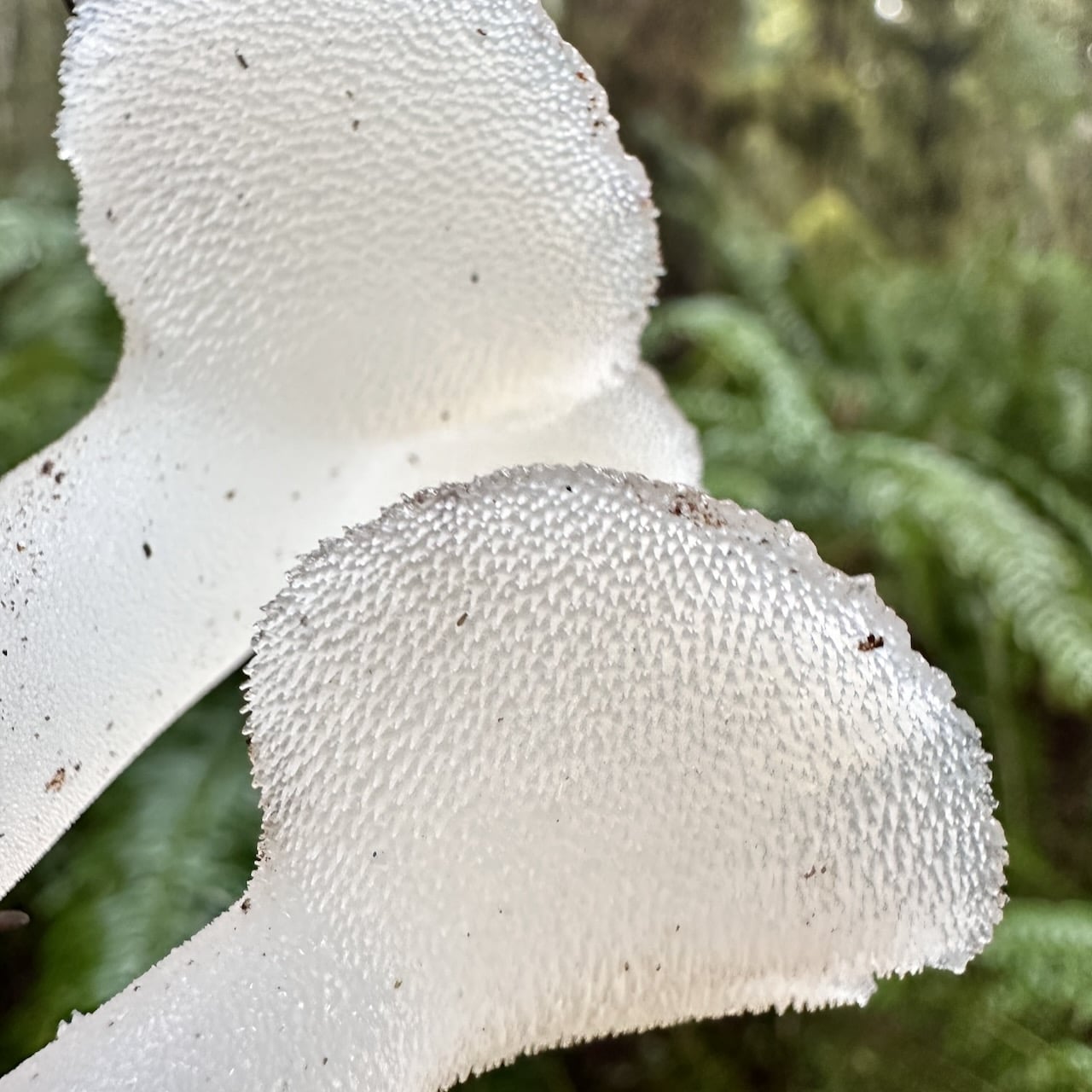
The toothed jelly fungus is a translucent, rubbery fungus that grows on decaying conifer wood. Unlike most gelatinous fungi, its underside is covered in soft, pale spines instead of a smooth surface — teeth on a jelly body, which is where both the common name and the genus name (from the Greek for “false hedgehog”) come from. It’s a wood decomposer, breaking down the log it grows on, unlike some other jelly fungi in the group that parasitize other fungi.
It is edible, though Ammirati rates it of slight food value and Arora finds the flavor nonexistent.
Track Wet Season Conditions on Forayz
The toothed jelly fungus fruits mostly in the wet months. Use the rainfall and soil moisture layers on Forayz to find wet forest areas near you, free with a Forayz account.
Identification
| Feature | Description |
|---|---|
| Body | 2–6 cm across, tongue-shaped to spoon-shaped or fan-shaped, sometimes with a short lateral stem-like base. Translucent white when fresh, occasionally grayish or grayish-brown, darkening as it ages. Gelatinous and rubbery throughout — it flexes and bounces back rather than tearing. |
| Underside | Densely covered in soft, pale, cone-shaped spines up to about 5 mm long, rather than gills or pores (Breitenbach, via MycoMatch). |
| Texture | Flexible, flabby and rubbery (Arora). |
| Spore print | White. |
| Substrate | Well-decayed conifer wood — stumps, logs, and woody litter — growing singly, scattered, or in loose clusters, common in Douglas-fir forests (MycoMatch). |
A jelly fungus with teeth
Most gelatinous fungi have a smooth spore-bearing surface. The toothed jelly fungus is the exception in this group: its underside is covered in soft spines instead. That combination — translucent jelly body, spiny underside, growing on wood — identifies it.
Why the Subspecies Name?
Field guides and iNaturalist file this mushroom as Pseudohydnum gelatinosum, but MycoMatch treats the name as no longer correct for the Pacific Northwest mushrooms. Vlasak designated a formal epitype (a reference specimen) for Pseudohydnum gelatinosum from material collected only in Eurasia. Separately, a neotype for Pseudohydnum gelatinosum subsp. pusillum was chosen from a Washington State collection — but it wasn’t split off as a full species, because the genetic difference from the European type is small (Spirin, via MycoMatch). Spirin treats subsp. pusillum as the North American subspecies, and this page uses that name. A separate species, Pseudohydnum omnipavum, occurs in the same region, and DNA work (Danny’s DNA Discoveries) has found further undescribed lineages in the Pacific Northwest.
Similar Species
The spiny underside invites comparison to hedgehog mushrooms, but the two are unrelated. Texture is the quickest check: hedgehogs are firm and fleshy and grow from soil.
| Feature | Toothed Jelly Fungus | Hedgehog Mushroom (Hydnum) |
|---|---|---|
| Texture | Gelatinous, rubbery, translucent | Firm, fleshy, opaque |
| Grows from | Decaying conifer wood (saprobic) | Soil, partnered with tree roots (mycorrhizal) |
| Color | Translucent white to grayish | Cream to pale orange, opaque |
See the Hedgehog Mushrooms guide for the several PNW Hydnum species — all good edibles, none related to the jelly fungi on this page. Among the other jelly fungi covered here — witch’s butter, orange jelly spot, jelly tree ear, amber jelly, and jelly-antler — none has a spiny underside, which makes the toothed jelly fungus the one to check first whenever a jelly fungus has visible teeth.
Habitat & Season
The toothed jelly fungus grows on well-decayed conifer logs, stumps, and woody debris, breaking the wood down rather than partnering with a living tree. It is common in Douglas-fir forests (MycoMatch). iNaturalist observations from Oregon and Washington are heaviest from October through January, tapering off through late winter into a quiet summer:
Based on 4,211 iNaturalist observations from Oregon and Washington, recorded as P. gelatinosum
Edibility
Edible, with little flavor
Ammirati calls it of slight food value, eaten raw with sugar and cream or marinated in salad dressing for salads (via MycoMatch). Arora describes it as fairly good with honey and cream, adding that “the texture is interesting, the flavor nonexistent”. It is not known to be toxic.
Sources: Mushrooms of Cascadia (Siegel & Schwarz, 2024); MycoMatch (© Ian Gibson), a compilation of published descriptions through which most other field-guide authors named here are quoted; Danny’s DNA Discoveries and the PNW Pictorial Key (© Danny Miller); iNaturalist observations.