
Late Oyster Sarcomyxa serotina — the cold-weather oyster-like mushroom of PNW hardwoods
Sarcomyxa serotina is the mushroom that shows up after everything else has gone home for the year. Formerly classified as Panellus serotinus, the late oyster is not a true oyster mushroom at all — it belongs to a different family entirely. But it grows on dead hardwood in shelf-like clusters, and from a distance the resemblance is close enough that the common name stuck. In Japan, where it is widely collected and eaten, it goes by mukitake — a name that references the peelable skin on its cap.
While true oyster mushrooms (Pleurotus) finish fruiting by mid-autumn, the late oyster is just getting started. It thrives in cold weather, fruiting from November through January and tolerating hard freezes that would destroy most other fleshy fungi. If you find fresh shelf mushrooms on alder or maple logs in December, there’s a good chance you’re looking at Sarcomyxa serotina.
Find Hardwood Habitat on Forayz
Use forest type layers and satellite basemaps to locate alder and maple stands along rivers and lowland areas — prime late oyster territory.
Identification
| Feature | Description |
|---|---|
| Cap | 3-10 cm across, kidney-shaped to semicircular, often overlapping in shelf-like clusters. Olive-green to olive-brown or yellowish-brown. Surface smooth, slightly viscid when wet, with a distinctive rubbery cuticle that can be peeled off. |
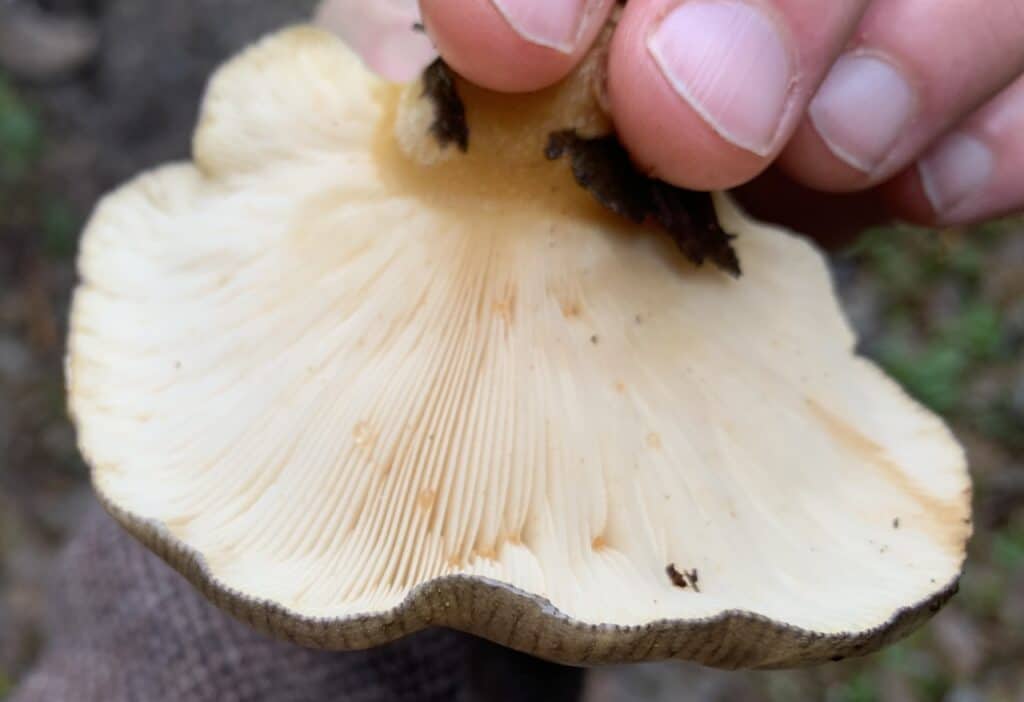
| Gills | Crowded, short-decurrent to adnate. Yellowish to cream-colored — distinctly warmer in tone than the white gills of true oysters. |
| Stipe | Very short or nearly absent, lateral, stubby. Often yellowish with small brownish scales. Much sturdier and scalier than the smooth stipe of Pleurotus. |
| Flesh | Thick, firm, with a distinctive gelatinous layer beneath the cap cuticle. Whitish to yellowish. Noticeably firmer and more rubbery than true oysters. |
| Odor | Mild, not distinctive. Lacks the anise-like sweetness of some Pleurotus species. |
| Taste | Mild to slightly bitter when raw. The gelatinous cuticle has little flavor. |
| Spore Deposit | White to pale cream. |
It fruits LATE — after the true oysters are done
The species name serotina means “late” in Latin, and this mushroom earns it. While true oyster mushrooms (Pleurotus) fruit from spring through mid-autumn, the late oyster doesn’t peak until November and December. It tolerates freezing temperatures and can even fruit after snowfall — making it one of the very few fleshy mushrooms you can forage in the dead of winter in the Pacific Northwest.
Late Oyster vs True Oyster (Pleurotus)
These two get confused regularly, but once you know what to look for, the differences are consistent and reliable:
| Feature | Late Oyster (Sarcomyxa) | True Oyster (Pleurotus) |
|---|---|---|
| Cap Color | Olive-green, olive-brown, yellowish-brown | White, gray, tan, or brown — never green |
| Cap Skin | Rubbery, peelable cuticle with gelatinous underlayer | Thin, dry, non-peelable |
| Gills | Yellowish to cream, short-decurrent | White, strongly decurrent (running down stipe) |
| Stipe | Stubby, scaly, yellowish with brown scales | Short or absent, smooth, white |
| Texture | Firm, rubbery, gelatinous layer under skin | Soft, tender, tears easily |
| Season | Late fall through winter (Nov-Jan peak) | Spring through mid-autumn |
Habitat & Where to Look
Sarcomyxa serotina is saprobic — it feeds on dead wood, not living trees. Look for it on fallen logs, standing deadwood, and old stumps of hardwood species. In the Pacific Northwest, its preferred substrates are red alder and bigleaf maple, though it also appears on black cottonwood and occasionally on conifers.
Best spots: Riparian corridors with mature alder, lowland forests with mixed hardwoods, and urban parks with standing dead maple or alder. Old logging roads through second-growth alder stands can be particularly productive. Check the same logs where you found true oysters earlier in the year — late oysters often colonize the same substrates.
Growth habit: Fruits in overlapping shelves and clusters, often several groups along the same log. A single productive log can yield dozens of fruitbodies. They can appear at any height on standing dead trees, so look up.
Season & Timing
The late oyster is one of the last fleshy mushrooms to fruit each year — and one of the first to appear after the new year. The season spans from October through January, with a sharp peak in November and December. Community observations from Oregon and Washington tell the story clearly:
Based on 3,312 community observations from Oregon and Washington
The seasonality chart shows one of the most dramatic late-season peaks of any PNW mushroom. Nearly 77% of all observations fall in just two months — November and December. January adds another meaningful flush, but by February the season is effectively over. Summer observations are negligible and likely represent misidentifications or old, persistent fruitbodies.
Explore Hardwood Stands Near You
Use Forayz to locate alder and maple habitat along rivers and in lowland forests — exactly where late oysters fruit in November and December.
Edibility & Cooking
Sarcomyxa serotina is edible and widely eaten in Japan, where it is commercially cultivated and sold as mukitake. However, it is a different culinary experience from true oyster mushrooms. The flesh is firmer and chewier, and the flavor is milder — some foragers find it bland compared to Pleurotus.
The key preparation tip: Peel the rubbery cap cuticle before cooking. The gelatinous skin layer is tough and unpleasant in texture. Once peeled, the underlying flesh responds well to sauteing, braising, and adding to soups and stews. In Japanese cooking, mukitake is commonly simmered in dashi-based soups and hot pots, where the firm texture holds up well to long cooking.
Harvesting notes: Select young, firm specimens. Older fruitbodies become waterlogged and slimy, especially after freeze-thaw cycles. Since this mushroom fruits in cold weather, specimens tend to stay fresh on the log longer than warm-season species — but once they start degrading, they go downhill quickly.
International Names
The late oyster is recognized and collected across the Northern Hemisphere. A few of its names in other languages reflect its distinctive traits:
- Japanese: Mukitake — from muki (to peel), referencing the peelable cap skin. Widely cultivated and eaten.
- German: Gelbstieliger Muschelseitling (yellow-stemmed shell oyster) or Spatherbst-Muscheling (late autumn shell fungus).
- Chinese: Known in some regions as a late autumn edible, collected from broadleaf forests.