Yellow flowerpot parasol mushroom

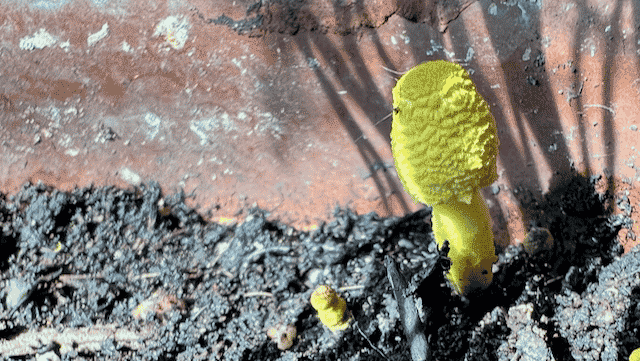
Have you found a small yellow mushroom growing with a houseplant? It is quite likely to be a mushroom native to tropical areas but found throughout the US with potted plants.

This mushroom known as Leucocoprinus birnbaumii

Leucocoprinus birnbaumii

more
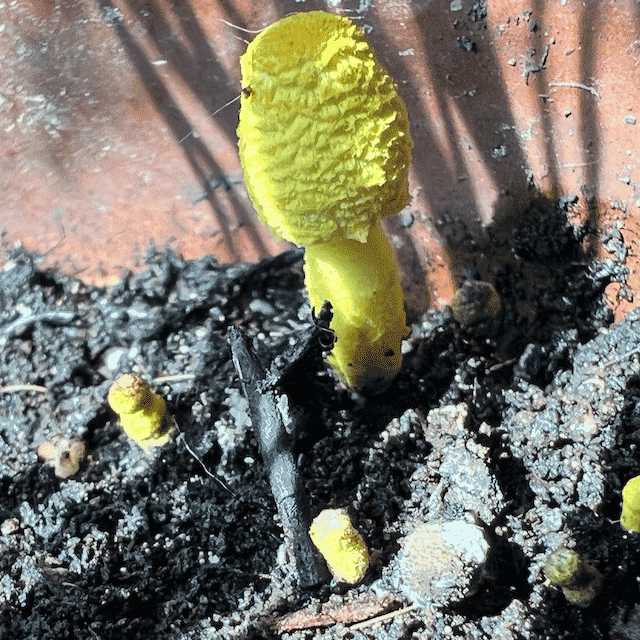
leucocoprinus birnbaumii square

Where did it come from?

These mushrooms are native to the tropics however they are now dispersed globally. The fungus is likely established in the soil of tripical houseplants. The fungus can live in the soil without creating mushrooms so it may go undetected. Heavy watering seems to promote mushroom fruiting.

How to kill mushrooms in houseplants?

There is much more to a mushroom than what you see above ground. Mushrooms grow from an interconnected web of mycelium that is often invisible to the naked eye. Unlike with plants, pulling out a mushroom has very little impact on the mycelial ‘roots’ which can regenerate from the smallest amount of tissue. Killing fungi in soil is incredibly difficult. One might try applying a fungicide, repotting in new soil, and reducing watering frequency. 

The mushroom is not harmful to the plant, and is only harmful to humans if eaten. If one is really concerned about pets or children eating the mushrooms, they could remove the mushrooms when they appear but expect them to return again in the future.

Edibility of Leucocoprinus birnbaumii

Toxic however so small and insubstantial that it is very unlikely one would eat enough to cause serious issues

Pro Membership

Get the data serious foragers use to find more mushrooms

Free members get soil temps, precipitation, and ecoregion data. Pro unlocks the layers that help you narrow down exactly where to look.

  • Historical burn perimeters — find morel habitat fast
  • Timber harvest boundaries across OR & WA
  • Detailed foraging area summaries with conditions
  • Offline maps in the Forayz iOS app

Similar Posts

  • Further Reading

    As I mention throughout this site, I am not an expert. My knowledge of mushrooms is based on my personal experience, videos, lectures, classes, and some excellent books. I’d like to share with you some of the books that I use most often and some that I know others really enjoy. ** This post is…

  • Upcoming Events

    Welcome to the 2026 season at Salish Mushrooms! Below are upcoming classes, tours, and forays. Contact Jeremy directly to schedule a private or small-group session, or browse the options below. Spring Mushroom Tours (Morels) — April through June 2026 Guided mushroom tours in the Mt. Baker-Snoqualmie National Forest. We’ll focus on morels and spring species…

  • Mushroom Cap Shapes

    One aspect of mushroom identification is comparing an unknown mushroom to descriptions of a known mushroom. Here are some common cap shapes and representations of these through familiar mushrooms. All mushrooms exhibit a variety of shapes throughout their lifecycle so identification through cap shape is more art than science. Key Takeaways Cap shapes can be…

  • Elementary Mushrooms v1.1

    This is a simplified talk on some interesting mushrooms we can find around the Pacific Northwest. Pro Membership Get the data serious foragers use to find more mushrooms Free members get soil temps, precipitation, and ecoregion data. Pro unlocks the layers that help you narrow down exactly where to look. Historical burn perimeters — find…

  • How to identify Matsutake

    Matsutake mushrooms, highly valued for their unique aroma and culinary applications, can be identified by several key features: Together, these characteristics are essential for accurately identifying matsutake mushrooms in the wild. Matsutake is also known by scientific names Tricholoma magnivelare and Tricholoma murrillianum Similar in Appearance: Smith’s AmanitaAmanita smithiana Key features of Amanita smithiana: 1….