
Black Cottonwood Populus trichocarpa
Black cottonwood (Populus trichocarpa) is a fast-growing riparian tree that often reaches 100 feet (USFS FEIS). For spring foragers it is a landmark: several morels grow with it, along with the early Verpa bohemica, and its dead wood hosts oysters and other wood-decay fungi.
Follow rivers, creeks, and wetland edges in western Washington or Oregon to find it. Cottonwood grows from sea level to mid-elevation, often forming stands on river floodplains and gravel bars.
Identification
Cottonwood is recognizable by its leaves, bark, and tall straight trunk, and by the cotton that fills the air after the seed capsules open in late spring and early summer. In western Washington, the look-alikes to rule out are red alder and bigleaf maple.
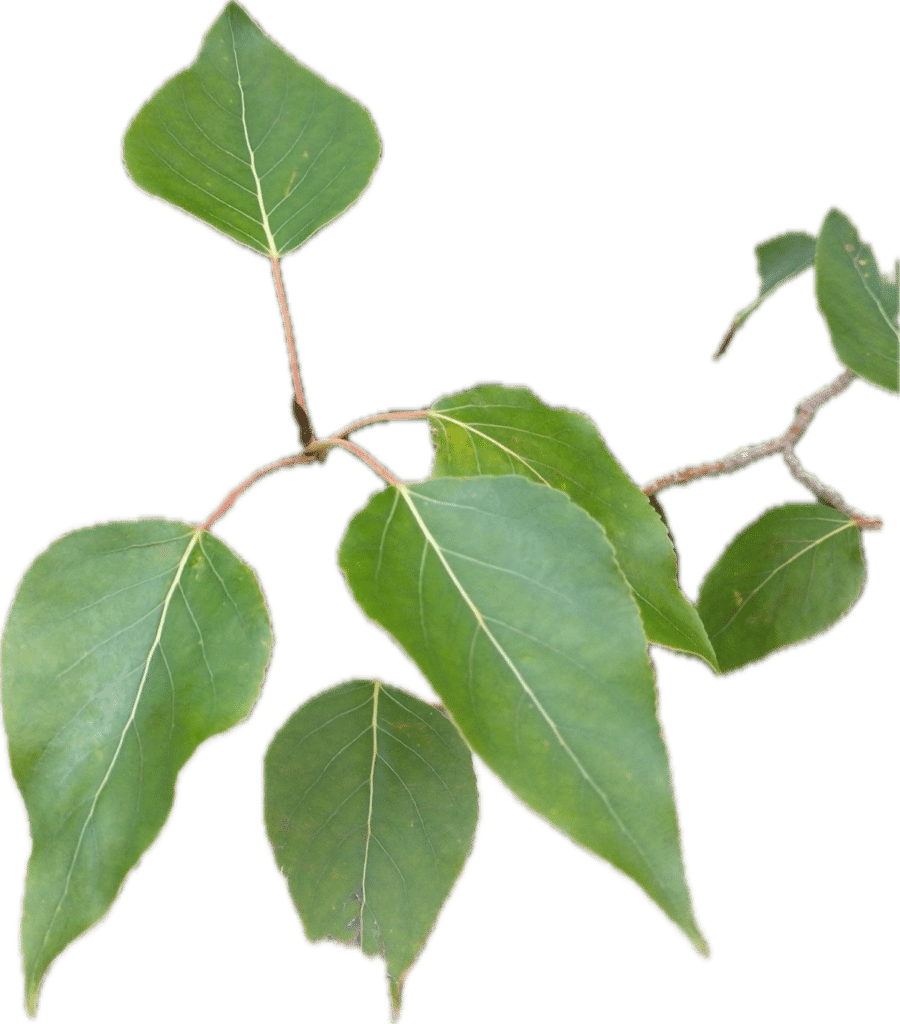
Leaves
Oval to heart-shaped with a tapered tip. Smooth, somewhat shiny surface. Edges very slightly serrated. Underside is pale. Red alder leaves are heavily serrated; bigleaf maple leaves are lobed.
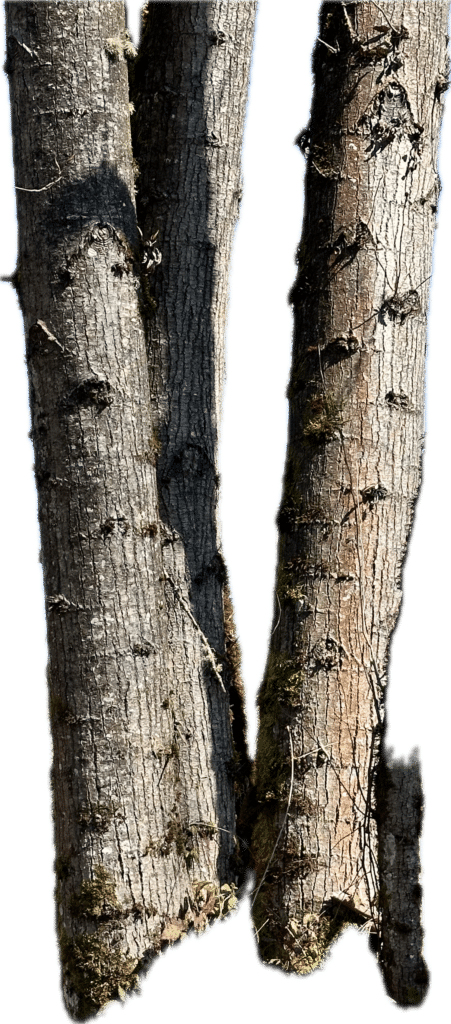
Bark
Dark gray-brown with deep furrows on mature trees (old bark is thick and furrowed, FEIS). Bigleaf maple bark is also furrowed, but its leaves are lobed. Red alder bark is smooth and pale. Young cottonwoods have smooth greenish-gray bark.
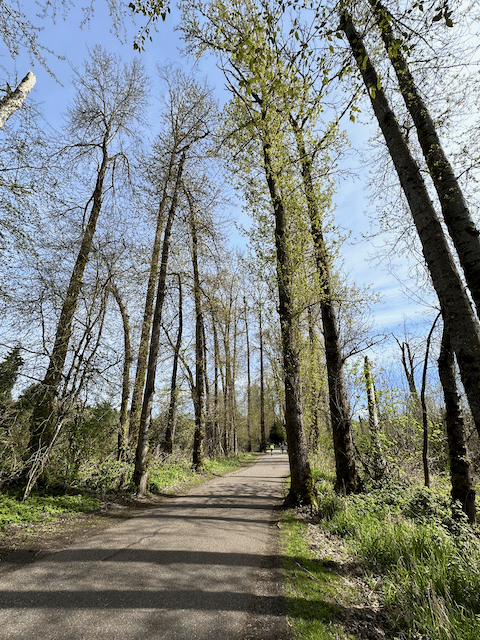
Stature
Tall and straight-trunked, often not forking until the upper canopy, commonly reaching about 100 feet and occasionally more (FEIS). Bigleaf maple tends toward a rounder, more branched crown.
Where to Find Cottonwood
Follow the water. Cottonwood grows along rivers, streams, lake margins, and wetland edges in the Pacific Northwest lowlands. River trails and greenways near cities often have cottonwood stands. The seed cotton is released from late April into July (FEIS), so late spring and early summer is the easiest time to spot it.
Range
Black cottonwood ranges from the Kenai Peninsula of Alaska to Baja California, east to the northern Rockies and Alberta (FEIS). It prefers moist soils and grows better along moving water than near stagnant water (FEIS).
Distribution in Washington & Oregon
Associated Mushrooms
Cottonwood is associated with several morels in spring and with Verpa, and its dead wood hosts wood-decay fungi through the rest of the year. Populus is typically ectomycorrhizal, but black cottonwood can also host arbuscular mycorrhizal fungi, especially early in stand development or on flooded sites (FEIS).
Oyster Mushroom
Pleurotus populinus
On hardwoods, especially black cottonwood and aspen. The larger, browner oysters in stacked shelves on dead cottonwood usually go by this name; it belongs to the oyster complex, whose members are hard to tell apart.
Saprotrophic Choice Edible Fall–WinterVelvet Foot
Flammulina velutipes group
Grows in clusters on hardwood snags, stumps and logs from fall to spring, more in cold weather. The common species here may be F. filiformis, which needs an ITS sequence to separate; F. populicola is the one tied to cottonwood and aspen roots, but it is uncommon and mostly east of the Cascades (Siegel & Schwarz). Deadly Galerina also grow on wood in similar colors, so be certain of your ID.
Saprotrophic Edible Fall–WinterVerpa
Verpa bohemica
An early-spring mushroom of cottonwood river bottoms, usually 1 to 3 weeks ahead of true morels (Arora). Its cap joins the stem only at the very top, and the stem is stuffed with pith; true morels are hollow throughout. Sources disagree on its safety; see our Verpa page before eating.
Caution SpringPlan Your Spring Morel Hunt on Forayz
Use soil temperature, precipitation data, and the cottonwood habitat layer together to find the right conditions. Pro members get full access to overlays and burn perimeter data.
Also on iOS: ForayzU
Practice identifying Pacific Northwest trees and mushrooms with spaced-repetition flashcards — including a dedicated tree identification deck.
Ecological Role
Black cottonwood is a pioneer and early seral species, and it is very shade intolerant (FEIS). It grows fast and often colonizes bare gravel bars. Cottonwood stands are also riparian wildlife habitat.
In western Oregon and Washington it grows with willows, red alder, bigleaf maple and other riparian trees (FEIS). It typically begins producing seed at 7 to 10 years and sets large crops nearly every year; the white fluff is the cotton carrying those seeds.
Photos: Black Cottonwood — iNaturalist (CC0) · Morel — Kari Moreland (CC0) · Velvet Foot — © Dave W, CC BY-SA.
Sources: Mushrooms of Cascadia (Siegel & Schwarz, 2024); MycoMatch (© Ian Gibson), a compilation of published descriptions through which most other field-guide authors named here are quoted; Danny’s DNA Discoveries and the PNW Pictorial Key (© Danny Miller); iNaturalist observations.