
Mushrooms of the Pacific NorthwestA guide to the major morphological groups
Mushrooms are grouped by their spore-bearing structures — gills, pores, teeth, veins, pits, and others. Learning to recognize these broad groups is the first step toward narrowing down what you’ve found in the field. Each group below links to a dedicated page with more detail and key species. New to all this? Start with the difference between a fungus and a mushroom.

Gilled
The largest group of mushrooms. Thin blade-like gills radiate from the stem on the cap’s underside, releasing spores into the air. This group includes prized edibles like matsutake and oysters and deadly species in Amanita — learning gill features is essential for safe identification.
Explore Gilled Mushrooms →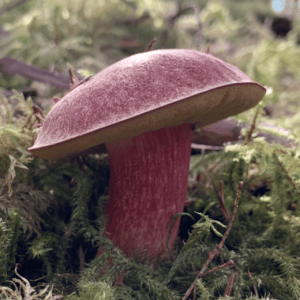
Boletes
Instead of gills, boletes have a spongy layer of pores on the underside of the cap. Many are excellent edibles — king boletes, admirable boletes, and butter boletes are PNW favorites. A few are toxic: the red-pored Rubroboletus pulcherrimus causes severe gastrointestinal illness and has been linked to at least one death (Bessette).
Explore Boletes →Veinchanterelle-like
Blunt, forking ridges or veins run down the underside of the cap — not true gills. Chanterelles are the most well-known members of this group and among the most popular wild mushrooms in the Pacific Northwest.
Explore Veined Mushrooms →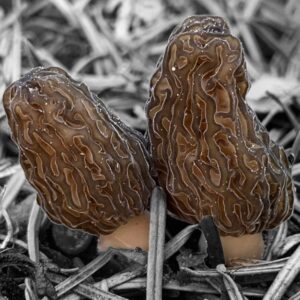
Morels
Distinctive honeycomb-pitted caps on a hollow stem. Morels are the most sought-after spring mushroom in the PNW, fruiting in burned forests, river bottoms, and disturbed ground. Learn to distinguish them from false morels.
Explore Morels →Polypores
Mostly tough, shelf-like fungi on wood, with a pore surface underneath; a few have stems and grow on the ground. Most are too leathery to eat, but chicken of the woods is a good edible when young. Many decompose dead trees, and some attack living ones.
Explore Polypores →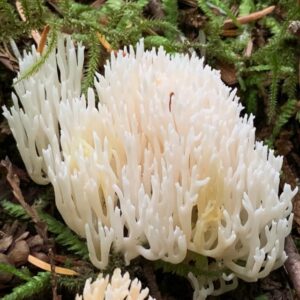
Coral
Branching, upright structures that look like underwater coral. Most PNW corals are Ramaria, and many species look nearly identical in the field, so identifying them to species is hard. The cauliflower mushroom, with flattened, ribbon-like lobes, is often grouped with them but isn’t closely related.
Explore Coral Mushrooms →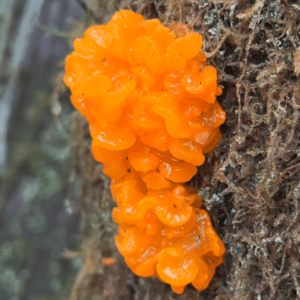
Jelly
Soft, gelatinous, often translucent mushrooms that can dry out and rehydrate with rain. Witch’s butter, orange jelly spot, and the toothed jelly fungus are common PNW examples. Most are harmless but few are worth eating.
Explore Jelly Mushrooms →Puffball
Round or pear-shaped mushrooms that release spores in a cloud of dust when mature. Several are edible when young and the interior is firm and pure white. Always slice them in half: any color or internal structure means it isn’t an edible puffball — it could be a young Amanita or a toxic earthball.
Explore Puffballs →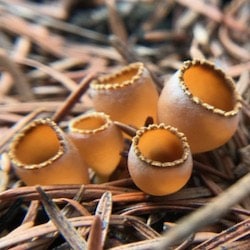
Cup
Bowl- or cup-shaped fruiting bodies, often small and growing on soil, wood, or duff. These are ascomycetes; the elfin saddles are close relatives. None of the PNW cup fungi are choice edibles, and the pink crown cup is mildly toxic.
Explore Cup Fungi →Club
Simple, upright clubs rising from the ground or wood, grouped here with the smaller corals. The candy club (Clavariadelphus truncatus) is the best known, and one of the few worth eating. Most are too small, tough, or bland to eat.
Explore Club Fungi →Find These Mushrooms in the Field
Forayz shows you where mushrooms fruit across the Pacific Northwest — soil data, burn perimeters, and community observations on one map.
Learn more about ForayzEvery Species Guide
Every mushroom guide on the site, arranged by the groups above. If you already have a rough idea of what you are holding, start here.
Gilled
- Agaricus
- Amanita
- Blewit (Collybia nuda)
- Brittlegills (Russula)
- Deer Mushroom (Pluteus)
- Fairy Ring Mushroom (Marasmius oreades)
- Ink Caps & Shaggy Mane (coprinoid)
- Late Oyster (Sarcomyxa serotina)
- Matsutake (Tricholoma murrillianum)
- Mycena
- Oyster Mushroom (Pleurotus)
- Psilocybe ovoideocystidiata
- The Prince (Agaricus augustus)
- Violet Webcap (Cortinarius violaceus)