Fungus vs. Mushroom What’s the Difference?

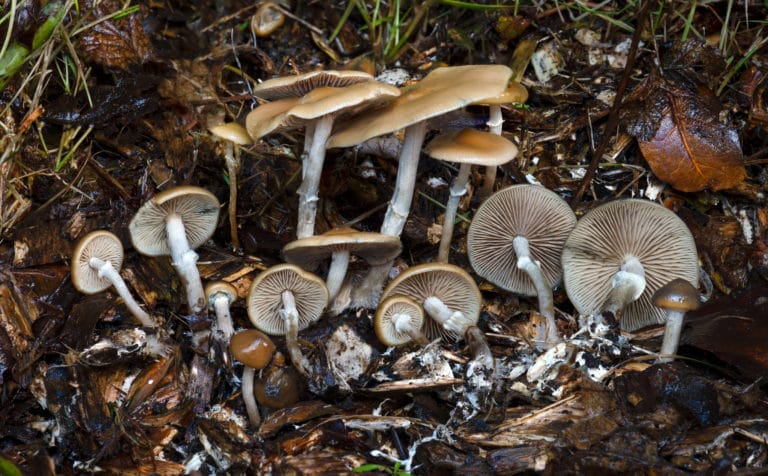
People use “fungus” and “mushroom” interchangeably, but they’re not the same thing. A fungus is the entire organism. A mushroom is just one part of it — the reproductive structure that pops up above ground to release spores. It’s like the difference between an apple tree and an apple.
This distinction matters more than you might think. Understanding what a fungus actually is — and how mushrooms fit into the picture — changes how you think about finding them. The mushroom you pick is a brief, visible event. The organism that produced it has been living underground for months, years, or decades, connected to tree roots and threaded through the soil.
The iceberg beneath the forest floor
Think of a mushroom like the tip of an iceberg. The part you see — the cap, the stem, the gills — is a tiny fraction of the organism. Below the surface, a vast network of thread-like cells called mycelium extends through the soil, sometimes spanning acres. This hidden network is the actual fungus. The mushroom is just its temporary, spore-producing structure.
What Is a Fungus?
A fungus is any organism belonging to Kingdom Fungi — a kingdom of life as distinct from plants and animals as those two are from each other. Fungi don’t photosynthesize like plants. They absorb nutrients from their environment, breaking down organic matter or forming partnerships with other organisms.
Kingdom Fungi is enormous and diverse. It includes:
- Mushroom-producing fungi: The ones foragers care about. These are mostly in the phyla Basidiomycota and Ascomycota.
- Yeasts: Single-celled fungi used in bread, beer, and wine production.
- Molds: The fuzzy growth on old bread or fruit. Penicillium molds gave us antibiotics.
- Rusts and smuts: Plant pathogens that cause crop diseases. No mushrooms involved.
- Lichens: Partnerships between fungi and algae or cyanobacteria. They look like crusty patches on rocks and trees.
Most fungi spend their entire lives as mycelium — microscopic threads woven through soil, wood, or other substrates. You walk over fungal networks every time you step into a forest. Only a small percentage of fungal species ever produce a visible mushroom.
Fungal diversity by the numbers
Scientists estimate there are 2 to 5 million fungal species on Earth. Only about 150,000 have been formally described. Of those, roughly 14,000 produce what we’d recognize as a “mushroom.” That means the vast majority of fungi are invisible to the naked eye — they exist only as mycelium, spores, or microscopic structures.
What Is a Mushroom?
A mushroom is the fruiting body of certain fungi — the structure that produces and releases spores for reproduction. When conditions are right (enough moisture, the right temperature, sufficient nutrients), the underground mycelium builds a mushroom and pushes it above ground. The mushroom releases millions of spores into the air, the wind carries them to new locations, and the cycle begins again.
A typical mushroom has several parts:
- Cap (pileus): The top of the mushroom. Protects the spore-producing surface underneath. Caps range from flat to convex to funnel-shaped.
- Gills, pores, or teeth: The spore-producing surface beneath the cap. Chanterelles have ridged “false gills,” boletes have spongy pores, and hedgehog mushrooms have tiny teeth.
- Stem (stipe): Elevates the cap above the ground so spores can catch the wind. Not all mushrooms have stems — puffballs and shelf fungi grow differently.
- Ring (annulus): A skirt-like remnant on the stem, left over from a partial veil that once covered the gills. Present on some species (like Agaricus), absent on others.
- Volva: A cup-like structure at the base of the stem, left over from a universal veil. Important for identifying Amanita species.
Not all fruiting bodies look like the classic cap-and-stem mushroom. Morels are honeycombed, coral fungi are branched, puffballs are round, and shelf fungi grow flat against trees. They’re all mushrooms — all spore-producing structures built by fungi.
Fungus vs. Mushroom: Side by Side
| Feature | Fungus | Mushroom |
|---|---|---|
| Definition | The entire organism — mycelium, spores, and any fruiting bodies it produces | The fruiting body only — the visible, spore-producing structure |
| Examples | Yeasts, molds, rusts, lichens, mushroom-producing fungi | Chanterelles, morels, boletes, puffballs, shelf fungi |
| Visibility | Mostly invisible — mycelium is microscopic and hidden in soil or wood | Visible above ground (temporarily) |
| Lifespan | Years to centuries — mycelial networks persist indefinitely | Days to weeks — mushrooms appear, release spores, and decay |
| Function | Nutrient absorption, decomposition, symbiosis with plants | Spore production and dispersal (reproduction) |
| Analogy | The apple tree | The apple |
See How Fungi Connect to Their Environment
Forayz maps the environmental conditions fungi depend on — soil moisture, soil temperature, precipitation, and the tree species they partner with. Free for all users.
Types of Fungi That Produce Mushrooms
Mushroom-producing fungi aren’t all doing the same thing. They fall into three broad ecological categories based on how they get their nutrients. Each type grows in different places, under different conditions — which is exactly why this matters if you’re trying to find them.
Mycorrhizal Fungi
These fungi form partnerships with living trees. Their mycelium wraps around or penetrates tree roots, trading soil nutrients (phosphorus, nitrogen, water) for sugars the tree produces through photosynthesis. Neither organism thrives as well without the other.
What this means for foragers: Mycorrhizal mushrooms only grow near their partner trees. No trees, no mushrooms. In the Pacific Northwest, this is the biggest category of edible wild mushrooms.
- Chanterelles — partner with Douglas fir, western hemlock, and Sitka spruce. The most popular wild mushroom in the PNW.
- King boletes (Boletus edulis group) — partner with spruce and fir at higher elevations.
- Matsutake (Tricholoma murrillianum) — partner with shore pine and lodgepole pine in sandy, nutrient-poor soils.
- Hedgehog mushrooms — partner with conifers in the same forests where you find chanterelles.
Saprobic Fungi
Saprobic (or saprophytic) fungi decompose dead organic matter — fallen logs, leaf litter, wood chips, dead roots. They’re nature’s recyclers, breaking down complex organic compounds and returning nutrients to the soil.
What this means for foragers: Saprobic mushrooms grow on or near dead wood and decaying organic matter. You find them on stumps, fallen logs, wood chip beds, and compost piles — not connected to living trees.
- Oyster mushrooms (Pleurotus spp.) — grow on dead hardwood, especially alder and cottonwood. One of the easiest mushrooms to identify in the PNW.
- Morels — complex ecology, but many species fruit heavily in disturbed ground and burned forests where they decompose dead roots and organic debris.
- Shaggy manes (Coprinus comatus) — fruit in disturbed soil, lawns, gravel shoulders, and wood chip beds throughout urban and suburban areas.
Parasitic Fungi
Parasitic fungi attack living organisms — trees, insects, or even other fungi. They take nutrients from their host without giving anything back, often weakening or killing it over time.
What this means for foragers: Parasitic mushrooms appear on living (often stressed or dying) trees and other organisms. Some of the most prized edibles are parasites.
- Chicken of the woods (Laetiporus spp.) — attacks living and recently dead hardwoods and conifers. Bright orange shelf fungus, unmistakable.
- Honey mushrooms (Armillaria spp.) — aggressive tree parasites that cause root rot. They produce clusters of tan mushrooms at the base of infected trees every fall. Armillaria ostoyae in Oregon holds the record for the largest known organism on Earth — a single individual spanning 2,385 acres.
- Lobster mushrooms — a parasitic fungus (Hypomyces lactifluorum) that attacks Russula and Lactarius mushrooms, transforming them into the dense, red-orange “lobster mushroom.”
Why This Matters for Mushroom Foragers
When you understand the fungus-mushroom distinction, you stop thinking of mushroom hunting as a random walk through the woods. You start reading the landscape.
- Tree identification becomes mushroom identification. Mycorrhizal fungi partner with specific tree species. If you can identify Douglas fir, western hemlock, and Sitka spruce, you’ve narrowed down where chanterelles, hedgehogs, and king boletes will fruit.
- Timing makes sense. Mushrooms appear when the underground mycelium has enough moisture and the right temperature to invest energy in reproduction. Fall rains trigger chanterelles. Spring warmth after snowmelt triggers morels. The mushroom is a response to conditions — not a random event.
- You know where to look. Saprobic mushrooms grow on dead wood. Mycorrhizal mushrooms grow near living tree roots. Parasitic mushrooms grow on stressed hosts. Once you know what category you’re after, you know what to scan for.
- Picking mushrooms doesn’t hurt the fungus. This is one of the most common concerns for new foragers. The mushroom is a temporary structure — the equivalent of picking an apple. The mycelium underground is unaffected and will fruit again when conditions are right.
Fungal Ecology on a Map
Understanding fungal ecology helps you find mushrooms. Forayz shows you the trees, soil conditions, and environmental data that different fungi depend on — precipitation patterns, soil moisture, ecoregions, and forest types.
Related Resources
Get the data serious foragers use to find more mushrooms
Free members get soil temps, precipitation, and ecoregion data. Pro unlocks the layers that help you narrow down exactly where to look.
- Historical burn perimeters — find morel habitat fast
- Tree species maps & timber harvest boundaries
- Foraging areas with fruiting calendars & conditions
- Offline maps in the iOS & Android apps