Fall Mushroom Foraging Near Seattle What actually comes up from September through December — in the city, and where to drive when it doesn’t
Fall is the main mushroom season in western Washington. The summer drought breaks with the first soaking rains, usually in late September or October, and mushrooms keep appearing until freezing weather arrives, in the mountains first.
But “near Seattle” and “in the Cascades” are two very different hunts. Several fall mushrooms fruit in city parks, planting strips and back yards. Others are mostly found outside the city. This guide sorts one from the other and shows roughly when each one is reported.
When Each One Shows Up
Timing shifts from year to year with the rain. Here is the rough shape of the season for the mushrooms people around Seattle look for.
| Species | Aug | Sep | Oct | Nov | Dec | Where |
|---|---|---|---|---|---|---|
| Shaggy Mane | • | ● | ◐ | • | In the city | |
| Shaggy Parasol | • | ● | ◐ | • | In the city | |
| King Bolete | ◐ | ● | ● | ◐ | Both | |
| The Prince | ◐ | ◐ | ◐ | • | In the city | |
| Oyster | • | ◐ | ● | ● | In the city | |
| Blewit | ◐ | ● | ◐ | In the city | ||
| Bear’s Head Tooth | • | ◐ | ● | • | Foothills | |
| Chanterelle | • | ◐ | ● | ● | ◐ | Foothills |
| Matsutake | • | • | ● | ● | • | Farther out |
| Hedgehog | • | ◐ | ● | ● | ◐ | Foothills |
| Lobster | ◐ | ● | ● | ◐ | Foothills |
● peak ◐ reliably around • possible, spotty
In the city means it is reported from Seattle-area parks, planting strips and back yards. Foothills means it is found mainly in forest outside the city, and Farther out means it is mostly found well away from the wet west-side forests. Both means it is reported in both settings. Symbols compare each month with that species’ busiest month of the year, based on iNaturalist research-grade observations, so the prince, which peaks in early summer, shows only mid-level symbols in fall.
Two Different Hunts
The fall mushrooms most often reported in Seattle itself are urban ones: shaggy manes and shaggy parasols in lawns and wood chips, the prince in landscaped beds, blewits in leaf litter and mulch, and oysters on dead hardwood such as alder and maple. You can find mushrooms on a fall walk without leaving the city if you look for the species that live here.
The classic Pacific Northwest fall harvest is a different trip. Chanterelles and hedgehogs are found mainly in conifer forest outside the city, and matsutake mostly farther out still, in habitat the wet west-side forests largely lack. Finding one inside the city is a lucky find, not a plan. For a basket, plan to drive to conifer forest.
October is the busiest month for most of the species below. Which ones you find depends on whether you drive.
See the Whole Season at Once
The Seattle mushroom calendar lays out all twelve months, species by species, plus local rainfall and temperature normals.
Fall Mushrooms Worth Knowing Around Seattle
Findable inside the city
Shaggy Mane
Coprinus comatus
A tall white cylinder with shaggy brownish scales that dissolves from the cap edge upward into black ink as it ages. It grows in lawns, wood chips and disturbed ground, singly or in dense troops. Pick it young and cook it the same day, since it liquefies fast. Skip ones from roadsides and other polluted spots, since they may accumulate toxic chemicals and heavy metals (Siegel & Schwarz, Mushrooms of Cascadia).
Peaks October Lawns & wood chips Photo: Jeremy Collison (CC BY-NC)Shaggy Parasol
Chlorophyllum olivieri
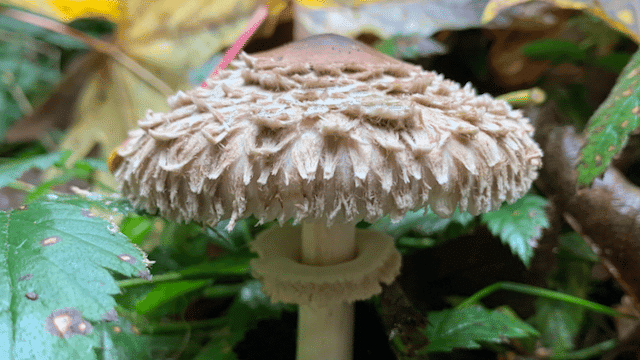
A large, tall mushroom with a shaggy cap of olive-grey to brownish scales, white gills that bruise orange to pinkish, a ring on the stem and a bulbous stem base. It grows in leaf litter and humus in disturbed ground, including gardens and mulched landscaping. Chlorophyllum brunneum, a close look-alike, also grows in urban settings; Siegel & Schwarz describe it as often urban, though most Seattle-area iNaturalist records are C. olivieri. Shaggy parasols can cause stomach upset or allergic reactions, so eat only fresh caps, cook them thoroughly and start with a small portion (Siegel & Schwarz).
Peaks October Mulch & garden bedsKing Bolete
Boletus edulis
A heavy, bun-capped bolete with pores instead of gills, a raised white net on the upper stem, white flesh that does not bruise blue, and a mild taste. In the Pacific Northwest it has two main habitats: Sitka spruce on the coast and higher-elevation conifer forest in the Cascades. iNaturalist has research-grade records from inside Seattle, including the University of Washington campus, parks and city streets, but most Washington records come from conifer forest.
September–October ConifersThe Prince
Agaricus augustus
A large Agaricus with a scaly golden-brown cap that bruises yellow, a scaly stem below a membranous ring, free gills that darken to chocolate brown, and a strong almond smell. It fruits from late spring into fall on disturbed ground with deep organic litter, including landscaped beds, paths and compost. A toxic look-alike also bruises yellow; see the look-alikes below.
Late spring–fall Disturbed ground Photo: Drew Henderson, Mushroom Observer (CC BY-SA)Blewit
Collybia nuda
Violet to lilac on cap, gills and stem when fresh, fading to brownish with age. It grows in leaf litter, compost and mulch, and fruits from late fall into early spring. Purple webcaps (Cortinarius) look similar and some are toxic: blewits have a pinkish-buff spore print, webcaps a rusty-brown one and often a cobweb-like veil. Cook blewits thoroughly, since raw ones can upset the stomach (Lincoff).
Peaks November Leaf litter & compost Photo: Jeremy Collison (CC BY-NC)Close to the city, but rarely in it
These are the mushrooms most people picture when they think “Pacific Northwest fall.” They are mostly found outside the city, in conifer forest. Learn them, then drive for them.
Pacific Golden Chanterelle
Cantharellus formosus
Yellow to brownish-ochre cap, and blunt, forking false gills (ridges, not blades) running down the stem. It grows with Douglas-fir and western hemlock, especially in younger to middle-aged forest, and is much more common west of the Cascade crest. Chanterelles are slow growers rather than a one-week flush: they often appear a couple of weeks after fall rain returns and keep coming until freezing weather, which reaches the mountains first. Oregon named it the state mushroom in 1999.
October–November Conifer forest Photo: Jeremy Collison (CC BY-NC)Matsutake
Tricholoma murrillianum
A firm, white to creamy-buff mushroom with a thick cottony veil that leaves a ring on the stem, flesh that stains orangish, and a spicy-musty odor often described as cinnamon and dirty socks. Smell narrows it down but does not confirm it: people differ in what they smell, and young Amanita smithiana, which is toxic, is reported to smell similar. The two productive habitats are coastal shore pine on sandy soil, and drier Douglas-fir, true fir and hemlock forest inland; away from the coast it is largely absent from the wet west-side forests.
October–November Sandy conifer duffHedgehog
Hydnum spp.
A good first mushroom for beginners: a cream to orange-tan, irregular cap with soft spines hanging underneath instead of gills or pores, which rub off easily with a fingertip. No dangerous mushroom in our region has spines there. The Pacific Northwest hedgehogs are several closely related species, all good edibles, and are mycorrhizal with conifers, especially spruce and pine. They fruit in fall and often keep going through winter.
Peaks October Conifer forestLobster Mushroom
Hypomyces lactifluorum
Not a mushroom species but a bright orange parasitic fungus that engulfs a host mushroom, in the Pacific Northwest almost always Russula brevipes (Siegel & Schwarz). The result is a lumpy orange-crusted mass with no gills and firm white flesh inside. It starts fruiting in summer and continues through fall.
Peaks October Conifer forest Photo: Drew Henderson, Mushroom Observer (CC BY-SA)How the Season Unfolds
Late August & September — the shoulder
Thin and weather-dependent. The prince, king boletes and lobster mushrooms are around, and chanterelles and matsutake are reported in small numbers. Seattle’s monthly precipitation normal rises from 0.83 inches in August to 1.37 in September and 3.49 in October.
October — the peak
October is the busiest month for most of the species here. Shaggy manes and shaggy parasols come up in lawns and mulch, oysters are common on dead hardwood, and chanterelles, hedgehogs, lobster mushrooms and bear’s head tooth fungus are at or near their peak in forest outside the city. Matsutake are also at their peak where they grow.
November — the second act
Shaggy manes are still going, blewits peak in the leaf litter, and oysters are at their fall high. Chanterelles, hedgehogs and matsutake are all still being reported. Rainfall averages 5.8 inches, the wettest month of the Seattle year.
December — winding down
Blewits, oysters and hedgehogs are still reported, and chanterelles continue at lower elevations until freezing weather. Seattle averages about eight days in December with a low of 32°F or below, and colder weather ends fruiting for most species, in the mountains first.
Look-alikes That Matter
Oysters vs. angel wings. Pleurocybella porrigens is thin-fleshed, stemless and strikingly white, and grows on well-decayed conifer wood, most often western hemlock. Many people have eaten it without harm, but deaths in Japan were attributed to a closely related species, and the local angel wings are best avoided (Siegel & Schwarz). Oysters can also grow on conifers, so a thin white shelf on conifer wood deserves a careful look whatever it is growing on.
The prince vs. the yellow-stainers. The toxic yellow-stainer (Agaricus xanthodermus) has a smooth, whitish to grayish cap and smells of phenol, like ink or antiseptic, rather than almond. But some people cannot smell phenol, and the prince bruises yellow too, so neither smell nor a scratch test is safe on its own. Check the golden scaly cap, the scaly stem and the almond smell together, and take a spore print.
Shaggy mane vs. the alcohol inky caps. Coprinopsis atramentaria and relatives have grayish caps that are smooth or only slightly scaly, not a shaggy white cylinder. They contain coprine, which blocks alcohol metabolism and can cause flushing, nausea and a racing heart if you drink alcohol within about three days of eating them (Benjamin). Arora notes that shaggy mane may rarely react with alcohol too, so skip the drink after either.
Shaggy parasol vs. its relatives. Chlorophyllum brunneum is similar but has more contrasting dark scales on a pale cap and an abruptly rimmed basal bulb, and is listed as edible with caution. The green-spored Chlorophyllum molybdites is poisonous and causes severe vomiting and diarrhea. It is rare here, grows in lawns, and its gills turn greenish gray with age, so take a spore print: green means don’t eat it. Any Chlorophyllum can cause stomach upset or an allergic reaction, so start with a small, well-cooked portion (Siegel & Schwarz).
Matsutake vs. Amanita smithiana. This one matters. A. smithiana is white and also grows in conifer woods in fall, and it has caused kidney failure. It usually smells mild or unpleasant, but young ones are occasionally reported to smell spicy like matsutake, so smell cannot separate them. Look instead at the structure: a matsutake has a thick cottony ring and appressed brown scales on the stem below it, while A. smithiana has a fragile veil, scruffy scales and powdery remnants on the cap. Both taper to a point at the base, so base shape does not separate them, and neither does firmness: A. smithiana can be quite firm too. Until you can reliably tell them apart yourself, have every mushroom checked in hand by someone who can. If you are not certain, leave it.
Chanterelles vs. false chanterelles. Hygrophoropsis aurantiaca has thin, crowded, repeatedly forking true gills and soft, thin flesh, and grows on rotting wood, coarse humus and wood chips. It has caused mild reactions in some people. A chanterelle’s underside is made of blunt, forking ridges that run down the stem, over solid, stringy white flesh.
Edible does not mean safe for everyone. Personal sensitivities, preparation, and accurate identification all matter, and no article is a substitute for handling a species with someone who knows it.
Where to Go From the City
The Snoqualmie corridor along I-90 is close to Seattle and has conifer forest near North Bend. North of the city, the Mountain Loop country around Darrington and the Skykomish valley around Index also have conifer forest. The golden chanterelle is much easier to find on the wet west side of the Cascades than on the east side.
Wherever you go, check the land status before you pick. Rules differ between national forest, state DNR land, county parks, and private timber. Foraging in city parks is uncommon, since the best edible species grow elsewhere, and walking off-trail in busy parks is generally discouraged because heavy use damages the habitat.
Check Conditions Before You Drive
The Forayz map layers soil moisture, soil temperature, recent rainfall, public land boundaries, and burn history over the whole region — so you can see whether the woods have actually had their rain yet.
Seasonality is based on iNaturalist research-grade observations for King County and Washington state; timing shifts from year to year with the rain. Climate normals: NOAA NCEI 1991–2020, Seattle Boeing Field station.
Sources: Mushrooms of Cascadia (Siegel & Schwarz, 2024); MycoMatch (© Ian Gibson), a compilation of published descriptions through which most other field-guide authors named here are quoted; iNaturalist observations; NOAA NCEI 1991–2020 climate normals.
Get the data serious foragers use to find more mushrooms
Free members get soil conditions, the past week of rain, snow, smoke and historical burns. Pro unlocks the layers that help you narrow down exactly where to look.
- Newest burn years, managed burns & burn severity
- Tree species maps (22 species) & timber harvests
- Town and mountain pass fruiting calendars with current conditions
- Offline map downloads in the iOS & Android apps
- 14- and 30-day rainfall windows
- Soil temperature & moisture at full zoom