“Is This a Morel?” A free photo quiz to sharpen your morel identification skills before you hit the woods
Morel season is approaching, and every year we see the same questions in foraging groups: “Is this a morel?” Sometimes it is. Sometimes it’s a Verpa. And sometimes it’s a Gyromitra — which can make you seriously ill.
We built a quick visual quiz to help you practice telling them apart. It uses real photos of real mushrooms found in the Pacific Northwest, and it explains why each answer is correct — not just whether you got it right.
Is This a Morel?
20 real mushroom photos. Three choices per round: Morel, Not a Morel, or I’m Not Sure. Instant feedback with ID tips after every answer.
Take the Quiz
Free · No account required · Takes 3-5 minutes
How It Works
Each round shows you a real photo and asks a simple question: is this a morel? You pick one of three answers:
Yes, It’s a Morel
You’re confident this is a true morel (Morchella species).
No, Not a Morel
You recognize this as a lookalike or unrelated species.
I’m Not Sure
Honest uncertainty. You’ll learn the answer either way.
After each answer, you get instant feedback explaining what the mushroom is, what features to look for, and — for lookalikes — what distinguishes them from true morels. The “I’m Not Sure” option is there on purpose: in real life, uncertainty is the safest response when you’re not confident in an ID.
What You’ll Learn to Recognize
The quiz covers the species you’re most likely to encounter (or confuse) during morel season in the PNW:
Black Morels
Morchella elata group
The classic burn morel. Dark ridges, fully hollow when sliced, cap attached directly to the stem.
True morel
Yellow Morels
Morchella americana group
Pale to golden, honeycomb pits. Found in river bottoms, old orchards, and urban landscapes.
True morel
Landscape Morels
Morchella importuna
Urban morels in woodchips, gardens, and disturbed ground. Often the first morels of the year.
True morel
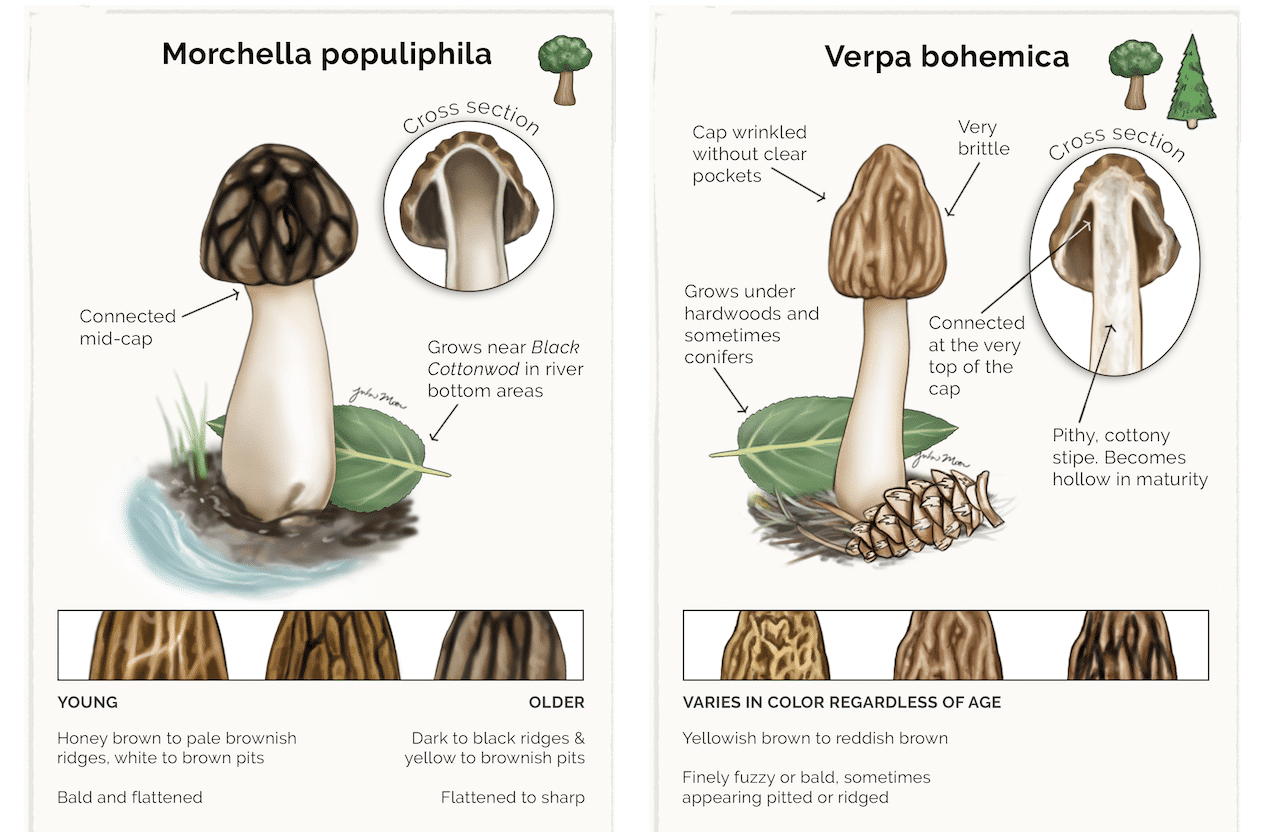
Verpa bohemica
Early morel / wrinkled thimble cap
Cap hangs like a skirt, attached only at the top. Stem stuffed with cottony fibers — not hollow.
Lookalike
Gyromitra
False morel / brain mushroom
Brain-like, lobed cap — no pits or ridges. Contains gyromitrin toxin. Not safe to eat fresh.
Dangerous lookalike
Half-Free Morels
Morchella populiphila
Small cap attached halfway up the stem. A true morel, but easy to confuse with Verpa at first glance.
True morel
Why this matters
Gyromitra species contain gyromitrin, a compound that metabolizes into monomethylhydrazine (rocket fuel). Symptoms of poisoning include vomiting, diarrhea, liver failure, and in severe cases, death. Every spring, foragers who confuse Gyromitra for morels end up in the hospital.
The single most important skill you can build before morel season is the ability to tell these apart confidently. This quiz is practice for that.
The Key ID Feature: Cut It in Half
If you take one thing away from the quiz, it’s this: slice the mushroom top to bottom. True morels are completely hollow inside — a single continuous chamber from cap to stem base. Verpas have a cap hanging free from the stem and cottony-stuffed interiors. Gyromitras have chambered, brain-like folds inside.
The hollow test
A true morel, sliced lengthwise, looks like a hollow vase. The cap and stem form one continuous cavity with no internal material. If you see anything stuffed, chambered, or the cap dangling free — it’s not a true morel.
Go Deeper
The quiz is a fast way to train your eye, but if you want the full picture — habitat, seasonal timing, cooking safety, and the alcohol question — our free morel course covers it all:
Free morel identification course
Our online morel course walks through every species in detail, with habitat photos, cross-sections, and the key features to check in the field. Free for all registered members.
Is This a Morel?
66 photos — true morels vs. look-alikes. Test your ID skills before you hit the field.
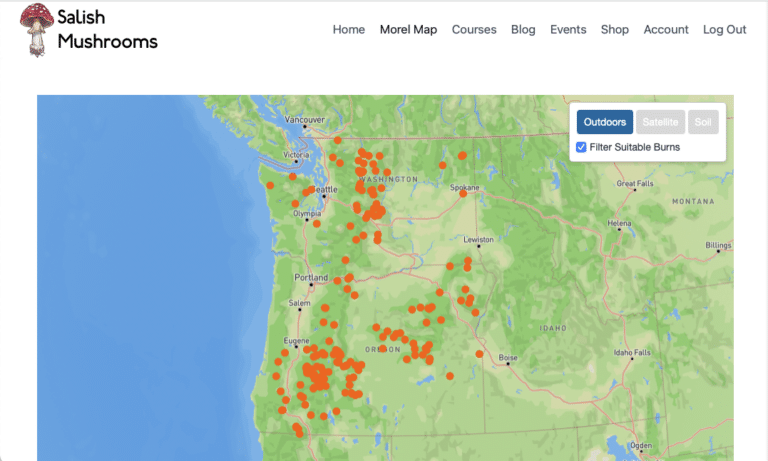
And when you’re ready to plan your hunts, Forayz maps the burn perimeters, soil temperature, snow cover, and forest types you need to find productive spots:
Plan Your Morel Hunts on Forayz
Burn perimeters, soil temp, snow cover, and forest types — everything you need to find morels without guessing. Free environmental layers for all members.