Meriwether Lewis on eating morels

June 19, 1806 – Lewis, Meriwether

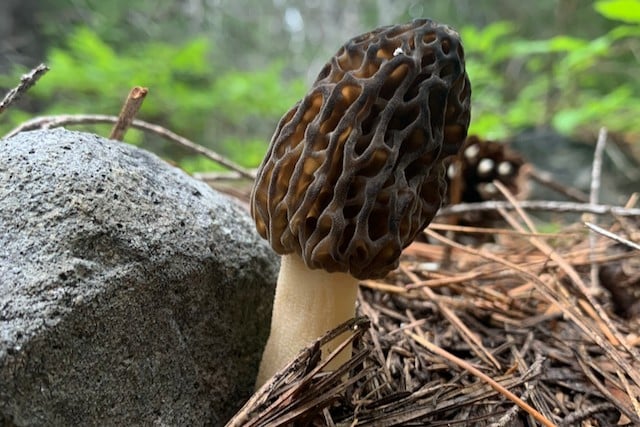
“Cruzatte (Cruzatte, Pierre) brought me several large morells which I roasted and eat without salt pepper or grease    in this way I had for the first time the true taist of the morell which is truly an insippid taistless food.    our stock of salt is now exhausted except two quarts which I have reserved for my tour up Maria’s River (Marias River) and that I left the other day on the mountain.— Most likely the black morel, Morchella angusticeps Pk., a spring mushroom highly prized by people who have access to salt and “grease.” 

Pro Membership

Get the data serious foragers use to find more mushrooms

Free members get soil temps, precipitation, and ecoregion data. Pro unlocks the layers that help you narrow down exactly where to look.

  • Historical burn perimeters — find morel habitat fast
  • Timber harvest boundaries across OR & WA
  • Detailed foraging area summaries with conditions
  • Offline maps in the Forayz iOS app

Similar Posts

  • Darrington

    Mid June in Darrington, WA 8 Mile Creek (48.15681, -121.60915)June 18 2021 Dry. Hit snow just above Three O’clock Rock.  Huckleberry Mountain (48.26901, -121.34937)June 19 Moderate mushroom activity but the active band was pretty narrow; maybe 3500-4500′ over the weekend. Snow at 4800′. A morel, gyromitra, sarcosphaera, cortinarius, and amanitas. Thimbleberries, coralroot. grouse. NF-27 Rat…

  • Pacific Northwest Trees

    Finding specific tree species in Washington and Oregon Finding specific mushrooms can require finding specific trees. Mushrooms like chanterelles, boletes, hedgehogs, at matsutake all depend on intimate connections with certain tree species. When you browse a mushroom guide you will often find these trees listed in the Habitat section. Learning about the environment a specific…

  • |

    PNW Boletes

    I just finished the first version of a PNW Boletes illustration. These are organized into general groups by Genus which should help to simplify things. Beginners intersted in edible boletes should focus on the Boletus genus first since these are more common, tasty, and easier to identify. Aureoboletus mirabilis known commonly as the Admirable Bolete…

  • What do mycologists do?

    What Do Mycologists Do?The science of fungi — and how to join it A mycologist is a scientist who studies fungi — the vast kingdom of life that includes mushrooms, molds, yeasts, rusts, and the unseen threads (mycelium) that knit forest soils together. Mycology sits at the crossroads of botany, microbiology, ecology, and genetics, which…