PNW Mushroom Fruiting Calendar When to find edible mushrooms in Oregon & Washington
The Pacific Northwest has two major mushroom seasons. Spring runs from March through June, starting at low elevations and moving into the mountains. Fall kicks off with the return of rain in September and peaks in October with the highest abundance and diversity of the year.
The charts below show relative fruiting patterns based on community observations from Oregon and Washington. Weather, elevation, proximity to the coast, and which side of the Cascades you’re on will shift these windows significantly in any given year.
Reading the charts
Taller bars mean more observations that month. These show relative patterns, not exact counts — use them to plan your season, not predict a specific week.
Spring
Plan your spring forays with real-time soil data
Forayz shows soil temperature, soil moisture, and 14-day precipitation — the conditions that drive morel and oyster mushroom fruiting across the PNW.
Summer
Chicken of the Woods
Laetiporus spp.
Bright orange shelf fungus that fruits on both conifers and hardwoods. Peaks in late summer when other edibles are scarce. L. conifericola (on conifers) and L. gilbertsonii (on hardwoods) are both common in the PNW.
Photo: Drew Henderson / CC BY-SAFall
October is the peak of PNW mushroom season. The return of fall rain triggers a wave of fruiting across nearly every edible group.
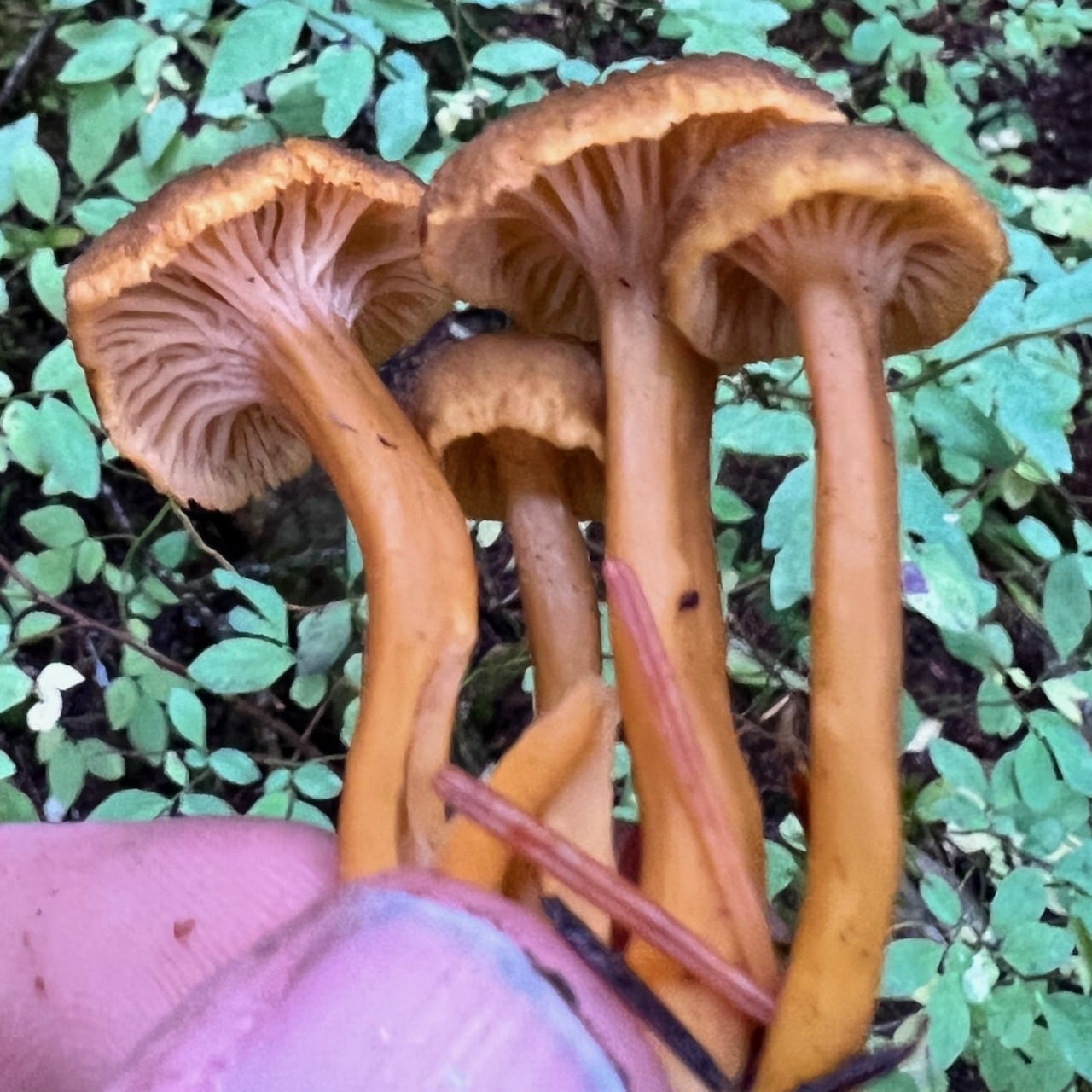
Chanterelles
Cantharellus spp.
The PNW’s signature fall mushroom. Pacific golden chanterelles (C. formosus) dominate west of the Cascades under Douglas fir and hemlock. White and rainbow chanterelles add variety from late summer through November.
Photo: M. Astrophel Crisp / CC BY-SABoletes
Boletus, Suillus, Butyriboletus, Xerocomellus
A huge group ranging from the prized king bolete (B. edulis) and spring kings to slippery jacks and butter boletes. Most peak in October, but spring kings fruit May–June at mid-elevations.
Photo: Alan Rockefeller / CC BYButton Mushrooms
Agaricus spp.
Wild relatives of the grocery store button mushroom. The Prince (A. augustus) is the most prized PNW species. Found in lawns, parks, trails, and woodland edges — but some species stain yellow and are toxic.
Photo: Drew Henderson / CC BY-SAHericium
Hericium spp.
Bear’s head (H. abietis) is the most common PNW species, growing on dead conifer logs and stumps. Lion’s mane (H. erinaceus) is rarer. All species are choice edibles with a seafood-like texture.
Photo: Huafang / CC BY-SA
Track fall conditions across the PNW
Forayz layers 14-day precipitation, soil moisture, and soil temperature over the map — dial in your timing for chanterelles, boletes, matsutake, and more.
Late Fall & Winter
Several species keep fruiting after the main October peak, extending the season well into December and beyond in mild coastal areas.
Hedgehog Mushroom
Hydnum spp.
Easy to identify thanks to spines (teeth) under the cap instead of gills. A reliable late-season edible that fruits alongside chanterelles but keeps going into December. Mild, nutty flavor.
Photo: Mandy Hackney / CC BY