
Poisonous Mushrooms of Oregon Identifying dangerous species in Oregon and what to do if someone eats one

Most mushrooms won’t kill you. Of the thousands of species growing in Oregon, only a handful contain toxins capable of causing serious organ damage or death. But those few species are responsible for nearly all fatal mushroom poisonings worldwide — and they grow right here, from Portland’s city parks to the Coast Range and the Cascades.
This page covers two things: which Oregon mushrooms are genuinely dangerous, and exactly what to do if you suspect someone has eaten one. Knowing both could save a life.
If Someone Ate a Poisonous Mushroom
Time is critical. Amatoxin poisoning symptoms are typically delayed 6–24 hours, sometimes longer (NAMA). Don’t wait for symptoms to appear.
- Save a specimen. Collect a complete mushroom including the base (dig it up — the volva may be underground). Take clear photos of the top, gills, stem, and base. If no whole mushroom is available, save any leftover pieces.
- Call the Oregon Poison Center immediately. 1-800-222-1222 — this number reaches the Oregon Poison Center at OHSU, staffed 24/7. Or visit poison.org. For pets, call your vet or the ASPCA Animal Poison Control.
- Get an ID. Post clear photos to Mushroom Poisoning Identification on Facebook — toxicologists and experienced identifiers monitor this group. For PNW-specific help: PNW Mushroom ID.
- Go to the ER if you suspect amatoxin-containing species (death cap, destroying angel, or deadly Lepiota). Early treatment dramatically improves outcomes.
Learn Mushrooms with Confidence
Forayz courses and field guides help you build real identification skills — not just memorizing names, but understanding the features that matter for safety.
Amatoxin-Containing Mushrooms: The Deadly Ones
Amatoxins cause delayed liver and kidney failure. These are the species responsible for nearly all mushroom fatalities. They share a key trait: symptoms usually don’t appear for 6–24 hours after eating, and after the first wave of GI symptoms fades, a deceptive “recovery” period often follows before liver and kidney damage becomes apparent — which is why treatment can’t wait for a patient to feel sick again.
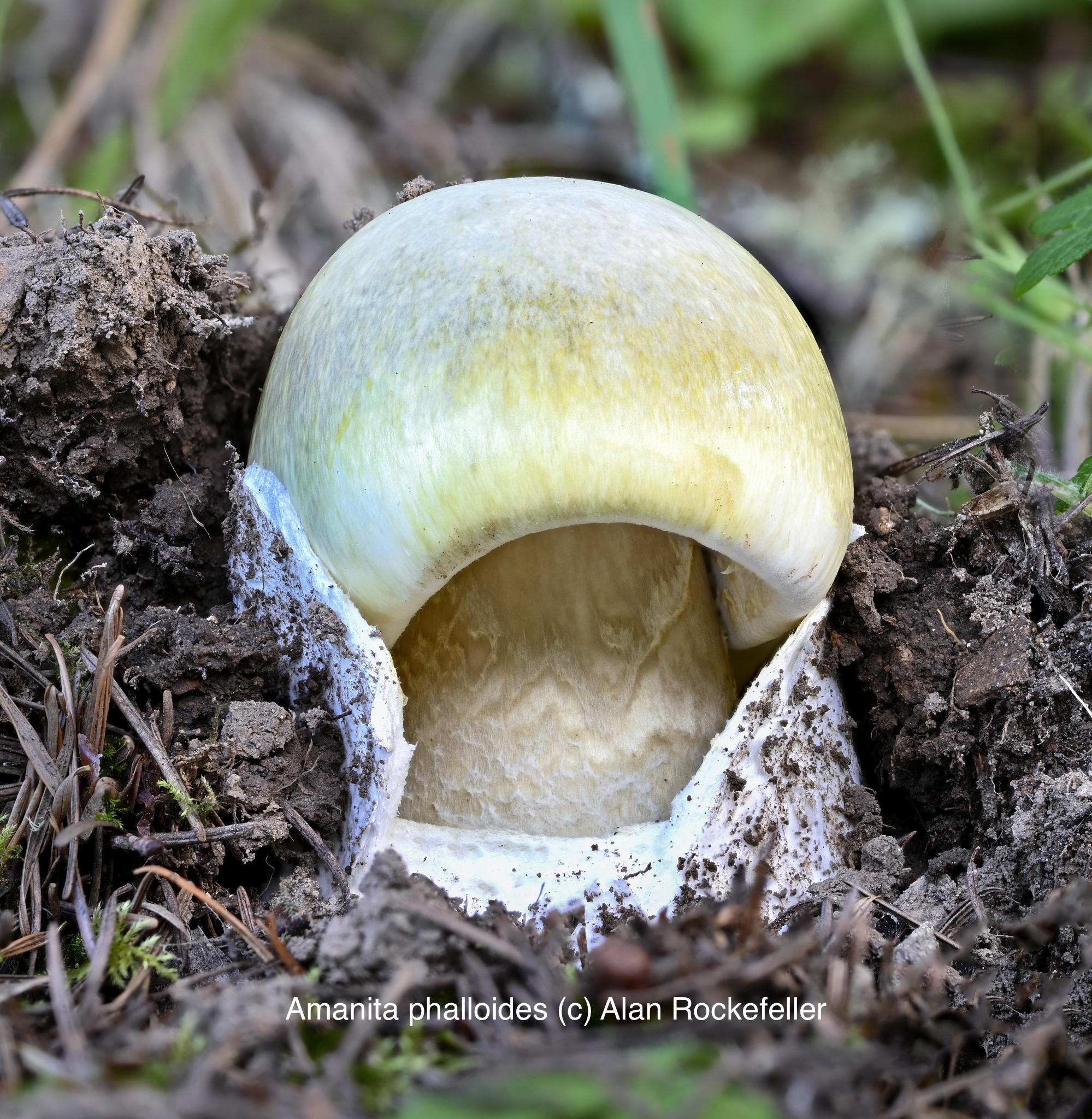

Death Cap
Responsible for more mushroom deaths worldwide than any other species. Introduced from Europe under planted oak, hornbeam, and other ornamental hardwoods (Siegel & Schwarz), with research-grade iNaturalist sightings in Portland, Salem, Eugene, Corvallis, and Ashland. It poisoned five Portland-area people in a 1988 stir-fry incident, four of whom needed liver transplants (Oregon Health Authority).
- Greenish-yellow to olive cap (can appear pale or white)
- White, free gills (not attached to stem)
- Bulbous base with a cup-like sac (volva) — often buried underground
- White ring (annulus) on the upper stem
- No distinctive smell when fresh
Destroying Angel
Amanita ocreata group
Photos: Alan Rockefeller / iNaturalist / CC BY; Thomas Laxton / iNaturalist / CC BY-SA (California)
Entirely white and easily mistaken for edible species like meadow mushrooms or puffballs by beginners. Rare in Oregon — DNA work suggests our white destroying angels are an undescribed species more closely related to the death cap than to the mostly-Californian A. ocreata, and turn up in lowland hardwood forests (D. Miller, via MycoMatch).
- Pure white cap, gills, stem, and base
- Free gills (not attached to stem)
- Bulbous base with volva sac
- Ring on upper stem (may disappear with age)
- No warts on cap (unlike A. muscaria)
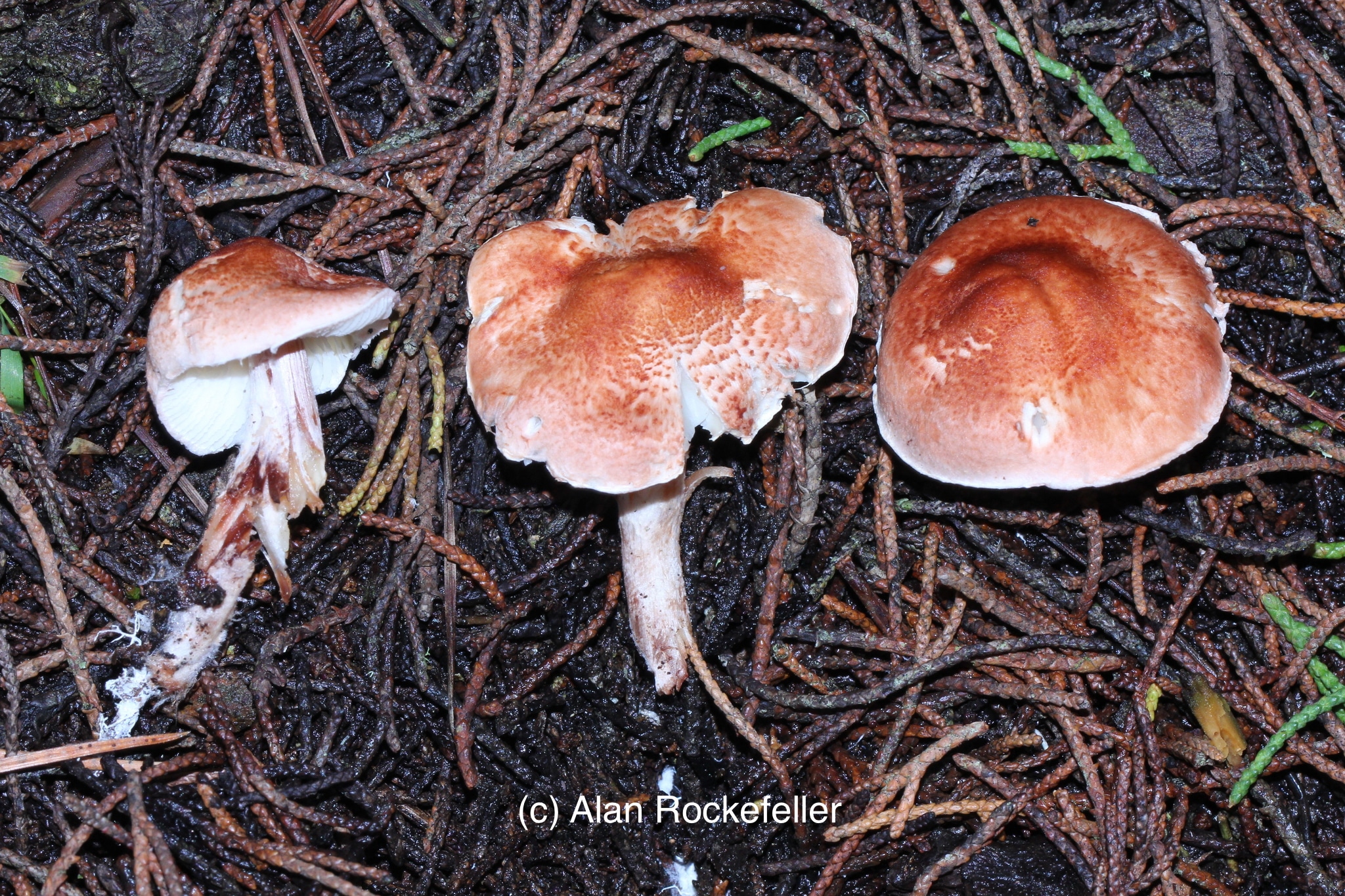
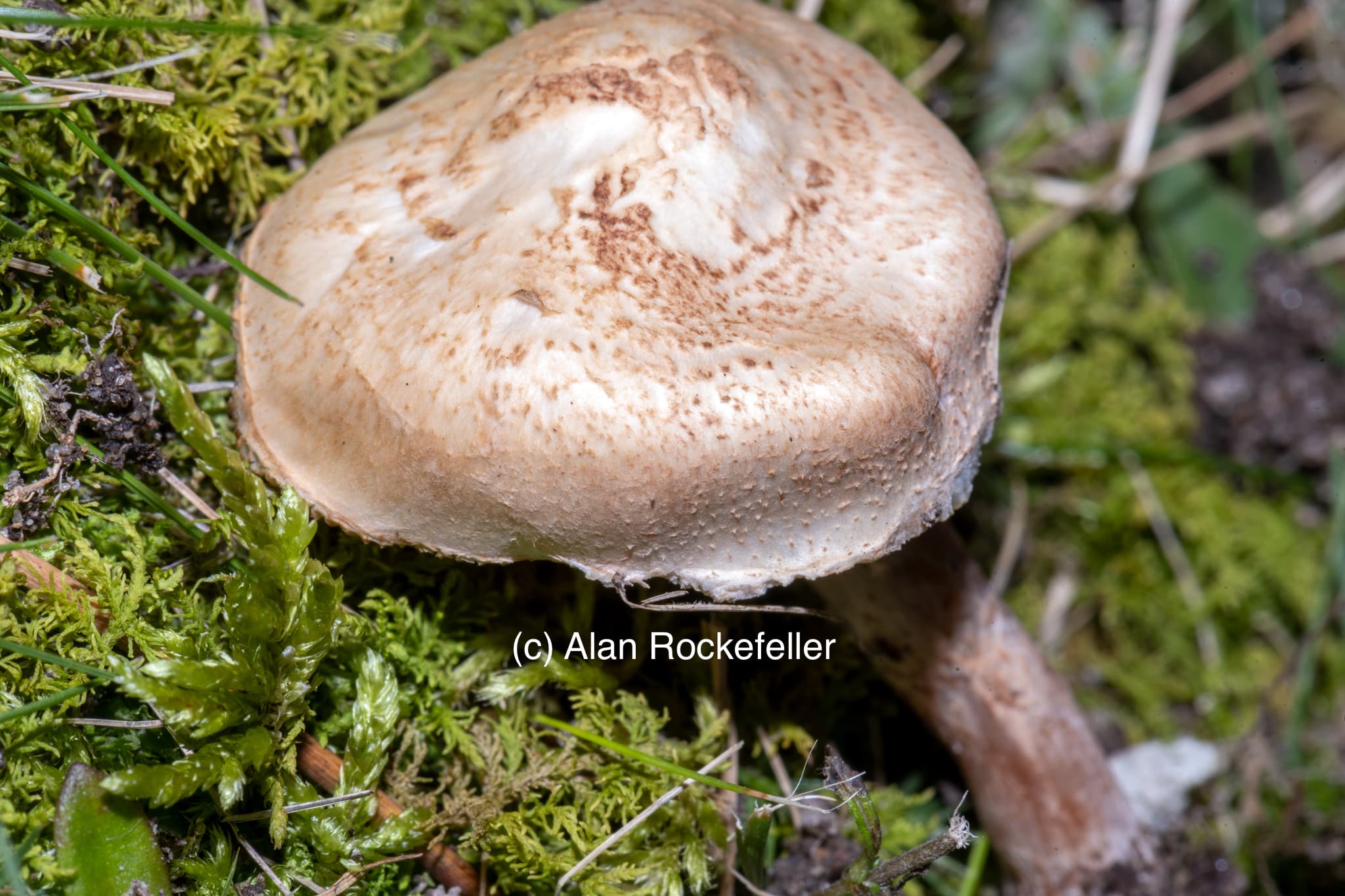
Deadly Lepiota
Lepiota subincarnata
Small, easily overlooked mushrooms that contain lethal doses of amatoxins. Found in gardens, mulched beds, and disturbed ground — places where people might casually pick mushrooms.
- Small (cap 2–5 cm) with pinkish-brown to reddish-brown scales
- White, free gills
- Ring on stem (may be fragile or fibrous)
- Often fruity or unpleasant smell
- Grows in gardens, greenhouses, and urban landscaping
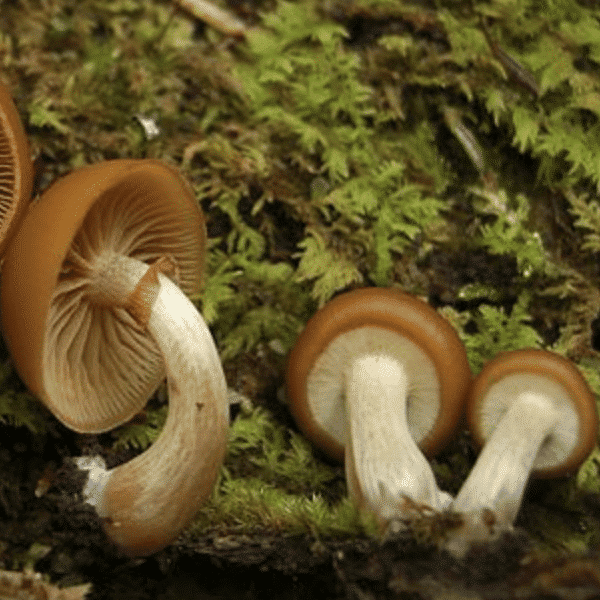
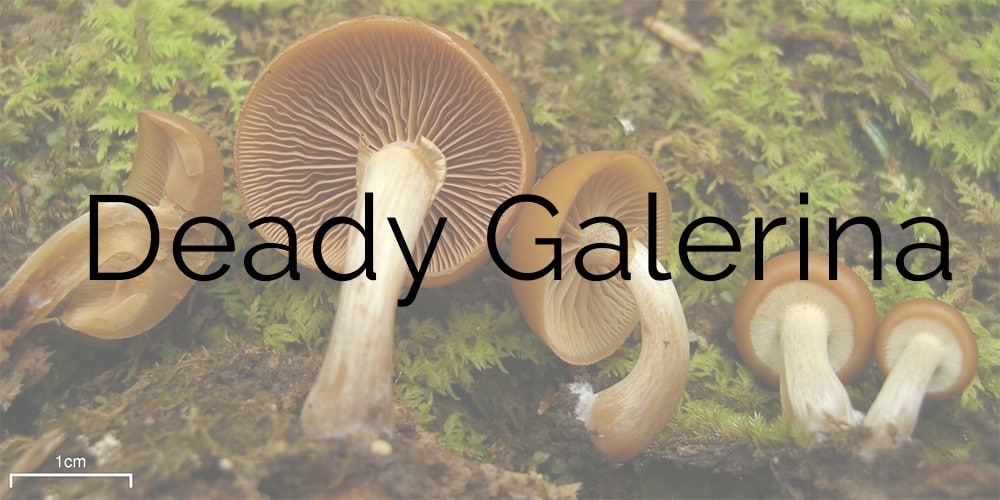
Deadly Galerina
Galerina marginata
A small brown mushroom that grows on decaying wood — sometimes mistaken for edible species or psychoactive Psilocybe. Most common in Oregon’s wet forests in fall and early winter, but can turn up in other seasons too.
- Small brown cap (2–5 cm), smooth and slightly sticky when wet
- Brownish gills, attached to stem
- Ring on stem (may be faint or disappear)
- Grows on rotting wood (logs, stumps, buried wood)
- Can fruit alongside edible species on the same log
The Amatoxin Pattern
Notice what these four species share: free or attached gills (never decurrent) and a ring, or ring zone, on the stem. They range from tiny (deadly Lepiota, cap 2–5 cm) to large (death cap, up to 20 cm), so size alone won’t protect you. They’re all “normal looking” mushrooms — which is precisely what makes them dangerous. When in doubt about any gilled mushroom, check for a ring on the stem and a sac at the base.
Other Toxic Mushrooms in Oregon
The amatoxin species above are the most dangerous, but other Oregon mushrooms can cause significant illness:
- Panther Cap (Amanita pantherina group) — Contains ibotenic acid and muscimol, and can cause delirium, seizures, and coma. Common in Oregon’s conifer forests. Looks like a brown version of the fly agaric; distinguished by white warts on a brown cap, white gills, and a bulbous base with a distinct rim.
- Smith’s Amanita (Amanita smithiana) — Causes kidney failure that develops days after initial gastrointestinal symptoms. Large, white, and found under conifers; sometimes mistaken for matsutake by hunters — a Portland OHSU case series traced four Pacific Northwest patients’ kidney failure to exactly that mix-up (Warden & Benjamin, Academic Emergency Medicine, 1998).
- Angel Wings (Pleurocybella porrigens) — White shelf fungus on conifer logs. Linked to fatal encephalopathy in people with pre-existing kidney conditions, particularly in Japan. Best avoided despite historical use as an edible.
- Jack O’Lantern (Omphalotus olivascens) — Orange, sometimes bioluminescent, and confused with chanterelles when found; the often-cited name O. olearius is European and doesn’t occur here. Not typically part of the Pacific Northwest mycoflora — occasional reports come from southern Oregon (D. Miller, Danny’s DNA Discoveries). Causes severe GI distress but not organ damage.
- False Morels (Gyromitra esculenta) — Contains gyromitrin, which converts to monomethylhydrazine. Can cause liver failure and seizures. Brain-like cap, not honeycomb-patterned like true morels.
Edible Mushroom Reactions
Even well-known edible species can cause reactions in some people. Morels must be thoroughly cooked, and some people report adverse reactions when combining morels with alcohol. Chicken of the woods can cause gastrointestinal upset or, less often, allergic reactions, even when properly cooked. When trying any mushroom for the first time, eat a small amount and wait 24 hours.
Build Your Identification Skills
Our in-person mushroom classes and guided forays teach safe identification in the field — including how to recognize and avoid the dangerous species on this page.
Know Where You’re Foraging
Forayz shows ecoregion data, public land boundaries, and habitat information to help you understand what species to expect in your area.
How to Avoid Poisonous Mushrooms
There are no shortcuts or folk tests that reliably separate edible from poisonous species. Silver spoons, peeling the cap, and animal behavior are all myths. What actually works:
- Learn specific species, not general rules. Know the exact features of each species you plan to eat. Don’t eat anything based on “it looks like” a photo.
- Always check the base. Dig up the entire mushroom. The volva (sac) at the base of deadly Amanita is the single most important safety feature to look for — and it’s often hidden underground.
- Take a class. In-person instruction from an experienced mycologist is the fastest way to build safe identification skills. Salish Mushrooms classes cover dangerous lookalikes alongside edible species.
- Start with distinctive species. Chanterelles, hedgehogs, oyster mushrooms, and chicken of the woods have few dangerous lookalikes compared to “little brown mushrooms” or white-gilled ground mushrooms.
- When in doubt, don’t eat it. No mushroom meal is worth the risk. If you can’t confidently identify a mushroom to species, leave it.
Resources
- Poison Control (poison.org) Call 1-800-222-1222 for immediate poisoning guidance — 24/7
- Mushroom Poisoning Identification (Facebook) Emergency ID group monitored by toxicologists and experienced identifiers
- PNW Mushroom ID (Facebook) Pacific Northwest regional identification help
- Oregon Mycological Society Portland-based club — forays, ID clinics, and an annual mushroom show
- Cascade Mycological Society Eugene-based club serving the southern Willamette Valley and Oregon coast
- NAMA: Mushroom Poisoning in Dogs and Cats North American Mycological Association guide for pet owners
- Bay Area Mycological Society: Amatoxins Detailed overview of amatoxin chemistry and treatment
- NAMA Poisoning Reports Summary (2018–2020) Data on mushroom poisoning incidents across North America
Sources: Mushrooms of Cascadia (Siegel & Schwarz, 2024); MycoMatch (© Ian Gibson), a compilation of published descriptions through which most other field-guide authors named here are quoted; Danny’s DNA Discoveries and the PNW Pictorial Key (© Danny Miller); iNaturalist observations.