March Mushroom Classes
2 mushroom class options posted for March including a 4-week Tuesday night course, and a single Saturday afternoon class
Springtime is quickly approaching and we’re already seeing a few morels showing up around the region. While the mountains are still frozen, this is an excellent time to start looking at morel spots for 2026. The Forayz app includes past burns that can easily be filtered by year so that you can focus on just…
Using a navigation app while mushroom foraging is a great way to track where you have been, choose where you want to go, and help you get back to your vehicle safely. Here are some of the apps that I use. Google Maps – Driving Directions, and terrain/satellite views while online Maps.me – Free, lightweight…
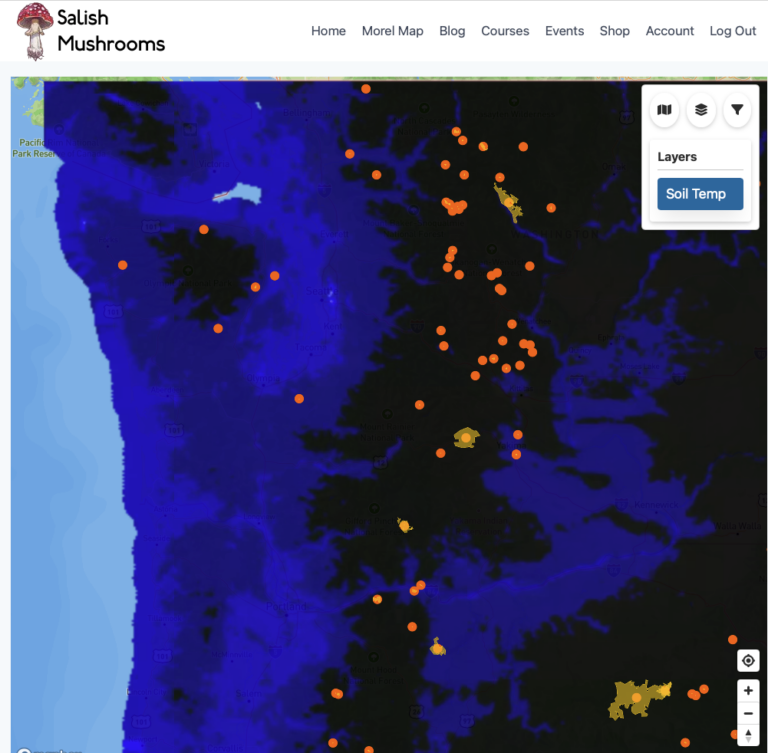
Soil Temperature Map for Morel Hunting Watch the ground warm into the mid-40s°F across Washington, Oregon, and the Western US Studies elsewhere put morel fruiting onset in the mid-40s°F (43°F for a European morel, Buscot 1989); there is no Pacific Northwest study, and none for burn morels. Air temperature swings too fast to be a…
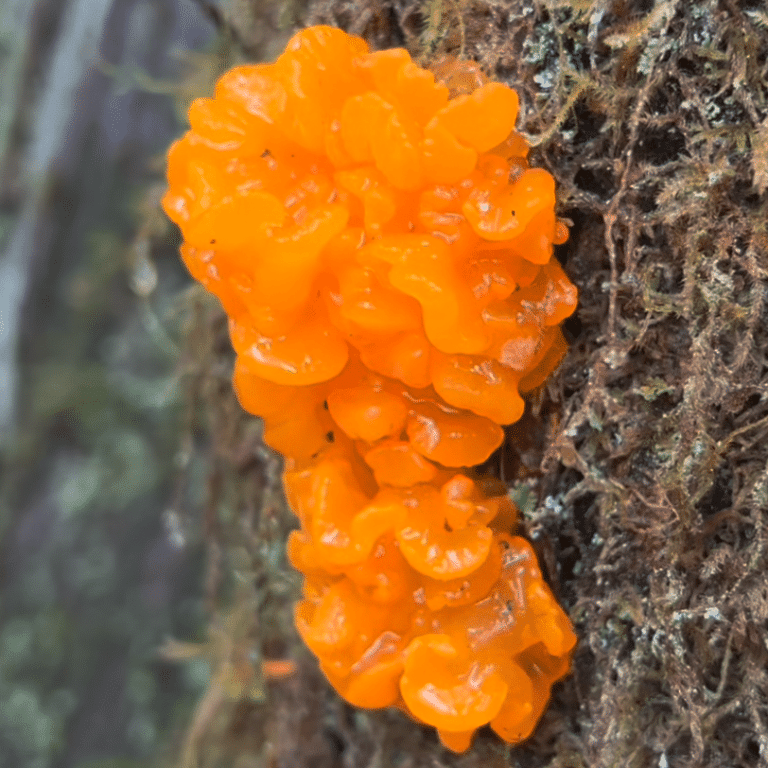
The following is a selection of mushrooms found in our region in January. Some have very specific habitats and might only be found in a small part of the region. Cat’s Tongue Pseudohydnum gelatinosum Considered a species ‘complex’, which includes multiple closely related species that can be difficult to separate visually. Chanterelle Cantharellus Chanterelles can…
Seattle-area mushroomers may be preparing for an excellent late-summer mushroom season this year. Cooler temperatures and above-average rain will prompt fruitings of many species found in our region’s late summer months, including choice edible species like king boletes and chanterelles. There is more to love about mushrooms than just these popular choice edibles. There…
Cleaning dirt, sand, and bugs from mushrooms is a common challenge for foragers. Here are some tips for reducing the amount of these that make their way into your cooking Clean Mushrooms As You Pick One key characteristic of morels is their honeycomb pockets. Unfortunately, these are also a great place for dirt to collect…
The Purpose and Role of Wilderness Areas Wilderness areas, managed by the National Forest Service, are essential for protecting natural landscapes and ecosystems. Created under the Wilderness Act of 1964, these regions are designed to remain free from significant human interference, allowing nature to thrive. Why Wilderness Areas Matter 1. Preserving Natural Environments These areas…
The genus name Gyromitra comes from two Greek words: gyros – circle or ring (as in gyroscope) mitra – headband or turban, later the bishop’s headdress (mitre, mitre joint) The “false morels” were traditionally all placed in Gyromitra, including brain-shaped, saddle-shaped, and disc-shaped species. Recent molecular work has split them into several genera (Maublancomyces, Paragyromitra,…
Morels are among the most widely foraged mushrooms in the United States. They are broadly distributed and easier to identify than most wild mushrooms, but they have toxic look-alikes (see below), so careful identification still matters. Their popularity has also produced a lot of misconceptions. Here are some of the most common. Morels are all…
Soil conditions, morel timing, and foraging tips delivered to your inbox.
✓ You're subscribed to seasonal updates
Mushroom foraging tools, guides, and education for the Pacific Northwest.
Guided forays, ID workshops, and private mushroom tours across the PNW.
View Events Book a private tour