
Popular Edible Mushrooms in the Pacific Northwest 13 species every PNW forager should know
These are the mushrooms you’ll hear about most often in Washington, Oregon, and British Columbia. Some, like chanterelles and morels, are widely known; others, like hedgehogs and black trumpets, are less so.
Most species link to a detailed identification page. If you’re new to foraging, start with the species below that have few look-alikes. Always confirm identification before eating anything wild, and review our guide to poisonous mushrooms so you know what to avoid.
Find These Mushrooms with Forayz
Use soil temperature, moisture, precipitation, and ecoregion data to locate productive foraging habitat. Environmental layers are free with a Forayz account.
Start Here: Beginner-Friendly Species
These four are common and have distinctive field marks. Morels have toxic look-alikes (see the morel card), so learn those before you eat any.
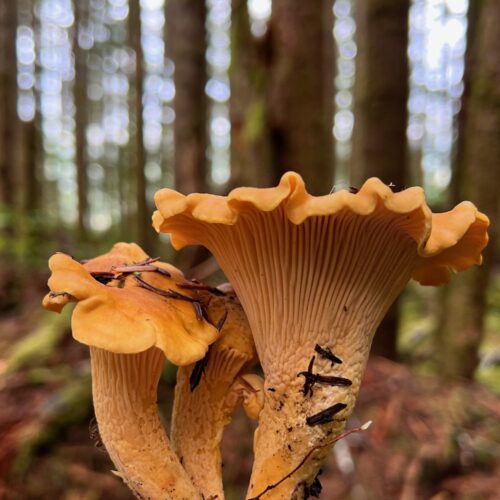
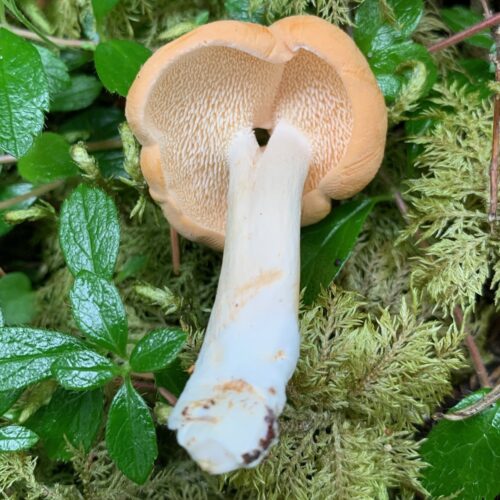
Prized Finds
These are less common or take more experience to find.
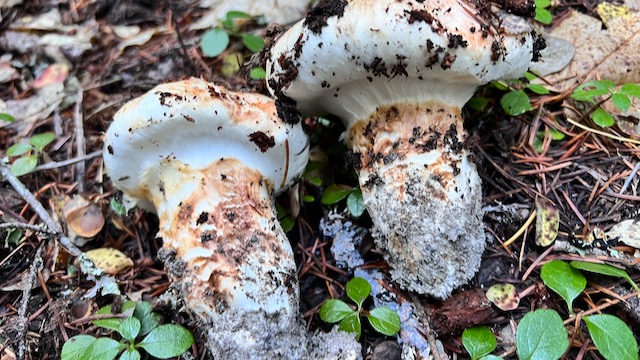

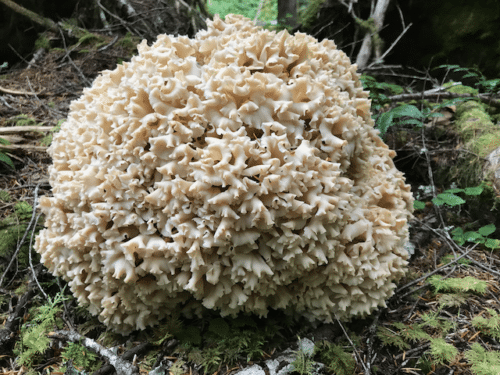

Mycorrhizal vs. Saprotrophic — Why It Matters
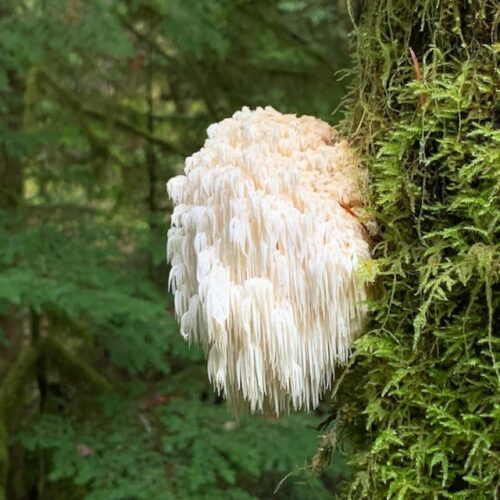
Mycorrhizal species (chanterelles, boletes, matsutake, hedgehogs) form partnerships with living tree roots. You’ll find them near specific tree species — learning which trees to look for is half the battle.
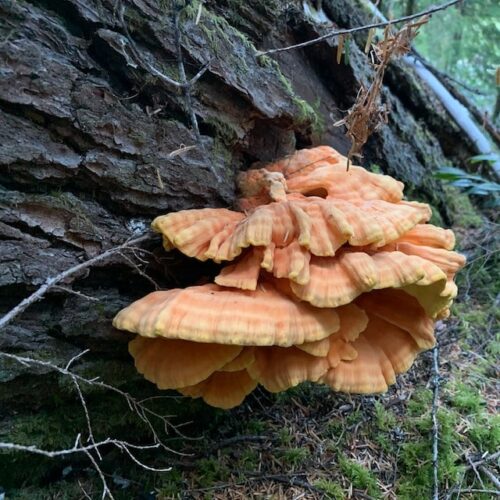
Wood-decay species (chicken of the woods, bear’s head, oyster) break down wood. Most grow on dead logs, stumps, and snags rather than depending on a particular living tree, though some, like chicken of the woods, also rot living trees.
Explore Ecoregions & Habitat Data
Forayz maps ecoregions, soil data, and precipitation patterns across the PNW — helping you match species to their preferred habitat. Pro adds full recent-burn data and offline downloads.
Reliable & Abundant
These species are often abundant in the right habitat and fruit across a long season.


Quick Reference: Season & Habitat
Season peaks are from iNaturalist research-grade observations in Oregon and Washington. Most species overlap in fall; morels and oysters also fruit in spring.
| Species | Peak Season | Ecology | Where to Look |
|---|---|---|---|
| Chanterelle | Aug–Dec (peak Oct) | Mycorrhizal | Moss and duff under Douglas-fir, hemlock |
| Morel | Mar–Jun (peak Apr) | Varies | Burn scars, cottonwoods, gardens |
| King Bolete | Aug–Nov (peak Oct) | Mycorrhizal | Coastal Sitka spruce; Cascade conifers at elevation |
| Hedgehog | Sep–Dec (peak Oct) | Mycorrhizal | Conifer forests, especially spruce and pine |
| Matsutake | Sep–Nov | Mycorrhizal | Sandy soil under shore pine; drier inland conifer forest |
| Lobster | Jul–Nov (peak Oct) | Parasitic | Where its host, short-stalked russula, grows |
| Cauliflower | Sep–Nov | Parasitic | Base of Douglas-fir, spruce; stumps |
| Black Trumpet | Nov–Jan | Mycorrhizal | Oak and madrone woodland, low elevations |
| Chicken of the Woods | Jul–Oct | Parasitic | Conifers; occasionally hardwoods |
| Bear’s Head | Sep–Nov | Saprotrophic | Large dead conifers, especially hemlock and fir |
| Wood Blewit | Oct–Dec | Saprotrophic | Leaf litter, compost, garden edges |
| Yellowfoot | Oct–Jan (peak Nov) | Mycorrhizal | Moss and needle duff in conifer forests |
| Oyster | Apr–May and Oct–Nov | Saprotrophic | Dead alder and other hardwoods; some on conifers |
Before You Go Foraging
The PNW is also home to seriously toxic species, including death caps and destroying angels. A few essentials:
- Take a mushroom identification class or learn from experienced foragers before eating anything wild
- Cook wild mushrooms thoroughly: it often lowers the chance of a reaction, though it does not rule one out. Eat only a little the first time you try a species
- Start with one species at a time and learn it well
- Check Forayz for habitat and environmental data before planning a trip
For a deeper dive into each species, habitat ecology, and seasonal timing, see our comprehensive edible mushrooms guide.
Is This a Morel?
66 photos — true morels vs. look-alikes. Test your ID skills before you hit the field.
Explore More
Sources: Mushrooms of Cascadia (Siegel & Schwarz, 2024); MycoMatch (© Ian Gibson), a compilation of published descriptions through which most other field-guide authors named here are quoted; iNaturalist observations.